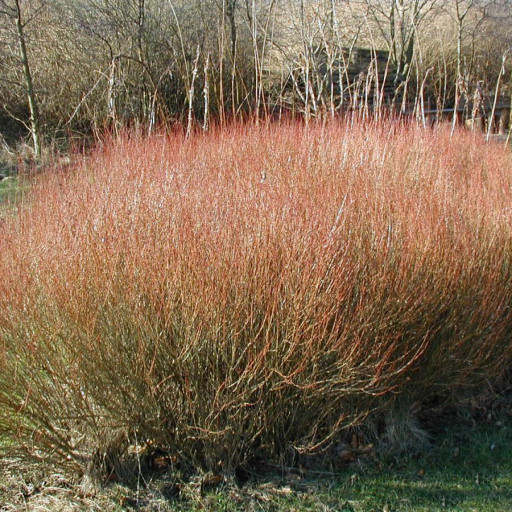
Plant Overview
Known widely as the Purple Osier or Arctic Blue Willow, Salix purpurea is the artist of the willow family. With its slender, violet-hued stems and elegant, blue-green foliage, it adds a sophisticated, "cool" tone to any landscape. Historically, it has been the darling of basket weavers for centuries, prized for its incredibly flexible twigs that transition from deep burgundy to dusty purple as they age.
🔍 How to Identify
- 🎨 The Stems: Look for thin, supple branches that range from deep purple to a reddish-brown hue. These colors are most vibrant on the new growth of the current season.
- 🍃 The Foliage: The leaves are slender and lance-like, often appearing in a unique "opposite" arrangement—a rare trait for willows. They feature a distinct silvery-blue or glaucous underside that shimmers in the wind.
- ☁️ The Catkins: In early spring, before the leaves emerge, the plant produces small, upright catkins. Unlike the fluffy white "pussies" of other willows, these are often smaller and tinged with purple or red scales.
🏡 In Your Garden
- 💧 Thirst for Life: This willow thrives in moist, even boggy soils where other plants might struggle with "wet feet." It is a champion at stabilizing soil, making it a go-to choice for preventing erosion near pond edges or stream banks.
- ✂️ The Pruning Secret: To maintain that stunning purple color, many gardeners practice "coppicing"—cutting the plant back nearly to the ground in late winter. This forces the plant to send up a fountain of fresh, brightly colored wands every spring.
- 🌬️ Hardy Nature: True to its "Arctic" nickname, this is a tough shrub that can handle cold winds and heavy clay, though it demands plenty of sunlight to keep its colors from fading to a dull grey.
⚠️ Safety & Toxicity
- 🐾 Pet Safety: Willows naturally contain salicin (the precursor to aspirin). While it isn't typically considered high-risk, if a pet consumes a large amount of bark or leaves, it can lead to stomach upset, vomiting, or lethargy.
- 👶 Human Caution: The bark has a very bitter taste which usually deters children from chewing on it. However, individuals with allergies to aspirin should handle the inner bark with caution to avoid potential skin irritation.
✨ Fun Fact
- 🧺 The Weaver's Knot: The stems of the Purple Osier are so incredibly flexible that they can be bent into a tight circle or even tied into a loose knot without snapping, which is why it remains one of the most popular materials for high-end wicker furniture and traditional baskets today!

Detailed Care Instructions
To grow a Salix purpurea (purple willow) plant, you can follow these steps:
- Choose the right planting location: Salix purpurea prefers full sun but can tolerate partial shade. It also requires moist soil that is well-drained.
- Prepare the soil: Ensure that the soil is fertile and loamy. Add compost or organic matter to improve drainage and provide nutrients.
- Planting: Salix purpurea can be propagated from cuttings or grown from seeds. For cuttings, take 6-8 inch long stems from a healthy plant, remove lower leaves, and plant them in moist soil, burying 2-3 inches deep. For seeds, sow them in a seed tray or small pots filled with moist soil, lightly covering them with a thin layer of soil.
- Watering: Keep the soil consistently moist, but avoid waterlogging. Water the plant regularly, especially during hot and dry periods.
- Fertilization: Apply a balanced slow-release fertilizer in early spring, according to the packaging instructions. Alternatively, you can feed the plant with a liquid fertilizer every month during the growing season.
- Pruning: Prune Salix purpurea in late winter or early spring to remove any dead, damaged, or weak branches. This will promote healthy growth and maintain the desired shape.
- Protection: Protect the plant during extreme cold temperatures by applying a layer of mulch around the base.
- Maintenance: Regularly check for pests and diseases, such as aphids or fungal infections. Treat them immediately to prevent further damage.
- Propagation: If you want to propagate more plants, you can take hardwood cuttings in late winter or early spring, or use the plant's natural ability to root from branches that touch the ground (layering).
By following these steps, you should be able to successfully grow a Salix purpurea plant. Remember to provide adequate care, and the plant will thrive and add beauty to your garden.

Place in a window with dappled sun or a spot in the middle of a room. Or directly in a window facing west or east.

To water this plant, it is important to keep the soil consistently moist but not waterlogged. This can be achieved by watering deeply once a week and ensuring the soil is draining well. Avoid allowing the soil to completely dry out between waterings. It is also recommended to mulch around the base of the plant to help retain moisture in the soil. When watering, be mindful not to get water on the leaves or foliage as this can promote disease growth.
To fertilize this plant, you should apply a well-balanced, slow-release fertilizer in the early spring before new growth appears. Use a fertilizer with a balanced NPK ratio and apply it evenly around the root zone of the plant. Avoid applying too much fertilizer, as this can lead to excessive growth at the expense of root development. Water the plant immediately after fertilizing to help distribute the nutrients and prevent root burn. Repeat this process annually for best results.
For Salix Purpurea, it is recommended to use a soil that is rich in nutrients and moisture-retentive. The soil should have a pH level that is slightly acidic to neutral. Organic matter such as compost or well-rotted manure can be added to the soil to increase its nutrient content and improve its structure. The soil should also have good drainage to prevent waterlogging, which can be detrimental to the plant's health. Additionally, it is important to avoid using heavy clay or sandy soils, as these can be unsuitable for Salix Purpurea and affect its growth and health.
Salix purpurea is a type of plant that can be propagated by various methods such as stem cuttings, division, and layering. To propagate the plant through stem cuttings, select a healthy stem and cut off a section of 3-6 inches long. Strip the lower leaves off the stem, leaving only a few leaves at the top. Dip the cut end of the stem in rooting hormone and place it in a pot with well-draining soil. Water the soil and cover the pot with plastic to maintain humidity. Keep the soil moist and remove the plastic cover once new growth has started.
Propagation through division involves digging up the entire plant and dividing it into smaller sections, ensuring that each section has roots and shoots. Each divided section can be planted in a separate pot with well-draining soil and watered regularly.
Propagation through layering involves bending a low branch towards the ground and pegging it down with a stake. After a few weeks, small roots will start to grow from the stem. Once the roots have established, the new plant can be cut from the parent plant and planted in a separate pot with well-draining soil.
Common pests of the purple willow include Larvae. Make a habit of checking your purple willow frequently for pests so that any infestations can be caught and managed early.








