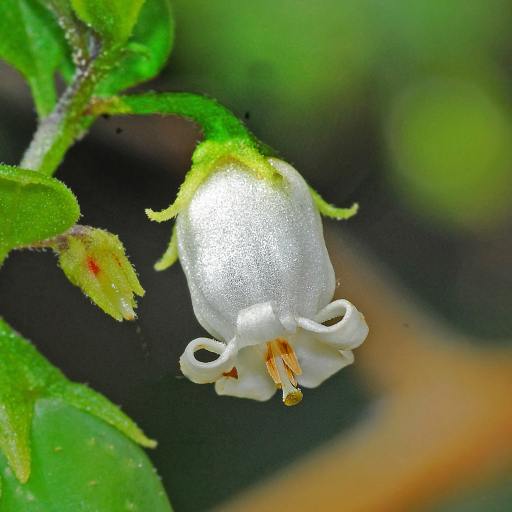
Plant Overview
Often called the Lily of the Valley Vine or the curious Cock's Egg, this South American native is a master of disguise. While its dainty white bells look innocent, this plant is a vigorous scrambler that can quickly take over a garden trellis or a coastal sand dune with equal ease. It belongs to the Nightshade family, carrying the same "wild" reputation as its cousins, the tomato and the deadly belladonna.
🔍 How to Identify
- 🌿 Velvety Foliage: The leaves are small, grayish-green, and shaped like little hearts or eggs. They are covered in fine, soft hairs that give the plant a slightly fuzzy texture.
- 🔔 Bell-Shaped Blooms: It produces tiny, creamy-white flowers that droop downwards. They look remarkably like the "Lily of the Valley" flowers, which is how it earned its most popular nickname.
- 🥚 Egg-Like Fruit: After flowering, it develops fleshy, oblong berries that turn from green to a translucent pale yellow or white. These "eggs" are often hidden deep within the tangled stems.
🏡 In Your Garden
- 🚧 A Determined Scrambler: This plant doesn't just grow; it colonizes. It uses its thin, flexible stems to weave through other shrubs and fences. In many regions, it is considered a stubborn weed because it can easily smother smaller garden plants.
- 🪵 Deep-Rooted Persistence: It is notoriously difficult to eradicate because of its extensive underground rhizome system. If you try to pull it out and leave even a tiny fragment of the root behind, a new vine will likely emerge within weeks.
- 🌱 Tough as Nails: It thrives in neglected areas, coastal sands, and poor soil. It is drought-tolerant and can survive in both full sun and deep shade, making it a very "low-maintenance" (but high-aggression) guest.
⚠️ Safety & Toxicity
- 🐾 Toxic Foliage: Most parts of the plant, including the stems and leaves, contain alkaloids typical of the Nightshade family. These can be toxic to pets and livestock if grazed upon in large quantities.
- ⚠️ Fruit Caution: While the fully ripe, yellow berries are sometimes cited as edible in their native South American range, they should be treated with extreme caution. Unripe green berries are toxic, and eating any part of the plant can cause digestive distress for children or sensitive individuals.
✨ Fun Fact
In its native Argentina and Brazil, the ripe fruit is sometimes used to make sweets and jams. It has a very unusual, pungent aroma that some people compare to a mix of pineapple and musk!

Detailed Care Instructions
| Humidity | Normal |
| Lighting | Part Sun |
| Toxicity | Poisonous |
| Difficulty | Medium |
To grow Salpichroa origanifolia, also known as lophospermum, you can follow these steps:
- Climate: Make sure you live in a suitable climate for this plant. It prefers warm and temperate regions, typically USDA hardiness zones 9-11.
- Choose a location: Select a site that receives full or partial sun for at least 6 hours a day. The plant prefers light, well-draining soil.
- Prepare the soil: Improve the soil by incorporating organic matter like compost. Ensure good drainage to prevent waterlogging, which can lead to root rot.
- Planting: Sow the seeds or plant the seedlings after the last frost date in your area. Space the plants around 12 to 18 inches apart to provide room for growth.
- Watering: Keep the soil consistently moist, but avoid overwatering. Salpichroa origanifolia doesn't tolerate drying out completely.
- Fertilization: Apply a balanced, slow-release fertilizer once a month during the growing season to provide essential nutrients.
- Pruning: Regularly trim the plant to encourage bushy growth and improve flowering. Pinch back the stems to control its size and shape. Deadheading spent flowers will also help promote continuous blooming.
- Support: If growing as a vine, provide a trellis, cage, or other support on which the plant can climb.
- Pests and diseases: Monitor the plant for any signs of aphids, spider mites, or fungal diseases. Treat as necessary using organic or chemical controls.
- Winter care: In colder regions, this plant may not survive freezing temperatures. Consider growing it as an annual or plan to protect it during the winter by bringing it indoors or covering it with frost blankets.
With proper care and attention, your Salpichroa origanifolia plant should grow well and produce beautiful flowers throughout the growing season.

Place in a window with dappled sun or a spot in the middle of a room. Or directly in a window facing west or east.

To properly water this plant, you should first check the soil moisture level by using a soil moisture meter or sticking your finger into the soil up to your second knuckle. If the top inch of soil feels dry, it is time to water.
To water, slowly pour water onto the soil until it comes out of the drainage holes at the bottom of the pot. Be sure to avoid getting water on the leaves as this can cause damage or promote fungal growth.
It is important not to over-water this plant, as it prefers well-draining soil and can suffer from root rot if left in standing water. Allow the soil to dry out partially between watering, but never let it completely dry out.
In the winter months, Salpichroa Origanifolia may require less frequent watering due to lower light levels and cooler temperatures. Be sure to adjust your watering schedule accordingly.
- Start by selecting a balanced fertilizer with equal amounts of nitrogen, phosphorus, and potassium.
- Dilute the fertilizer according to the instructions on the label.
- Apply the fertilizer to the soil around the plant, avoiding contact with the leaves.
- Water the plant thoroughly after fertilizing to help the nutrients penetrate the soil.
- Repeat fertilization once every 2-3 weeks during the growing season, reducing it to once a month in the winter months.
The best soil type for the Salpichroa Origanifolia plant is a well-draining soil that is rich in organic matter. This type of soil will allow for proper water drainage and nutrient absorption, which will help the plant grow healthy and strong. Additionally, the soil should have a pH level in the range of 6.0 to 7.0, which is slightly acidic to neutral. This will help to prevent nutrient deficiencies and ensure that the plant can absorb the necessary nutrients from the soil. It is also important to avoid using soil that is compacted, as this can limit root growth and lead to poor plant development. Overall, providing a proper soil environment for the Salpichroa Origanifolia plant will help to ensure long-term growth and success.
- Start by selecting a healthy Salpichroa Origanifolia plant with mature stems and leaves.
- Take a cutting from the plant using a sharp, clean pair of pruning shears. Make sure the cutting is at least four inches long and contains several leaves.
- Remove the bottom leaves from the cutting, leaving only the top few leaves intact.
- Dip the cut end of the cutting into a rooting hormone powder to encourage root growth.
- Fill a small pot or container with a well-draining potting mix that is moist but not waterlogged.
- Make a small hole in the potting mix and insert the Salpichroa Origanifolia cutting, pressing the soil firmly around it.
- Cover the pot with a clear plastic bag or dome to create a humid environment and keep the cutting moist.
- Place the pot in a warm, bright location out of direct sunlight. Keep the soil consistently moist but not waterlogged.
- Wait for several weeks until the cutting has developed roots and started to grow new leaves.
- Once the cutting has established itself, it can be transplanted into a larger pot or into the ground.








