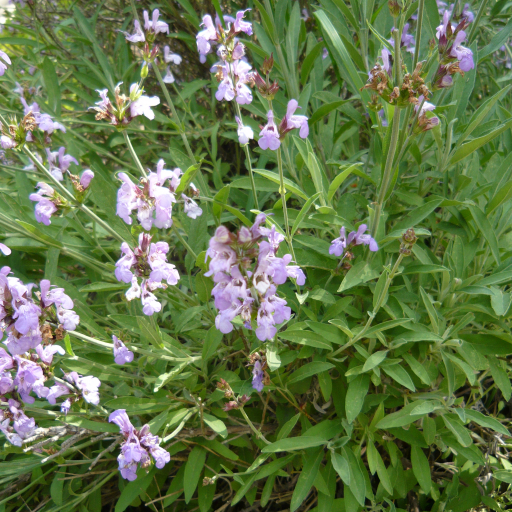
Plant Overview
Often called Spanish Sage, this aromatic beauty acts as a bridge between the culinary world and the lavender fields of the Mediterranean. Unlike its common cousin, this sage offers a refined, citrusy scent and a more compact, elegant form that thrives in harsh, rocky soils where other plants might struggle. It has been a staple in Spanish folk medicine for centuries, prized for its ability to "clear the mind."
🔍 How to Identify
- 🌿 The Foliage: Look for narrow, lance-shaped leaves that are a soft grey-green. They have a velvety, felt-like texture and are much smaller and slimmer than those of common garden sage.
- 💜 The Flowers: In late spring and early summer, it produces upright spikes of violet-blue flowers. Unlike some sages, the flowers are held well above the foliage on delicate stems.
- 👃 The Scent: When the leaves are bruised, they release a clean, balsamic aroma that lacks the heavy, musky "oniony" scent of culinary sage, leaning more toward rosemary or lavender.
🏡 In Your Garden
- ☀️ The "Wet Feet" Rule: This plant is a true Mediterranean native. It will fail quickly in heavy, waterlogged clay because its roots require high oxygen levels. If your soil is dense, plant it in a raised bed or a gritty terracotta pot to ensure sharp drainage.
- ✂️ Pruning for Longevity: Spanish Sage can become "leggy" or split open in the middle as it ages. To keep it tight and silvery, prune it back by about a third after the flowers fade, but avoid cutting into the old, leafless wood, as it may not sprout back from the base.
⚠️ Safety & Toxicity
- 🐾 Pet Safety: Good news for pet owners! Salvia lavandulifolia is generally considered non-toxic to dogs, cats, and horses.
- 👶 Human Use: While it is edible and often used in herbal teas, it contains high levels of essential oils (like eucalyptol). It is perfectly safe for garden handling, but pregnant women are often advised to avoid concentrated medicinal doses of this specific sage species.
✨ Fun Fact
Modern science is catching up to ancient wisdom—recent clinical trials have shown that extracts of Spanish Sage can significantly improve memory and word recall in healthy adults, proving its historical reputation as a "brain tonic" was spot on!

Detailed Care Instructions
| Humidity | Normal |
| Lighting | Part Sun |
| Toxicity | Poisonous |
| Difficulty | Easy |
| Hibernation | Cold Period |
| Temperature | 14°C - 30°C |
| Hardiness Zones | 10 - 11 |
The relative humidity levels between 30 and 50 percent are ideal for these plants. They exhibit unpleasant symptoms when the moisture content in the environment is unfavorable. Avoid letting the air temperature rise too high or low and use a humidifier, whenever possible. Misting is also beneficial, although frequent watering is also necessary. The optimal relative humidity will promote plant growth.








