Plant Overview
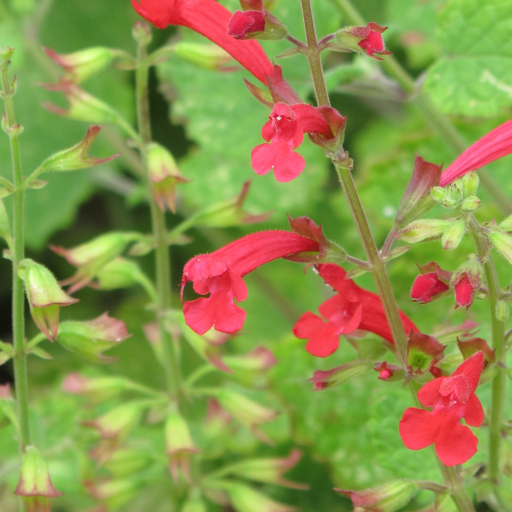
Often called the "Cedar Sage," Salvia roemeriana is a hidden gem of the Texas Hill Country and Northern Mexico. While most members of the Salvia family are sun-worshippers, this hardy perennial is a "shadow-dweller" that brings a splash of fiery scarlet to the coolest, darkest corners of the garden. It is a favorite for those trying to add color to woodland areas where other flowers refuse to grow.
🔍 How to Identify
- 🌺 The Flowers: Produces brilliant, tubular crimson blossoms that stand tall on slender stalks. They are specifically shaped to fit the beak of a hummingbird.
- 🍃 The Foliage: Its leaves are distinct—deep green, heart-shaped (cordate), and covered in soft, fine hairs with scalloped edges.
- 📏 The Stature: Unlike its sprawling relatives, Cedar Sage stays compact and low to the ground, usually forming a tidy clump about 12 inches tall.
🏡 In Your Garden
- 🌳 The "Cedar" Connection: In the wild, it grows in the needle litter under Ashe Juniper (Cedar) trees. In your garden, it thrives in well-drained, rocky, or limestone soils and actually prefers "dry shade."
- 🦋 Pollinator Magnet: If you want to see hummingbirds, this is your plant. The bright red color and nectar-rich tubes are like a neon "Open" sign for migrating birds and butterflies.
- ✂️ Self-Seeding: It is a polite guest; it will drop seeds and slowly colonize a shady patch without becoming invasive or aggressive.
⚠️ Safety & Toxicity
- ✅ Status: Generally considered non-toxic and safe for home landscapes.
- 🐾 Pets & Kids: There are no known toxic effects for dogs, cats, or humans. However, while it is a true "Sage," it is used for its beauty rather than its flavor—it doesn't have the culinary appeal of common kitchen sage.
✨ Fun Fact
Cedar Sage is a "shade-specialist." It has evolved specifically to photosynthesize efficiently in low light, making it one of the few plants that can produce such vibrant red pigments without direct, full-day sunlight.

Detailed Care Instructions
To grow Salvia roemeriana, also known as Cedar Sage, you can follow these steps:
- Choose the right location: Find a spot in your garden that receives partial shade or filtered sunlight. Salvia roemeriana tolerates full sun but prefers some shade.
- Soil preparation: Prepare the soil by removing any weeds or grass from the planting area. Loosen the soil with a garden fork or tiller. Add organic matter such as compost or well-rotted manure to improve drainage and fertility.
- Planting: Dig a hole slightly larger than the plant's root ball. Place the Salvia roemeriana plant in the hole, ensuring that the top of the root ball is level with the surrounding soil. Fill the hole with soil, gently firming it around the plant.
- Watering: Water the plant thoroughly after planting to settle the soil around the roots. Salvia roemeriana prefers moist but well-draining soil. Water regularly to keep the soil evenly moist during the growing season. However, avoid overwatering as it can lead to root rot.
- Mulching: Apply a layer of organic mulch, such as wood chips or straw, around the base of the plant. Mulching helps retain soil moisture, suppress weeds, and insulate the plant's roots.
- Fertilizing: Salvia roemeriana generally does not require heavy feeding. However, you can apply a balanced slow-release fertilizer once a year in early spring to promote healthy growth. Follow the manufacturer's instructions for application rates.
- Pruning: Prune Salvia roemeriana after blooming to encourage bushier growth and prolong flowering. Cut back spent flower spikes and trim any leggy or unruly growth. Avoid pruning more than one-third of the plant's overall size at a time.
- Pests and diseases: Cedar Sage is generally an easy-to-grow plant and is relatively free of serious pests and diseases. However, keep an eye out for common garden pests like aphids or spider mites. Treat any infestations promptly using organic or chemical measures.
- Overwintering: Salvia roemeriana is perennial in USDA hardiness zones 7-10. In colder regions, consider growing it as an annual or moving potted plants indoors for the winter. Provide protection from frost by covering the plants with a frost blanket or bringing them indoors when temperatures drop.
Remember to research any specific care requirements for Salvia roemeriana based on your local climate and growing conditions.

Place in a bright room that is sun drenched almost all day. Or directly in a south-facing window.

To water this plant, it is important to first assess the soil moisture. Stick your finger approximately 2-3 inches deep into the soil to check if it is dry. If so, then it is time to water. When watering, make sure to evenly distribute water around the base of the plant and avoid getting water on the leaves. It is best to water deeply and infrequently, rather than shallowly and often, to encourage deeper root growth. Allow the soil to dry out slightly between watering to prevent root rot. Additionally, it is important to use well-draining soil to prevent standing water.
To fertilize the Salvia Roemeriana plant, use a balanced fertilizer with equal amounts of nitrogen, phosphorus, and potassium. Apply the fertilizer once every month during the growing season, which is typically from early spring to late summer. Water the plant thoroughly before and after fertilization to help the nutrients penetrate the soil and reach the plant's roots. Avoid over-fertilizing, as this can lead to leaf burn and weaker growth. Always follow the fertilizer manufacturer's instructions for the best results.
Salvia Roemeriana has specific soil preferences. It thrives in well-draining soil that is rich in nutrients and organic matter. The soil should also have a slightly acidic to neutral pH level. The ideal soil type for Salvia Roemeriana is loamy soil. It is important to avoid clay soil or compacted soil as this can cause drainage problems and lead to root rot. Adding compost or other organic matter to the soil can improve its drainage and nutrient content, which can help the plant to grow and develop properly. Additionally, Salvia Roemeriana prefers soil that is moist but not waterlogged, so it is important to water the plant regularly while ensuring that the soil does not become oversaturated.
One method of propagating this plant is through stem cuttings. Select a healthy stem with firm growth tips and cut it at an angle just below a node. Remove the bottom leaves and dip the cut end in rooting hormone. Place the cutting in a pot filled with well-drained soil and keep it moist. Place the pot in a warm, bright location but out of direct sunlight. After a few weeks, roots should begin to grow, indicating successful propagation.








