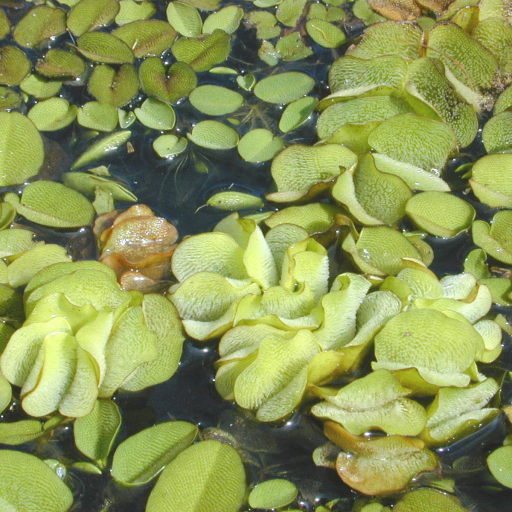
Plant Overview
Often called the "Kariba Weed" or "Water Velvet," Salvinia molesta is a free-floating aquatic fern that looks like a lush carpet of tiny, folded green hearts. While it may look charming in a controlled aquarium, this South American native is famous for being one of the world’s most aggressive "superweeds," capable of doubling its volume in just a few days under the right conditions.
🔍 How to Identify
- 🌿 Leaf Structure: It features small, oval leaves that grow in pairs along a floating stem. As the plant matures, the leaves become crowded and fold upward, creating a characteristic "open book" appearance.
- 🫧 The "Egg-Beater" Hairs: The upper leaf surface is covered in unique, water-repellent hairs. Under a magnifying glass, these hairs look exactly like tiny kitchen egg-beaters, which trap a layer of air to keep the plant buoyant.
- 🕸️ Modified "Roots": It has no true roots. Instead, it produces a third leaf that hangs underwater, masquerading as a cluster of brown, feathery roots to absorb nutrients directly from the water column.
🌊 In Your Water Garden
- 🚀 Growth Nuance: This plant thrives in stagnant or slow-moving water high in nutrients (like runoff or pond fertilizers). Because it reproduces through fragmentation, even a tiny broken piece of a stem can start an entirely new colony.
- 🌥️ The Shading Effect: In a pond environment, it quickly forms mats up to two feet thick. While this provides shade, it can also block all sunlight for submerged plants and deplete oxygen levels, which is dangerous for goldfish or koi.
⚠️ Safety & Toxicity
- 🚫 Eco-Hazard: Salvinia molesta is a "Class A" noxious weed in many parts of the world. It is not toxic to touch, but it is "dangerous" to the environment; it can choke out native species and ruin local waterways if released.
- 🐾 Pet Safety: It is generally non-toxic to dogs and cats. However, dense mats on the surface of a pond can be deceptive; small pets may mistake the green "carpet" for solid ground and accidentally fall into deep water.
✨ Fun Fact
Scientists are obsessed with the "Salvinia Effect." The plant's "egg-beater" hairs are so good at trapping air that the leaf surface stays completely dry even when submerged for weeks. Engineers are currently trying to copy this biology to create "air-cushion" coatings for ships to help them slide through the ocean with less fuel!

Detailed Care Instructions
To grow Salvinia molesta, also known as giant salvinia or kariba weed, you will need to follow these steps:
- Choose the right location: Salvinia molesta thrives in freshwater environments, such as ponds, lakes, or aquariums. Ensure that the location has access to full or partial sunlight, as this plant requires sufficient light to grow.
- Acquire a sample plant: Obtain a healthy Salvinia molesta specimen. You can usually find it through online retailers, nurseries, or other hobbyists who may have extra plants. Make sure the plant is free from diseases or pests.
- Prepare the planting area: Clean the area where you intend to grow the plant. Remove any debris or potential competitors that could hinder its growth.
- Monitor water quality: Salvinia molesta prefers clean, still or slow-moving water with a pH ranging from 6.5 to 8.0. Maintain a suitable temperature between 15-30°C (59-86°F). Periodically test the water quality to ensure it meets optimal conditions.
- Place the plants: Gently place the Salvinia molesta plants on the surface of the water. Ensure they are spread out to allow room for growth and to avoid overcrowding.
- Provide nutrients: Although Salvinia molesta can extract nutrients from the water, it benefits from additional fertilization. Add a slow-release aquatic plant fertilizer to the water or use a tablet specifically designed for aquatic plants according to the manufacturer's instructions.
- Control growth: Salvinia molesta is known for its rapid growth, which can become invasive in some regions. To avoid overgrowth, remove excessive plants regularly. You can use a small net or your hands to scoop out excess plants. Alternatively, introduce herbivorous fish species to consume the extra plants.
- Address pests and diseases: Monitor the plants for any signs of pests or diseases, such as aphids, snails, or rot. If necessary, treat the affected plants or remove them from the water to prevent further spread.
- Harvest or prune if desired: Depending on your purpose for growing Salvinia molesta, you may choose to harvest or prune the plants. Harvesting can be done by scooping out a portion of the plants or cutting them at the desired length.
Note: Salvinia molesta is considered an invasive species in many areas due to its rapid growth and ability to crowd out native aquatic plants. Therefore, it is important to take necessary precautions and consult with local authorities before introducing this plant into natural waterways.

Place in a bright room that is sun drenched almost all day. Or directly in a south-facing window.

1. Fill a container or watering can with clean water.
2. Locate the planting area where the Salvinia Molesta is growing.
3. Position yourself next to the planting area and hold the watering can or container at a slight angle.
4. Begin pouring water onto the soil allowing it to soak in slowly.
5. Try not to pour the water directly onto the plant's leaves.
6. Water the plant frequently enough to keep the soil moist but not waterlogged.
7. Avoid over watering the plant as this can cause root damage and fungal growth.
8. Monitor the plant regularly and adjust watering as needed based on weather conditions and soil moisture levels.
9. In periods of drought, increase watering frequency to ensure the plant's survival.
10. Use only clean and filtered water to ensure the Salvinia Molesta stays healthy and free from toxins.
To fertilize this plant, use a water-soluble fertilizer with balanced N-P-K (nitrogen, phosphorus, and potassium) nutrients. Dilute the fertilizer solution according to the manufacturer's instructions and apply it to the water surface where the plant is growing. Be careful not to over-fertilize, as excess nutrients can cause algae growth and harm aquatic animals. Monitor the plant's growth and adjust the fertilization frequency as needed.
The ideal soil for the plant species should be nutrient-rich and well-draining, with a pH range between 6.0 to 7.5. A mixture of loamy soil, sand, and peat moss would be suitable. It is also important to ensure that the soil remains moist but not waterlogged, as the plant is a semi-aquatic species and requires a certain level of water to thrive. Additionally, the soil should be kept free from debris and any potential contaminants, as the plant is highly sensitive to pollution and can quickly deteriorate in quality if exposed to harmful substances.
Salvinia Molesta plant can be propagated through the creation of side shoots and division.
To propagate through side shoots, wait for the plant to produce new shoots alongside the main plant. Once these shoots are large enough, gently detach them from the parent plant and plant them in a separate container filled with water. Make sure to provide the new plant with adequate light and nutrients.
To propagate through division, carefully remove the plant from its container and separate the plant into smaller sections, ensuring each section has a healthy root system. Replant each section in a separate container filled with water or soil rich in nutrients.
Once propagated, maintain the plant's growth by providing it with adequate light, water, and nutrients.








