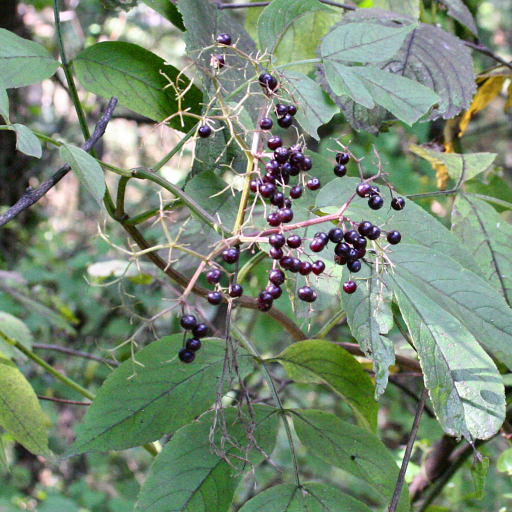
Plant Overview
Often called the "American Elderberry" or simply the "Pieberry," Sambucus canadensis is a cornerstone of North American folklore and foraging. This fast-growing, deciduous shrub transforms from a cloud of lacy white blossoms in early summer into a heavy-laden bounty of dark purple berries by autumn. For centuries, it has been a staple in farmhouse kitchens for jams and syrups, though it holds a dual reputation as both a healer and a plant that demands respect.
🔍 How to Identify
- 🌿 Compound Leaves: The leaves are arranged in opposite pairs along the stem, featuring 5 to 11 leaflets with finely serrated edges and a distinct pointed tip.
- 🌸 Umbrella Blossoms: It produces massive, flat-topped clusters (cymes) of tiny, creamy-white flowers that emit a faint, sweet perfume during the peak of summer.
- 🍇 Drooping Berries: In late summer, the white flowers transition into heavy, drooping bunches of small, glossy, dark-purple to black berries that often weigh the branches down.
🏡 In Your Garden
- 💧 Thirst for Moisture: In the wild, you’ll find this plant near stream banks and ditches. In your garden, it thrives in rich, moist soil and can even handle "wet feet" where other shrubs might rot.
- ✂️ The Thicket Factor: This plant is a "suckering" shrub, meaning it loves to send up new shoots from the roots. If you don't prune it annually, it will quickly transform from a single bush into a dense, wild thicket—perfect for privacy but a challenge for small spaces.
⚠️ Safety & Toxicity
- 🚫 Toxic When Raw: WARNING. All green parts of the plant (leaves, stems, and roots) and the raw berries contain cyanogenic glycosides, which can cause severe nausea and vomiting.
- 🐾 Pet & Child Safety: Keep a close eye on curious pets and toddlers. The berries must be fully ripe and thoroughly cooked or dried to neutralize the toxins before they are safe for human consumption.
✨ Fun Fact
The genus name Sambucus comes from the Greek word "sambuke," an ancient stringed instrument. Historically, the soft, pithy centers of the elderberry’s branches were hollowed out by children and musicians to create flutes, whistles, and even blowguns!

Detailed Care Instructions
| Color | White |
| Soil Ph | Acidic |
| Lighting | Full Sun |
| Soil Type | Rich, Well-Draining, Loamy |
| Bloom Time | Spring |
| Plant Type | Shrub |
| Mature Size | 10–15 Feet |
| Native Area | North America |
| Sun Exposure | Full Sun To Partial Shade |
| Hardiness Zones | 3-10 |
To grow a Sambucus Canadensis plant, also known as American elderberry, you can follow these steps:
- Choose a suitable location: Find a spot in your garden that receives full sun or partial shade. Ensure the soil is well-drained and fertile.
- Planting time: Plant elderberry in early spring when the ground is workable. The plant can be grown from seeds or cuttings.
- Prepare the soil: Before planting, loosen the soil and remove any weeds or grass. Add organic matter or compost to enhance fertility and drainage.
- Planting from seeds: Sow the seeds about ¼ inch to ½ inch deep in the prepared soil. Space the seeds 2-3 feet apart. Water them gently.
- Planting from cuttings: Prepare hardwood cuttings by taking 4-6 inch sections from a healthy elderberry plant in late winter or early spring. Dip the cut end in rooting hormone and plant them in the soil with 2-3 buds exposed, spacing them about 2-3 feet apart. Water them thoroughly.
- Watering and care: Keep the soil moist, especially during the first year. Water regularly, especially during dry spells. Apply a layer of mulch around the base of the plant to retain moisture and inhibit weed growth.
- Pruning: Prune the plant in late winter or early spring to remove dead or damaged wood and to promote new growth. Pruning also helps in shaping the plant and maintaining its size.
- Fertilizing: Apply organic fertilizer or compost annually to provide essential nutrients to the plant.
- Pests and diseases: Monitor the plant regularly for pests like aphids, spider mites, or borers. Use organic insecticides if necessary. American elderberry is generally resistant to many diseases, but if any issues arise, consult a local nursery or extension office for guidance.
- Harvesting: Elderberries typically ripen in late summer or early fall. Harvest them when the berries are dark purple and fully ripe. Use them for making jams, jellies, or elderberry-infused drinks. Be aware that elderberries must be cooked before consumption.
By following these steps, you should be able to successfully grow Sambucus Canadensis in your garden.

Place in a bright room that is sun drenched almost all day. Or directly in a south-facing window.

To properly water [plant], you should first check the soil moisture level by sticking your finger about an inch into the soil. If it feels dry, then it's time to water. Use a watering can or hose to thoroughly saturate the soil around the base of the plant, allowing the water to reach the roots. Be careful not to overwater, as this may cause root rot or other issues. It's recommended to water [plant] deeply once a week, depending on the climate and local weather conditions. Additionally, [plant] prefers well-draining soil, so make sure the soil is not waterlogged or overly compacted.
To properly fertilize this plant, you should wait until the end of winter or early spring to apply a slow-release fertilizer. Be sure to apply the fertilizer evenly around the base of the plant, but not directly onto the stem or foliage. Water thoroughly after fertilizing to ensure that the nutrients are absorbed by the roots. It is recommended to fertilize once a year for optimal growth and health.
For growing a particular plant species, it is important to choose the right type of soil that provides the necessary nutrients and growing conditions. In the case of Sambucus Canadensis, a high-quality soil with good drainage is required.
The ideal soil should be rich in organic matter, have a neutral to slightly acidic pH level, and be well-drained. It should also provide adequate moisture retention while allowing excess water to drain away, preventing waterlogging of the plant's roots.
Adding compost or other organic matter to the soil can improve its quality by increasing its nutrient content and enhancing soil structure. Soil with good drainage helps prevent stagnation and root rot, which can be detrimental to the health of the plant.
When planting Sambucus Canadensis, it is recommended to prepare the soil by digging a hole that is at least twice the size of the plant's root ball. The soil should be amended with compost or other organic matter before planting, and then watered thoroughly to help the roots establish themselves. Ongoing care for the plant should include periodic fertilization and proper watering to maintain healthy growth.
The plant that will be discussed is a deciduous shrub species that belongs to the Adoxaceae family. It is native to North America and grows best in USDA hardiness zones 3 to 8. The plant is known for its creamy white flowers that appear in large clusters during late spring and its small dark purple berries that mature in late summer.
To propagate this plant, one can use several methods, including softwood cuttings, hardwood cuttings, and seed propagation.
Softwood Cuttings:
- Take cuttings from the plant during the summer months when the stems are still green and tender.
- Cut a 4 to 6-inch stem from the parent plant, making sure that it has at least two sets of leaves.
- Strip off the leaves from the lower part of the stem and dip the cut end in rooting hormone powder.
- Plant the cutting in a pot containing well-draining soil and keep it well-watered until roots develop.
- Once the cutting has established roots, it can be transplanted to its permanent location.
Hardwood Cuttings: - Take cuttings from the plant during the dormant season, in late fall or early winter.
- Cut a 6 to 8-inch stem from the parent plant, making sure that it has at least three sets of healthy buds.
- Dip the cut end of the stem in rooting hormone powder.
- Plant the cutting in a pot containing well-draining soil and keep it in a sheltered location until spring.
- Once new growth appears in the spring, the cutting can be transplanted to its permanent location.
Seed Propagation: - Collect ripe berries from the parent plant in late summer.
- Thoroughly clean the berries and extract the seeds.
- Plant the seeds in a pot containing well-draining soil and cover them with a thin layer of soil.
- Keep the pot moist and warm, with temperatures between 60 and 70 degrees Fahrenheit.
- Once the seedlings have grown to a height of 2 to 3 inches, they can be transplanted to their permanent location.
Common pests of the american elder include Aphids, larvae. Make a habit of checking your american elder frequently for pests so that any infestations can be caught and managed early.








