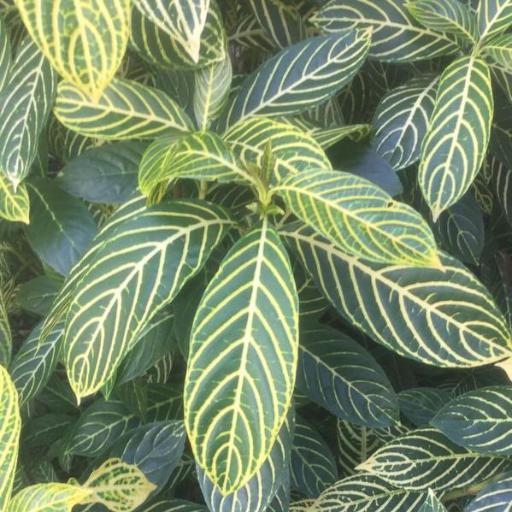
Plant Overview
Known as the "Shrubby White-vein" or "Fire Fingers," Sanchezia oblonga is a bold, tropical showstopper that looks like it stepped straight out of a prehistoric jungle. Native to the lush rainforests of Peru and Ecuador, it is beloved by gardeners for its "zebra-striped" foliage and architectural presence. Whether grown as a towering shrub in warm climates or a vibrant accent in a bright conservatory, it brings an immediate sense of the exotic to any space.
🔍 How to Identify
- 🍃 Graphic Foliage: Large, lance-shaped leaves of deep emerald green, characterized by striking, thick veins in shades of creamy yellow or ivory.
- 🔥 Fire-Like Blooms: It produces upright spikes of tubular yellow flowers that peek out from bright orange-to-red "bracts" (specialized leaves), resembling flickering flames.
- 📏 Square Stems: A unique trait of its family (Acanthaceae) is its sturdy, distinctly four-angled or square-shaped stems, which are often tinted with purple or red.
🏡 In Your Garden
- ☁️ Humidity Hunter: Because of its Amazonian roots, this plant is a "humidity hog." If the air is too dry, the leaf edges will quickly turn brown and crispy, so it thrives best near ponds, in steamy bathrooms, or grouped with other plants.
- 🌤️ Dappled Light: Think of the rainforest floor—it hates the harsh, direct midday sun which can bleach its beautiful yellow veins. It prefers "bright-indirect" light or the shifting shadows under a taller tree canopy.
- ✂️ Pruning for Fullness: Left to its own devices, it can become tall and "leggy." Pruning it back after the flowering season encourages it to branch out, creating a much fuller, more dramatic bush.
⚠️ Safety & Toxicity
- ✅ Safe for Pets: Sanchezia is generally considered non-toxic to cats, dogs, and horses, making it a fantastic "worry-free" addition to a pet-friendly home.
- 🧤 Sap Sensitivity: While not poisonous, the plant's internal sap can occasionally cause mild skin redness or itching in humans with sensitive skin. It’s a good idea to wash your hands after taking cuttings.
✨ Fun Fact
The Sanchezia is an evolutionary specialist; its bright yellow, tubular flowers are perfectly shaped for the long, curved beaks of tropical hummingbirds, who serve as its primary pollinators in the wild.

Detailed Care Instructions
To grow a Sanchezia Oblonga plant, follow these steps:
- Soil: Choose a well-drained, rich potting soil. The soil should be slightly acidic with a pH range of 5.5 to 7.
- Potting: Select a pot that has drainage holes at the bottom to avoid waterlogging. Ensure the pot is at least 2-3 inches larger than the root ball.
- Light: Place the plant in a location that receives bright, indirect sunlight. Avoid placing it in direct sunlight as it can scorch the leaves.
- Watering: Water the plant thoroughly and let the top inch of soil dry out before watering again. Overwatering can lead to root rot, so ensure the soil is moist but not soggy.
- Humidity: The Sanchezia Oblonga plant thrives in high humidity. Mist the leaves regularly or place a humidifier nearby to maintain the required humidity level.
- Fertilizer: Use a balanced liquid fertilizer diluted to half strength during the growing season (spring and summer). Apply it every 2-4 weeks to promote healthy growth.
- Pruning: Trim the plant to maintain its desired shape and size. Remove any yellow or damaged leaves regularly.
- Propagation: Sanchezia Oblonga plants can be propagated through stem tip cuttings. Take a 4-6 inch cutting from a healthy plant and root it in a medium such as perlite or vermiculite mixed with potting soil.
- Pests: Watch out for common houseplant pests like mealybugs, spider mites, and aphids. Inspect the plant regularly and treat with organic insecticidal soap if necessary.
- Potting up: As the plant grows, you may need to repot it in a slightly larger container to accommodate its expanding root system. Repotting is usually done every 1-2 years in spring.
By following these guidelines, you can successfully grow and care for a Sanchezia Oblonga plant.

Place in a window with dappled sun or a spot in the middle of a room. Or directly in a window facing west or east.

In order to properly water this particular plant, it is important to pay attention to its soil moisture level. One can use their finger or a moisture meter to gauge the dryness of the soil. It is best to water deeply and allow the soil to drain excess water, as this plant prefers consistently moist, but not waterlogged, soil. It may be helpful to water less frequently during the winter months, as the plant's growth rate tends to slow down during this time. It is also important to avoid getting water on the plant's leaves, as this may lead to fungal diseases. Instead, water directly at the base of the plant.
To fertilize Sanchezia Oblonga plant, apply a balanced water-soluble fertilizer at half strength once a month during the growing season (spring and summer). Avoid over-fertilizing as it can cause leaf burn and damage the plant. Also, make sure to water the plant thoroughly before applying fertilizer to avoid root burn. Lastly, do not fertilize during the dormant season (fall and winter).
The ideal soil for this plant should be a well-draining, nutrient-rich soil mix that is slightly acidic in nature. It should have good water-retention capacity and should not be too compact or heavy. A soil mix that is composed of a combination of peat moss, perlite, and sand or vermiculite is ideal for this plant. The peat moss helps to retain moisture while the perlite and sand or vermiculite helps to improve drainage. The soil pH should be between 5.5 and 6.5 for optimal growth. It is recommended to fertilize this plant regularly during the growing season using a balanced, water-soluble fertilizer to promote healthy growth and flowering.
To propagate this plant, take stem cuttings from the parent plant, making sure each cutting has a few leaves and a node (where a leaf meets the stem). Remove any lower leaves from the cutting and dip the cut end in rooting hormone. Plant the cutting in moist, well-draining soil and cover with a plastic bag to create a humid environment. Place the cutting in a bright but indirect light, and keep the soil moist. After a few weeks, roots should start to form. Once the cutting has established roots, remove the plastic bag and treat the new plant as you would an adult Sanchezia Oblonga.
Common pests of the shrubby whitevein include Mealybugs, spider mites. Make a habit of checking your shrubby whitevein frequently for pests so that any infestations can be caught and managed early.








