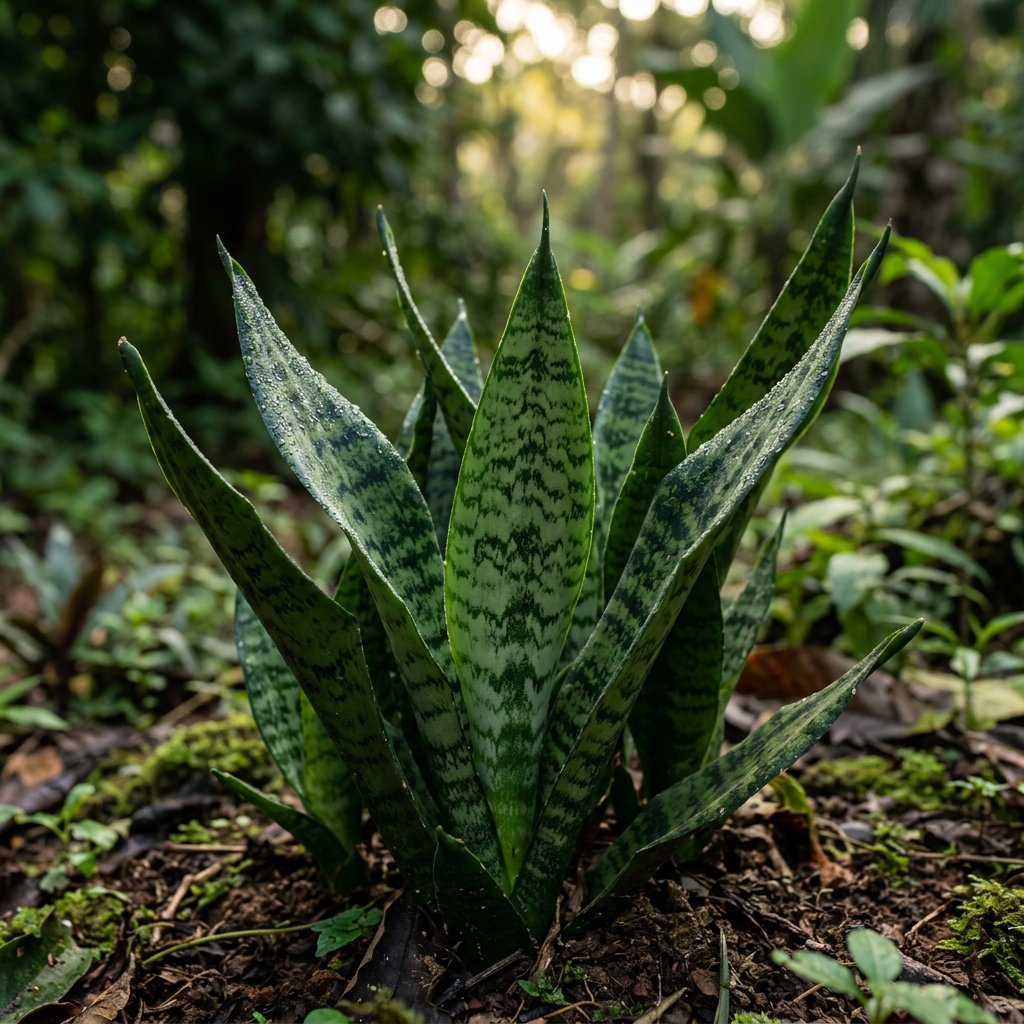
Plant Overview
Often referred to as the "Mother-in-Law's Tongue" or the "Snake Plant," Sansevieria trifasciata is the ultimate survivor of the indoor plant world. Native to West Africa, it has earned a reputation for being nearly indestructible, making it a beloved companion for forgetful gardeners and urban dwellers alike. In many cultures, its pointed leaves are seen as a symbol of protection, believed to ward off bad energy with their sharp, sword-like presence.
🔍 How to Identify
- 🐍 Foliage Shape: Features stiff, sword-shaped leaves that grow vertically from a central rosette, reaching heights of anywhere from 1 to 4 feet.
- 🎨 Coloring: The leaves are typically dark green with lighter grayish-green horizontal banding, resembling the scales of a snake. Many popular cultivars also feature bright yellow margins.
- 💪 Texture: The leaves are thick, leathery, and succulent-like, designed to store water for long periods of drought.
🏡 In Your Garden & Home
- 🏜️ The Drought Specialist: This plant thrives on neglect; it prefers its soil to dry out completely between waterings. The most common cause of death is "kindness"—overwatering leads to root rot because the thick rhizomes can't handle constant moisture.
- 🌑 Light Versatility: While it loves bright, indirect light, it is one of the few plants that can tolerate deep shade and low-light corners of a home, though its growth will slow significantly.
- 🪴 Tight Squeeze: It actually prefers being slightly root-bound. You only need to repot it when the growing roots start to crack the plastic nursery pot or push themselves out of the soil.
⚠️ Safety & Toxicity
- 🐾 Pet Warning: The plant contains saponins, which act as a natural insecticide but are toxic to cats and dogs.
- 🤢 Symptoms: If ingested, it can cause mouth irritation, drooling, nausea, and occasional vomiting. Keep it on a high shelf or stand if you have curious nibblers at home.
- 🚫 Human Safety: While not deadly to humans, it can cause a mild allergic reaction or skin irritation in some individuals if the sap touches the skin.
✨ Fun Fact
Unlike most plants that exchange gases during the day, the Snake Plant performs a specific type of photosynthesis called Crassulacean Acid Metabolism (CAM). This means it takes in carbon dioxide and releases fresh oxygen primarily at night, making it the perfect "bedroom plant" for better sleep quality!

Detailed Care Instructions
To grow Sansevieria Trifasciata, also known as snake plant or mother-in-law's tongue, you can follow these simple steps:
- Choose the right soil: Snake plants prefer well-draining soil, so use a mixture of cactus potting mix or loam soil with perlite or sand to enhance drainage.
- Select a suitable container: Choose a pot that has drainage holes to prevent waterlogging and promote healthy root growth. The size of the pot should be proportionate to the size of your plant.
- Provide proper lighting: Snake plants can tolerate a range of lighting conditions, from low to bright indirect light. However, they prefer bright indirect light for optimum growth. Placing them near a window that receives filtered sunlight or in a well-lit room is ideal.
- Watering: Snake plants are drought-tolerant and prefer to be slightly underwatered rather than overwatered. Allow the soil to dry out partially between waterings, and make sure to water less during winter when their growth slows down. Overwatering can lead to root rot and other issues.
- Temperature and humidity: Snake plants can thrive in a wide range of temperatures, between 55°F (13°C) and 85°F (29°C). They can handle lower temperatures temporarily but should be kept away from cold drafts. They can adapt to moderate humidity levels, but average household humidity is usually sufficient.
- Fertilizing: Snake plants generally don't require frequent fertilization. You can apply a balanced liquid fertilizer diluted to half strength during the growing season (spring and summer) every 2-3 months. Avoid overfertilizing as it can lead to burnt leaves.
- Propagation: Snake plants can be propagated through division or leaf cuttings. To propagate through division, carefully separate the overcrowded plants during repotting, ensuring each division has some healthy roots. To propagate through leaf cuttings, select a healthy leaf, cut it into sections, and plant them in moist soil. New shoots should emerge from these sections.
- Pruning: Remove any yellow or damaged leaves to maintain a neat appearance and prevent diseases.
- Pests and diseases: Snake plants are relatively resistant to pests and diseases. However, they can occasionally attract spider mites or mealybugs. Inspect your plants regularly, and if you notice any pests, treat them with an appropriate insecticide or wipe them off with a cotton swab dipped in rubbing alcohol.
By following these guidelines, you can successfully grow and care for your Sansevieria Trifasciata plant.

Place in a window with dappled sun or a spot in the middle of a room. Or directly in a window facing west or east.

To water this plant, wait until the top layer of soil feels dry to the touch. Then, give it a good soak, making sure the water reaches all the way to the bottom of the pot. Allow excess water to drain out completely before placing the plant back in its normal location. Avoid getting water on the leaves or in the center of the plant, which can cause rot. Depending on the humidity and temperature of the room, water the plant about once a week to once every two weeks.
For best results, use a balanced, water-soluble fertilizer during the growing season. Apply the fertilizer monthly, diluting it to half-strength. Allow the soil to dry out slightly before each application, to avoid over-fertilizing. Do not fertilize during the winter months.
It is recommended to use a well-draining soil for the Sansevieria Trifasciata plant. A mix of coarse sand, perlite, and peat moss or coconut coir can work well. The soil should be able to retain some moisture, but not hold onto water for too long. It is important to avoid using heavy, compact soil that can become waterlogged and lead to root rot. A soil pH of around 6.0 to 7.5 is ideal for this plant.
Sansevieria Trifasciata can be propagated through two methods: leaf cuttings and division of rhizomes.
To propagate through leaf cuttings, take a healthy leaf and cut it into several pieces. Each piece should be around 2-3 inches long and should have some roots attached to it. Allow the cuttings to dry for a few hours and then plant them in well-draining soil. Keep the soil moist but not waterlogged, and place the pot in a warm and brightly lit area. Within a few weeks, the cuttings should begin to root and grow.
To propagate through division of rhizomes, carefully remove the plant from its pot and gently tease apart the rhizomes. Each division should have at least one healthy shoot and root system. Plant each division in a separate pot with fresh soil, and follow the same care instructions as for mature plants.
Propagation is best done in spring or summer when the plant is actively growing and the temperatures are warmer. Both methods of propagation work well with Sansevieria Trifasciata and can lead to healthy and thriving new plants.
Common pests of the snake plant include Scale insect. Make a habit of checking your snake plant frequently for pests so that any infestations can be caught and managed early.








