Plant Overview
Often called the "Native Peach" or the "Desert Quandong," this iconic Australian shrub is a true survivor of the arid outback. For thousands of years, it has been a vital "bush tucker" food source for Indigenous Australians, prized for its tart, vitamin-packed fruit and its highly decorative, dimpled seeds. It belongs to the sandalwood family, bringing a touch of ancient woodland magic to the harsh desert landscape.
🔍 How to Identify
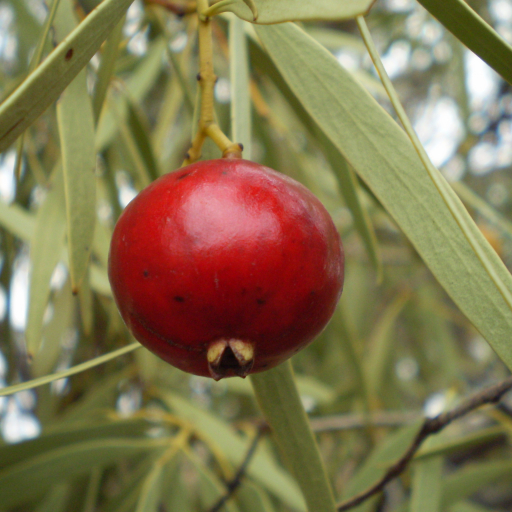
- 🍃 The Foliage: Look for leathery, olive-green leaves that hang in pairs. They are "acuminate," meaning they taper to a long, sharp point, helping the plant shed water efficiently.
- 🍒 The Fruit: The most striking feature is the bright, waxy red fruit. About the size of a golf ball, the skin is thin and covers a dry, tart flesh.
- 🕳️ The Stone: Inside the fruit sits a large, woody, and deeply pitted stone. These stones are so unique they are often used in traditional games or crafted into jewelry.
🏡 In Your Garden
- 🧛 A "Vampire" Lifestyle: The Quandong is hemiparasitic. This means it can’t survive alone; it attaches its roots to a "host" plant (like a wattle or a native grass) to steal water and minerals. If you plant one, it must have a neighbor to feed on!
- ☀️ Desert Toughness: It is incredibly drought-tolerant and thrives in sandy, well-draining soil. However, it hates "wet feet"—too much water in the soil will quickly lead to root rot.
⚠️ Safety & Toxicity
- 🍏 Status: Edible and highly nutritious.
- 💊 Details: The fruit is famous for having twice the Vitamin C of an orange. While the flesh is safe for humans and most pets, the large, hard pit inside could pose a significant choking hazard or cause intestinal blockage if swallowed by a dog.
✨ Fun Fact
The kernel inside the pitted stone is so rich in flammable oils that it can be skewered and lit like a candle, burning with a bright, steady flame!

Detailed Care Instructions
Santalum acuminatum, also known as the quandong or native peach, is a small, evergreen tree native to Australia. Here are some tips on how to grow and care for this plant:
- Climate: Santalum acuminatum grows best in a warm to hot climate with well-draining soil. It is drought-tolerant once established but will benefit from regular watering during dry periods.
- Sunlight: This plant prefers full sun to part shade. Make sure it receives at least 6-8 hours of sunlight per day.
- Soil: Santalum acuminatum thrives in well-draining, slightly acidic soil. You can amend your soil with sand or perlite to improve drainage if necessary.
- Propagation: You can propagate Santalum acuminatum from seeds or cuttings. Seeds will take longer to germinate, so it is recommended to start from cuttings if possible.
- Planting: Plant your Santalum acuminatum in a spacious area with plenty of room for the tree to grow. Make sure to provide adequate support for young plants to ensure proper growth.
- Pruning: Prune your Santalum acuminatum tree regularly to promote healthy growth and shape. Remove any dead or damaged branches and trim back overgrown areas as needed.
- Fertilizing: Fertilize your Santalum acuminatum tree with a balanced fertilizer in the spring and summer months to encourage strong growth. Avoid over-fertilizing, as this can cause damage to the plant.
- Pests and diseases: Keep an eye out for pests such as aphids, scale insects, and spider mites, as well as fungal diseases like powdery mildew. Treat any infestations promptly to prevent damage to your plant.
By following these tips, you can successfully grow and care for Santalum acuminatum plants in your garden. Enjoy the beautiful foliage and edible fruits that this native Australian tree has to offer!
Santalum Acuminatum plants should be watered deeply and infrequently to encourage deep root growth. They prefer well-draining soil, so be sure not to overwater to prevent root rot. Allow the top few inches of soil to dry out before watering again. Water at the base of the plant to avoid wetting the foliage, as this can lead to disease. During hot, dry periods, increase the frequency of watering, but always be mindful not to drown the roots. It is important to monitor the plant's moisture needs and adjust your watering schedule accordingly.
To fertilize the plant, apply a balanced, water-soluble fertilizer specifically formulated for woody plants. Dilute the fertilizer according to package instructions and apply it to the soil around the base of the plant, being careful not to let the fertilizer come in direct contact with the roots. Fertilize the plant once in the spring and again in the fall to promote healthy growth and blooming. Avoid over-fertilizing, as this can lead to nutrient imbalances and cause damage to the plant.
Santalum Acuminatum, a slow-growing shrub native to Australia, prefers well-draining soil that is slightly acidic to neutral. It thrives in sandy loam or sandy soil with good organic content. Additionally, the plant benefits from soil that is rich in nutrients, such as compost or aged manure, to encourage healthy growth and flowering. It is important to avoid waterlogged or compacted soil as this can lead to root rot and other issues. Adding a layer of mulch around the base of the plant can help retain moisture and regulate soil temperature, further promoting the growth and development of Santalum Acuminatum.
Santalum acuminatum plants can be easily propagated through both seed propagation and stem cuttings.
To propagate Santalum acuminatum from seeds, start by scarifying the seeds to increase germination rates. This can be done by soaking the seeds in warm water for several hours or lightly scratching the seed coat with sandpaper. After scarification, plant the seeds in a well-draining potting mix and water thoroughly. Keep the soil consistently moist and place the pots in a warm, sunny location. Germination typically occurs within 2-4 weeks.
Alternatively, Santalum acuminatum can also be propagated from stem cuttings. Take a healthy stem cutting from a mature plant, making sure it is at least 4-6 inches long and has several nodes. Remove the lower leaves from the cutting and dip the end in a rooting hormone to promote root growth. Plant the cutting in a well-draining potting mix, water lightly, and place in a warm, bright location. Keep the soil consistently moist and within a few weeks, roots should begin to develop.
Overall, Santalum acuminatum plants are relatively easy to propagate and can be a rewarding way to expand your collection of these unique and beautiful plants.








