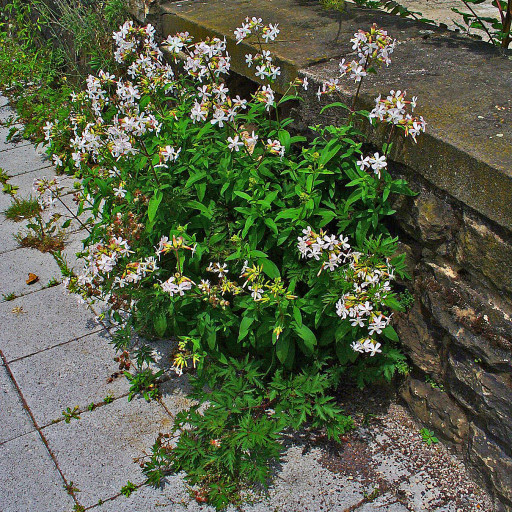
Plant Overview
Commonly known as Soapwort or the charmingly named "Bouncing-bet," this perennial wildflower has been a household staple for centuries—long before bottled detergents existed. Originating in Europe and Siberia, it followed settlers across the globe because of its magical ability to create a cleaning lather. In the wild, you’ll often find it dancing along roadsides or stream banks, showing off its delicate, pale pink blooms that release a sweet, clove-like scent in the evening.
🔍 How to Identify
- 🌸 The Flowers: Clusters of five-petaled blossoms that range from white to a soft, "ballet slipper" pink. Many heirloom varieties are "double-flowered," looking like tiny, ruffled carnations.
- 🍃 The Foliage: Smooth, lance-shaped leaves that grow in opposite pairs along the stem. If you look closely, you’ll see three distinct veins running lengthwise down each leaf.
- 🦴 The Stem: Noticeably swollen at the joints (nodes), giving the plant a slightly "knobby" appearance similar to its cousins in the Pink family (Caryophyllaceae).
🏡 In Your Garden
- 🧼 The Suds Factor: The plant contains high levels of saponins. If you crush the leaves or roots in water and agitate them, they produce a gentle, pH-balanced foam that has been used for centuries to clean delicate museum-grade tapestries.
- 🏃 A Gracious Wanderer: Soapwort is incredibly hardy and spreads via underground rhizomes. While it’s beautiful in a cottage garden, give it plenty of space or use root barriers, as it can be quite "enthusiastic" about taking over a flower bed.
- 🌙 Moth Magnet: Because the flowers are most fragrant at dusk, they are a favorite destination for nocturnal pollinators like Sphinx moths, which hover like tiny hummingbirds to drink their nectar.
⚠️ Safety & Toxicity
- 🐾 Mildly Toxic: While historically used as a medicine and soap, it is not edible. If ingested in large quantities, it can cause stomach upset, drooling, or vomiting in dogs, cats, and horses.
- 🐟 Aquatic Warning: Saponins are highly toxic to cold-blooded creatures. Never wash Soapwort "suds" into ponds or streams, as it can interfere with the way fish breathe through their gills.
- 🖐️ Skin Sensitivity: For most, the "soap" is gentle, but individuals with very sensitive skin may experience mild irritation from handling the crushed roots.
✨ Fun Fact
Soapwort is so effective yet gentle that it is still used by conservationists today to clean ancient, fragile textiles—including the world-famous Bayeux Tapestry!

Detailed Care Instructions
| Color | Pink, White |
| Soil Ph | 5 To 7 |
| Soil Type | Sandy, Loamy, Or Clay |
| Bloom Time | May To September |
| Plant Type | Perennial Herb |
| Mature Size | Roughly 1 To 3 Feet In Height And Width |
| Native Area | Europe, Asia |
| Sun Exposure | Full Sun To Part Sun |
| Hardiness Zones | 3 To 9, Usa |
To grow Saponaria Officinalis, also known as Soapwort, you can follow these steps:
- Choose a suitable location: Soapwort prefers full sun to partial shade, so select a spot in your garden that receives at least 6 hours of direct sunlight per day.
- Prepare the soil: Soapwort grows best in well-draining soil. If your soil is heavy or clayey, amend it with organic matter such as compost or well-rotted manure to improve drainage and fertility.
- Sow seeds or propagate from cuttings: You can start Soapwort from seeds or propagate it from stem cuttings. If using seeds, sow them in late winter or early spring, either indoors or directly into the garden soil. Cover the seeds lightly with soil and keep them moist until they germinate. If using cuttings, take 4- to 6-inch-long stem cuttings from a healthy Soapwort plant, dip the cut ends in rooting hormone, and place them in a container with a well-draining potting mix. Keep the cuttings moist until they develop roots.
- Watering and maintenance: Soapwort requires regular watering, especially during the first few weeks after planting or until established. Once established, it is moderately drought-tolerant. Water the plant when the top inch of soil feels dry. Avoid overwatering, as it may lead to root rot. Additionally, remove any weeds around the plant to reduce competition for nutrients and water.
- Fertilizing: Soapwort generally doesn't require heavy feeding. A light application of balanced organic fertilizer once in spring should be sufficient. Follow the recommended dosage on the fertilizer packaging.
- Pruning: Soapwort benefits from regular pruning to keep it tidy and promote bushier growth. After the flowering period, trim back the spent flowers and any leggy or dead stems. This will encourage new growth and ensure a more compact, attractive plant.
- Pest and disease control: Soapwort is generally not prone to serious pest or disease issues. However, keep an eye out for common pests like aphids or snails, and take appropriate measures to control them if necessary.
- Harvesting and using: The leaves and roots of Soapwort can be harvested for their soap-like properties. When the plant is mature, gently dig up the roots and wash them thoroughly to remove any dirt. Crush the roots to release the saponins (natural soapy substances) and use the resulting liquid as a mild detergent or for making homemade soap.
By following these steps, you should be able to successfully grow Saponaria Officinalis or Soapwort in your garden.

Place in a bright room that is sun drenched almost all day. Or directly in a south-facing window.

To water this plant, ensure that the soil is slightly moist before watering. Water the plant deeply and allow the excess water to drain out of the bottom of the pot or container. Make sure to avoid overwatering as this can lead to root rot. Aim to water the plant about once a week, or more frequently during periods of hot and dry weather.
To fertilize this plant, apply a balanced, slow-release fertilizer once a year in early spring. Follow the instructions on the fertilizer label for proper application rates. Avoid over-fertilizing, as this can lead to excessive foliage growth at the expense of flowers. Water the fertilizer in thoroughly after application.
When planting Saponaria Officinalis, it is recommended to use a well-draining, fertile soil that has a pH level between 6.0 and 7.5. The soil should be rich in organic matter, such as compost, and have good water retention capabilities. It is important to avoid soils that are too heavy or compacted, as they can lead to poor drainage and root rot. Mulching around the base of the plant can help to maintain consistent moisture levels in the soil. Overall, Saponaria Officinalis thrives in a soil that is rich and well-draining, allowing the plant to grow strong and healthy.
Propagation of this plant can be done through various means such as stem cuttings, seed sowing, or root division. In stem cutting propagation, take a stem cutting from the plant that has at least two nodes and remove the lower leaves. Dip the end of the cutting in rooting hormone and plant it in a potting mix. Keep the cutting in a warm, bright, and humid place and wait for it to develop roots and new shoots.
For seed sowing, sow the seeds in well-draining soil in a pot or directly in the ground after the last frost. Cover the seeds with a thin layer of soil and keep them moist but not waterlogged. The seeds will germinate in 1-2 weeks and the seedlings can be transplanted once they have developed a few sets of leaves.
For root division propagation, dig up the plant and divide the root ball into several sections using a sharp knife. Ensure that each section has roots and at least one stem. Replant each section in well-draining soil and keep them moist until they establish themselves.
Propagation can be done in spring or fall, and the propagated plants can be planted outdoors once they have developed strong roots and are well-established.
Common pests of the bouncing-bet include Spider mites, aphids. Make a habit of checking your bouncing-bet frequently for pests so that any infestations can be caught and managed early.








