Plant Overview
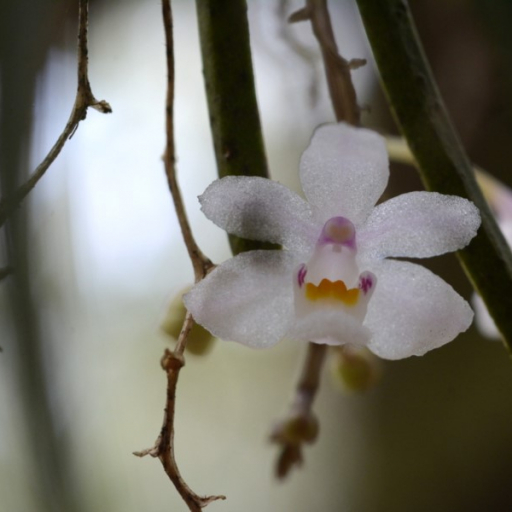
Often referred to as Hill’s Fairy Orchid or Myrtle Bells, this miniature Australian native is the definition of "small but mighty." Growing naturally along the eastern coast of Australia, it is a delicate epiphyte that clings to trees and rocks, producing sprays of tiny, crystalline blossoms that look like they were crafted for a woodland sprite. It is a favorite among orchid enthusiasts who appreciate the beauty of "micro" species.
🔍 How to Identify
- 🌸 The Blooms: Features clusters of 2 to 10 tiny, bell-shaped flowers (about 6-10mm wide). They are usually icy white or pale pink with a distinctively spotted "lip" or labellum.
- 🍃 The Foliage: The leaves are narrow, leathery, and dark green, typically measuring only a few centimeters long. They often grow in a fan-like arrangement.
- 🧶 The Roots: It possesses relatively thick, fleshy grey-green roots that wander over the surface of its host, designed to grip tight and soak up moisture from the humid air.
🏡 In Your Garden
- 🌳 Mounting is Best: Because it is an epiphyte, this orchid hates having "wet feet." It performs best when mounted on a piece of cork, hardwood, or tree-fern slab rather than sitting in a traditional pot.
- ☁️ Humidity is Key: While it is surprisingly hardy, it thrives in high-humidity environments with excellent air circulation. If keeping it indoors, a daily misting or a pebble tray is essential to mimic its rainforest home.
- ☀️ Dappled Light: In the wild, it hides under the canopy. It needs bright, indirect light—direct midday sun will scorch its tiny leaves very quickly.
⚠️ Safety & Toxicity
- ✅ Status: Generally Non-Toxic.
- 🐾 Details: Sarcochilus hillii is not known to be toxic to humans, cats, or dogs. However, because orchids can be delicate and sometimes treated with fertilizers, it is always best to keep them out of reach of curious nibbling pets.
✨ Fun Fact
Despite its fragile appearance, the "Myrtle Bells" orchid is named after its frequent habit of growing on the trunks of Backhousia myrtifolia (Grey Myrtle) trees. It has evolved to be so light that it can live on the thinnest of branches where larger orchids would fall off!

Detailed Care Instructions







