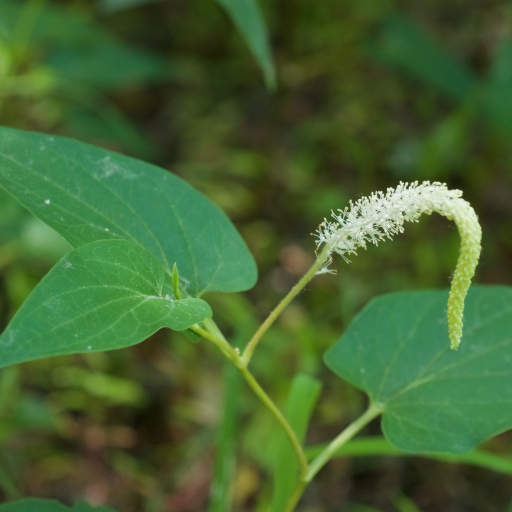
Plant Overview
Often called the Lizard’s Tail or the Water-dragon, Saururus cernuus is a charming perennial that looks like it belongs in a prehistoric marsh. It is famous for its distinct, arching white flower spikes that mimic the flicking tail of a lizard, adding a touch of movement and a sweet fragrance to any shoreline. In the wild, it forms lush, emerald colonies that provide vital shelter for aquatic life.
🔍 How to Identify
- 🦎 The "Tail": Slender, 6-inch-long spikes of tiny white flowers that characteristicly "nod" or droop at the tip.
- 🍃 Heart-Shaped Foliage: Large, leathery green leaves that are shaped like broad hearts with pointed tips and prominent veins.
- 👃 Spicy Aroma: If you crush a leaf or sniff the flowers, you’ll notice a pleasant, citrus-like or spicy scent unique to this species.
🏡 In Your Garden
- 💧 Wet Feet Only: This plant is a true water-lover. It thrives in mud or standing water up to 6 inches deep, making it the perfect choice for pond margins or "boggy" spots where other plants might drown.
- 🏃 Spreading Habit: It expands via underground runners (rhizomes). While it’s excellent for stabilizing soil and preventing erosion along a stream, it can be quite assertive; in a small garden pond, consider planting it in a submerged container to keep it from taking over.
⚠️ Safety & Toxicity
- 🐾 Non-Toxic: Saururus cernuus is generally considered safe and is not listed on major toxic plant databases for cats or dogs.
- 👄 Not for Eating: Despite its safety, it is not an edible plant for humans. Ingesting large amounts may cause mild stomach upset or nausea due to its natural chemical compounds.
✨ Fun Fact
The name Saururus is derived from the Greek words sauros (lizard) and oura (tail). Early settlers and Native American tribes also used the mashed leaves as a poultice to treat inflammation, earning it the folk nickname "Breastweed."

Detailed Care Instructions
| Lighting | Full Sun |
| Hardiness Zones | 5A - 9B |
To successfully grow Saururus Cernuus plant, also known as Lizard's Tail, follow these steps:
- Climate and location: Saururus Cernuus prefers moist to wet conditions, making it an ideal choice for bog gardens or areas near ponds, streams, or water features. It grows well in full to partial shade. Ensure that your climate and location can provide these conditions.
- Soil preparation: The plant thrives in rich, loamy soil that is consistently moist. Before planting, amend the soil with organic matter like compost or well-rotted manure to improve its moisture-retaining capacity.
- Planting: Saururus Cernuus can be planted either from seeds or from nursery-bought plants. The ideal planting time is in spring or early summer. Dig a hole slightly wider and deeper than the plant's root ball, place the plant in the hole, and backfill with the amended soil, gently firming it around the roots.
- Watering: Maintain consistently moist soil to mimic the plant's natural boggy habitat. Water the plant deeply and regularly, particularly during dry periods. However, be careful not to overwater and create waterlogged conditions as this can lead to root rot.
- Mulching and weed control: Apply a layer of organic mulch, such as wood chips or straw, around the base of the plant to help retain moisture, suppress weeds, and maintain a cool root zone. Regularly remove any weeds that emerge to prevent competition for nutrients and water.
- Fertilization: Saururus Cernuus typically doesn't require heavy fertilization. However, applying a slow-release, balanced fertilizer in spring can provide essential nutrients. Follow the manufacturer's instructions for application rates.
- Pruning: Lizard's Tail doesn't require much pruning; however, you can remove any dead or damaged foliage to maintain its appearance and overall health.
- Propagation: Saururus Cernuus can be propagated through division. In early spring or fall, carefully dig up the plant and divide it into smaller sections, ensuring each section has several healthy roots and shoots. Replant the divisions in the desired location, following the same planting guidelines.
By following these tips, you can successfully grow Saururus Cernuus plant and enjoy its attractive flowers and unique foliage.

Place in a window with dappled sun or a spot in the middle of a room. Or directly in a window facing west or east.

To properly water this plant, you should first consider the environmental conditions and the stage of growth. The soil should be moist, but not waterlogged. It is best to water from the base of the plant rather than overhead, as it can be prone to fungal diseases if the leaves are constantly wet. Allow the soil to dry out slightly between waterings, but never let it completely dry out. During periods of growth, the plant may require more frequent waterings. It is also important to ensure that the plant is in well-draining soil to prevent water buildup and root rot.
Saururus Cernuus should be fertilized during the growing season with a balanced, all-purpose fertilizer. Apply the fertilizer once every 2-4 weeks at half the recommended strength. Avoid fertilizing during the winter months when growth is slow. Water the plant before and after fertilizing to prevent damage to the roots.
Saururus Cernuus plant prefers a moist, rich and well-draining soil that is slightly acidic in nature. It can be planted in a soil mix consisting of peat moss, perlite and coarse sand, with a pH range of 5.5 to 6.5. The soil should be kept consistently moist but not waterlogged, as this can lead to root rot. A layer of organic mulch can be added to retain moisture and add nutrients to the soil. Fertilizer should be applied sparingly, as the plant is not a heavy feeder. Overall, the soil provided should be nutrient-rich, well-draining and kept uniformly moist for the best growth and health of Saururus Cernuus.
To propagate this plant, take cuttings from the mature plant in the early spring or late fall. Using a sharp, sterilized knife, cut a stem about four inches in length from the mother plant. Remove the bottom leaves and pinch off the top growth to encourage branching. Dip the cut end in rooting hormone powder and plant the cutting in a container filled with a moistened mixture of equal parts sand and peat moss. Cover the container with plastic wrap or a clear plastic bag to create a humid microclimate for the cutting. Keep the soil evenly moist and place the container in a bright, but not direct, light. Once roots have formed, usually in about 4-6 weeks, gradually acclimate the new plant to its growing conditions before transplanting it to its permanent location.








