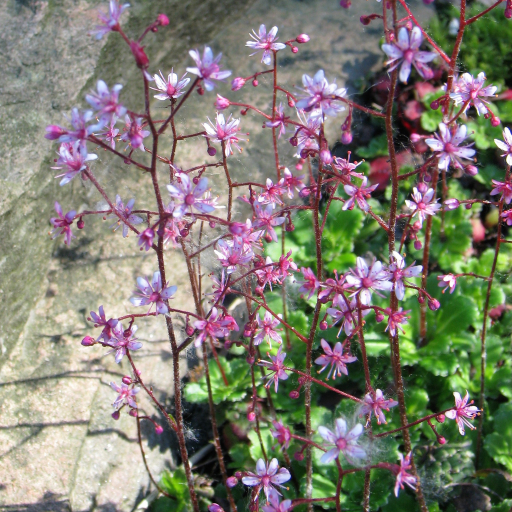
Plant Overview
Often called "London Pride" or "St. Patrick’s Cabbage," Saxifraga umbrosa is a resilient, low-growing perennial that has been a staple in European gardens for centuries. It is famous for its ability to thrive in the "umbral" shadows (its name literally means "of the shade"), where other flowers might wither. During the Victorian era, it became a symbol of urban resilience, often found blooming in the tiny, soot-covered cracks of London’s brickwork.
🔍 How to Identify
- 🍃 Rosette Foliage: It forms dense, low-growing mats of evergreen leaves. The leaves are thick, leathery, and spoon-shaped with distinctively scalloped or "toothed" edges.
- 🌸 Starry Blooms: In late spring and early summer, it sends up delicate, wiry reddish stems that hover above the foliage. These carry airy clusters of tiny, five-petaled white flowers, often speckled with minute red or pink dots.
- 🌱 Creeping Habit: The plant spreads through short runners, slowly forming a lush green carpet that acts as an excellent weed-suppressing groundcover.
🏡 In Your Garden
- ☁️ The Shade Specialist: Unlike many flowering plants that crave the sun, this Saxifraga is happiest in dappled or full shade. It is the perfect solution for those "difficult" north-facing corners of the garden or under the canopy of large trees.
- ⛰️ Rocky Roots: As a member of the "Rockfoil" family, it prefers well-drained soil. While it likes moisture, it hates sitting in soggy, heavy clay, which can cause the center of the rosettes to rot.
- ✂️ Low Maintenance: Once established, it requires very little care. After the flowers fade, you can shear off the tall stems to keep the green carpet looking tidy and compact.
⚠️ Safety & Toxicity
- ✅ Generally Safe: Saxifraga umbrosa is considered non-toxic to humans, dogs, and cats.
- 👐 Skin Sensitivity: While not poisonous, the sap of some Saxifraga species can occasionally cause minor skin irritation in people with very sensitive skin if handled extensively during pruning.
✨ Fun Fact
Saxifraga umbrosa gained legendary status during World War II. It became a symbol of hope because it was one of the few plants that continued to grow and bloom amidst the rubble of bombed-out buildings during the London Blitz, earning it a permanent place in the hearts of city gardeners.

Detailed Care Instructions
To grow Saxifraga Umbrosa, also known as London Pride or St. Patrick’s Cabbage, follow these steps:
- Choose a suitable location: Saxifraga Umbrosa prefers a shady location with well-drained soil. It is ideal for rock gardens, woodland areas, or the base of trees. However, it can also tolerate partial sun.
- Prepare the soil: Saxifraga Umbrosa is adaptable to different soil types but prefers a humus-rich, slightly acidic soil. Amend the soil by adding organic matter, such as compost or well-rotted manure, to improve drainage and fertility.
- Planting: Dig a hole slightly larger than the root ball of the plant. Place the plant in the hole, making sure the crown is level with the soil surface. Backfill the hole with soil, gently firming it around the plant.
- Watering: Keep the soil consistently moist but avoid overwatering, as excessive moisture can cause rot. During the dry season, provide supplemental watering to prevent the plant from drying out.
- Mulching: Apply a layer of organic mulch, such as bark chips or compost, around the plant to help retain moisture, suppress weeds, and regulate soil temperature.
- Pruning: Trim back any dead or damaged foliage in early spring to encourage new growth. Regularly remove spent flower stalks to promote continuous blooming.
- Fertilizing: Feed the plants with a balanced, slow-release fertilizer in early spring. Avoid excessive fertilization, as it can cause weak growth and reduce overall plant vigor.
- Propagation: Saxifraga Umbrosa can be propagated by division. In early spring or fall, dig up the plant and gently separate the roots into individual sections, ensuring each section has several healthy shoots. Replant the divisions in prepared soil and water well.
- Pest and disease control: Saxifraga Umbrosa is relatively resistant to pests and diseases. However, watch out for slugs and snails, which may feed on the foliage. Use organic pest control methods or remove them by hand if necessary.
- Winter care: Saxifraga Umbrosa is a hardy perennial and can withstand winter temperatures. However, it may benefit from a light mulching or covering with a layer of straw or evergreen boughs to protect it from extreme cold or frost.
Following these tips should help you successfully grow and maintain Saxifraga Umbrosa plants in your garden.

Place in a window with dappled sun or a spot in the middle of a room. Or directly in a window facing west or east.

To properly water Saxifraga Umbrosa, it is essential to follow specific guidelines:
1. Observe the soil: Before watering, examine the soil to determine if it is dry. Gently press your finger into the soil to a depth of about an inch. If it feels dry at that depth, it is an indication that watering is needed.
2. Choose the water source: It is recommended to use distilled, rainwater, or tap water that has been sitting for 24 hours. Avoiding the use of hard water or water that contains high levels of minerals is crucial for this plant.
3. Watering technique: To prevent overwatering, use a gentle watering technique. Avoid drenching the plant with large quantities of water all at once. Instead, water the soil evenly and slowly, allowing the water to penetrate and reach the roots.
4. Watering frequency: Saxifraga Umbrosa prefers slightly moist soil. However, it is crucial to establish a proper watering schedule to avoid waterlogged conditions. Depending on the climate and humidity levels, watering once a week may be sufficient. During extremely hot or dry periods, it might be necessary to water more frequently.
5. Drainage is key: Ensure that the pot or planting area has adequate drainage holes to allow excess water to escape. Standing water can lead to root rot and damage the plant.
6. Observe the plant's response: After watering, observe the plant's response to determine if it has received enough water. The leaves should appear plump and healthy, while the soil should be slightly moist but not waterlogged.
Remember, each plant's water requirements may slightly vary. Monitoring the plant's growth, appearance, and response to water will help you adjust the watering routine accordingly.
To fertilize Saxifraga Umbrosa plant, follow these instructions:
- Use a balanced fertilizer with equal amounts of nitrogen, phosphorus, and potassium. This will provide the plant with essential nutrients for healthy growth.
- Dilute the fertilizer according to the manufacturer's instructions. Typically, a general recommendation is to use 1 tablespoon of fertilizer per gallon of water.
- Apply the diluted fertilizer to the soil around the base of the plant. Avoid getting it on the foliage, as this may cause leaf burn.
- Water the plant thoroughly after fertilizing to ensure the nutrients are absorbed by the roots.
- Fertilize Saxifraga Umbrosa plant every 4 to 6 weeks during the growing season, which is usually spring to early autumn. Avoid fertilizing in winter when the plant goes dormant.
- Monitor the plant's response to fertilization. If you notice excessive foliage growth with few flowers, reduce the frequency or strength of fertilization. On the other hand, if the plant appears weak or lacks vigor, increase the frequency but use a slightly weaker solution.
Remember, it's always a good idea to read the fertilizer label for specific instructions and adjust the fertilization regimen according to the plant's individual needs.
When selecting soil for Saxifraga Umbrosa, it is important to consider its specific requirements. This plant thrives in well-draining soil that is rich in organic matter. The ideal soil type for Saxifraga Umbrosa is moderately acidic to slightly alkaline.
A suitable soil mixture can be prepared by combining equal parts of high-quality potting soil, perlite, and coarse sand. This blend creates a light and airy medium that promotes proper drainage, preventing the roots from sitting in water and potentially rotting. The addition of perlite and coarse sand helps to increase soil porosity and prevent compaction.
Organic matter can be incorporated into the soil mixture to enhance nutrient content and moisture retention. Well-decomposed compost or leaf mold can be added in smaller quantities, ensuring that it does not make the soil excessively compact or waterlogged.
It is vital to avoid using heavy clay soils or those that tend to become waterlogged, as Saxifraga Umbrosa is susceptible to root rot under such conditions. Also, avoid using overly sandy or gravelly soils, which may hinder moisture retention.
Regularly check the moisture level of the soil to avoid either overwatering or letting it dry out completely. Saxifraga Umbrosa prefers soil that is consistently moist but not soggy.
In summary, providing Saxifraga Umbrosa with a well-draining, slightly acidic to slightly alkaline soil that is rich in organic matter is crucial for its successful growth and development.
To propagate Saxifraga Umbrosa, start by selecting a healthy and well-established plant from which to take cuttings. Here is a detailed step-by-step guide:
- Obtain a clean pair of sharp pruning shears or scissors, and sterilize them with rubbing alcohol or a disinfectant solution to prevent the transmission of diseases.
- Identify a suitable stem to take cuttings from. Ideally, select a non-flowering stem that is young and vigorous, with several sets of leaves.
- Using the sterilized shears, make a clean cut just below a node (the point where the leaf meets the stem). The cutting should be approximately 3-4 inches in length.
- Remove the lower leaves from the cutting, leaving only a couple of sets of leaves at the top. This helps reduce moisture loss during the propagation process.
- Prepare a rooting medium using a well-draining soil mix. You can use a mixture of equal parts perlite and peat moss or a commercial seed-starting mix.
- Moisten the rooting medium slightly to provide adequate moisture for the cuttings without making it waterlogged.
- If desired, dip the lower end of the cutting in a rooting hormone powder or gel to stimulate root development, following the manufacturer's instructions.
- Create a hole in the rooting medium using a pencil or your fingertip and gently insert the cutting into the hole, ensuring that at least half of its length is buried in the medium.
- Lightly firm the medium around the cutting to secure it in place but avoid compacting it too much, as this may hinder root growth.
- Place the pots or propagation tray in a warm and bright location with indirect sunlight. Avoid exposing the cuttings to direct sunlight, as it can cause wilting or scorching.
- To maintain high humidity around the cuttings, cover the pots or tray with a clear plastic bag or use a propagator with a transparent lid.
- Water the cuttings as needed to keep the rooting medium slightly moist. Mist the cuttings periodically to maintain humidity if using a plastic bag.
- After a few weeks, gently tug on the cuttings to check for resistance, indicating the development of roots. Once roots have formed, they can be transplanted into individual pots with standard potting soil.
- Continue to care for the newly rooted plants by providing bright, indirect light and watering moderately. Over time, you can acclimate them to more sunlight.
- Monitor the plants for any signs of pests or diseases and take appropriate action if necessary.
- Once the propagated plants have become established and grown larger, they can be transplanted into the garden or larger containers if desired.
Remember to be patient during the propagation process, as it can take several weeks for roots to develop. With proper care and patience, you can successfully propagate Saxifraga Umbrosa and enjoy its attractive foliage and delicate flowers in your garden or indoor space.
Common pests of the london pride include Mealybugs, spider mites, aphids. Make a habit of checking your london pride frequently for pests so that any infestations can be caught and managed early.








