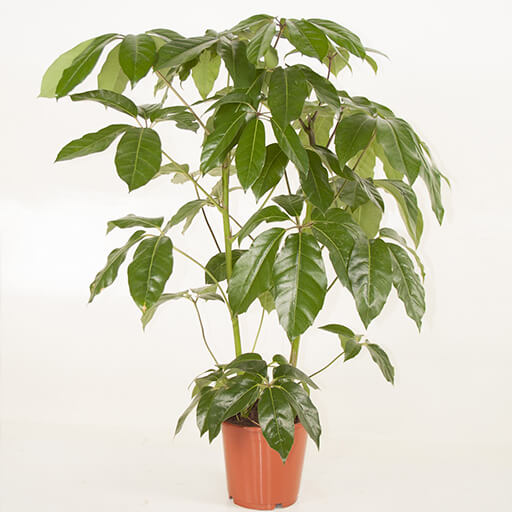
Plant Overview
Often called the Umbrella Tree or the Octopus Tree, Schefflera actinophylla is a tropical showstopper hailing from the rainforests of Australia and New Guinea. It earned its nickname from the way its glossy leaflets radiate outward from a central point, much like the ribs of an umbrella. While it starts as a modest tabletop plant, it is a vigorous grower that can quickly transform a corner of your home into a lush, prehistoric-looking jungle.
🔍 How to Identify
- 🌿 The "Umbrella" Foliage: The most striking feature is the compound leaves. Each leaf consists of 7 to 16 large, oval, glossy green leaflets that fan out in a circular pattern.
- 🖐️ Leaf Texture: The leaflets are thick and leathery to the touch, often reaching up to 12 inches long as the plant matures.
- 🐙 The "Octopus" Blooms: In the wild (or very sunny outdoor spots), it produces long, red, tentacle-like flower spikes that sit atop the foliage, resembling an upside-down octopus.
🏡 In Your Garden & Home
- ☀️ Light & Stretching: This plant thrives in bright, indirect light. If it doesn't get enough sun, it tends to get "leggy," stretching its stems toward the nearest window and losing its compact, bushy charm.
- 🪴 Space for Roots: It is a fast grower with a vigorous root system. If you notice the growth slowing down significantly, it is likely "pot-bound" and needs a larger container to continue its upward journey.
- ✂️ Shape Management: Because it wants to be a giant tree, indoor specimens benefit from regular pruning. Pinching off the growing tips encourages the plant to branch out rather than just shooting straight to the ceiling.
⚠️ Safety & Toxicity
- 🐾 Toxic to Pets: Schefflera contains insoluble calcium oxalate crystals, which are sharp at a microscopic level.
- 👄 Irritation: If chewed or swallowed by cats, dogs, or curious children, it can cause intense oral irritation, drooling, vomiting, and difficulty swallowing. It is best kept on a high stand or in a restricted area.
✨ Fun Fact
🐦 In its native Australian habitat, the "Octopus" flowers produce such massive amounts of nectar that they provide a primary food source for honeyeaters, lorikeets, and even tree-kangaroos!

Detailed Care Instructions
| Color | White, Pink, Or Red (Indoor Plants Rarely Bloom) |
| Soil Ph | 6.0 To 6.5 |
| Humidity | High |
| Lighting | Part Sun |
| Toxicity | Poisonous |
| Soil Type | Rich And Moderately Moist |
| Bloom Time | Summer (Outdoors) |
| Difficulty | Medium |
| Plant Type | Broadleaf Evergreen Shrub Or Small Tree |
| Hibernation | Cold Period |
| Mature Size | Top Out At 15 Feet (Indoors) |
| Native Area | Australia, Taiwan, Hainan |
| Temperature | 18°C - 25°C |
| Sun Exposure | Bright, Indirect Light |
| Hardiness Zones | 10-11 |
To grow a Schefflera Actinophylla plant, commonly known as a "Umbrella tree," follow these steps:
- Lighting: Place the plant in a spot with bright, indirect light. Avoid placing it in direct sunlight, as this can scorch the leaves. However, it can tolerate lower light conditions for short periods.
- Temperature: The ideal temperature range for Schefflera Actinophylla is between 65-75°F (18-24°C). Avoid drastic temperature fluctuations and draughty areas.
- Watering: Water the plant when the top inch (2.5 cm) of the soil feels dry. Avoid overwatering, as this can lead to root rot. Ensure the pot has drainage holes to prevent water from accumulating at the bottom.
- Humidity: Increase humidity around the plant by misting the leaves regularly or placing a tray of water near the plant. Avoid misting if the humidity in the air is already high.
- Fertilizer: Feed the plant every 4-6 weeks during the growing season (spring and summer) using a balanced, water-soluble fertilizer. Follow the instructions on the packaging for the correct dosage.
- Pruning: Trim back any leggy or damaged branches to encourage bushier growth. Prune in early spring or late winter before new growth emerges.
- Repotting: Repot the plant every 1-2 years in a slightly larger pot with fresh, well-draining potting mix. Avoid using soil that retains too much moisture, as this can cause root rot.
- Pests: Keep an eye out for common indoor plant pests such as spider mites, mealybugs, and scale insects. If detected, treat the plant with an appropriate insecticide or wipe the leaves with a damp cloth.
- Propagation: Schefflera Actinophylla can be propagated from stem cuttings. Take a 4-6 inch (10-15 cm) cutting from a healthy stem and place it in a glass of water. Once roots have developed, transfer the cutting to a pot with well-draining soil.
Remember, plants can vary in their specific care requirements, so it's always helpful to research more about the particular variety of Schefflera Actinophylla you have.

Place in a window with dappled sun or a spot in the middle of a room. Or directly in a window facing west or east.

To water this plant, wait until the top inch of soil feels dry to the touch before giving it a thorough watering. Use lukewarm water and water at the base of the plant, being careful not to get water on the leaves. Allow any excess water to drain away from the pot, and avoid letting the plant sit in standing water. In the winter months, reduce watering frequency to prevent overwatering.
To fertilize this plant, use a balanced fertilizer with equal amounts of nitrogen, phosphorus, and potassium. During the growing season, apply the fertilizer every two to three weeks, diluting it to half-strength. Do not fertilize during the plant's dormant season. Water the plant thoroughly before and after fertilizing to avoid burning the roots.
The recommended soil for planting this plant is a well-draining soil, with a pH of 5.5 to 6.5. It should be rich in organic matter, and ideally, it should be a mix of peat moss, perlite, and sand. The soil should also have good water retention capacity, as the plant prefers to be kept moist but not waterlogged. To ensure the proper nutrients are available, it is advisable to fertilize the plant every two weeks with a balanced liquid fertilizer during the growing season. Additionally, it is recommended to repot the plant every two years to refresh the soil and prevent root binding.
To propagate this plant, you will need to take stem cuttings from a mature plant. Choose a healthy stem that has several leaves attached and cut it off at a 45-degree angle with a sharp, clean knife or scissors. Remove the leaves from the bottom 2 inches of the stem, leaving only a few leaves at the top.
Dip the cut end of the stem into rooting hormone powder, then plant it in a pot filled with well-draining soil. Water the cutting thoroughly and place it in a bright, warm location out of direct sunlight.
Cover the cutting with a plastic bag or dome to create a mini greenhouse. This will help retain moisture and humidity around the cutting, promoting root growth.
Check the soil moisture frequently and water as needed, but don't overwater as too much moisture can cause the cutting to rot. After a few weeks, gently tug on the stem to see if there are any signs of resistance, which indicates that roots have formed.
Once the cutting has established roots, remove the plastic cover and gradually acclimate it to more light and lower humidity levels. Eventually, you can transplant it into a larger pot or into your garden if the weather and conditions are suitable.
Common pests of the octopus tree include Scale insect, mealybugs, thrips. Make a habit of checking your octopus tree frequently for pests so that any infestations can be caught and managed early.








