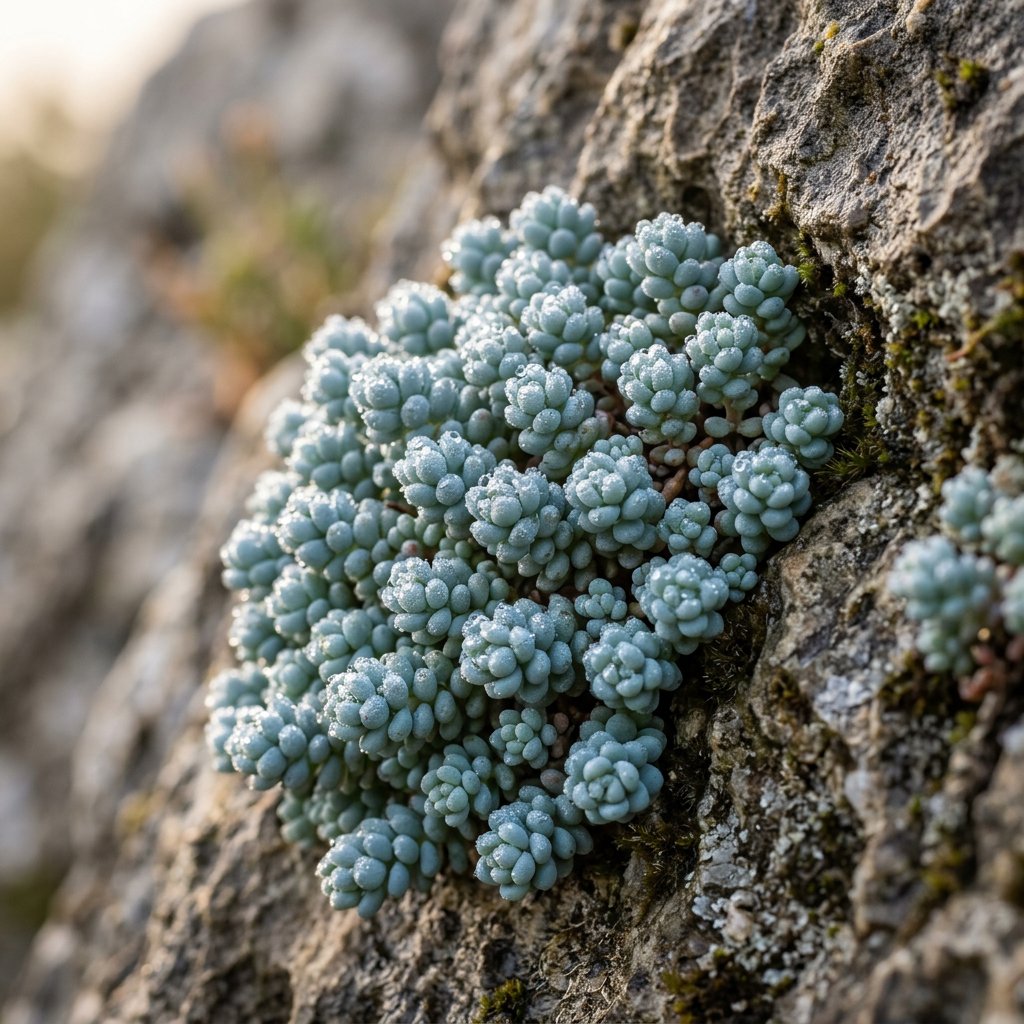
Plant Overview
Known affectionately as the Corsican Stonecrop or "Blue Stonecrop," this tiny succulent looks like a spill of turquoise pearls across a rocky cliffside. Native to the Mediterranean, it creates a lush, pebble-like carpet that thrives in the tightest crevices where other plants might struggle. It is a favorite for fairy gardens and "living walls" because of its miniature, gem-like appearance and hardy nature.
🔍 How to Identify
- 🍃 The Foliage: Tiny, round, bead-like leaves that are closely packed together. They usually sport a powdery blue-grey or glaucous green hue.
- 🌸 The Blooms: In early summer, it produces small, star-shaped white flowers, often decorated with delicate pink or purple streaks on the petals.
- 📏 Growth Habit: A low-growing, mat-forming succulent that rarely exceeds a few inches in height but spreads horizontally to fill gaps.
🏡 In Your Garden
- ☀️ The Stress Blush: While it loves bright light, this plant has a beautiful secret; when "stressed" by intense sun or cold temperatures, the blue leaves often take on a stunning lilac or soft pink tint.
- 💧 Drainage is Key: Because it is adapted to rocky slopes, it hates "wet feet." It is best tucked into rock gardens, stone walls, or gritty potting mixes where water can drain away instantly to prevent root rot.
- 🌱 Self-Propagating: It is incredibly easy to spread; even a single leaf that knocks loose and falls onto the soil has the potential to sprout roots and start a new colony.
⚠️ Safety & Toxicity
- 🐾 Status: Generally considered non-toxic to humans and common household pets like cats and dogs.
- 🖐️ Details: While safe, the sap of many Sedums can cause mild skin irritation for those with sensitive skin. It is always best to admire its beauty visually rather than as a snack, as ingesting large amounts of any succulent can lead to a mild stomach upset.
✨ Fun Fact
The species name dasyphyllum translates to "thick-leaved" or "hairy-leaved." If you look at this plant under a magnifying glass, you’ll discover that the tiny beads are actually covered in microscopic, sticky glandular hairs!

Detailed Care Instructions
To grow Sedum Dasyphyllum (also known as Corsican Stonecrop or Blue Tears), you can follow these steps:
- Choose the right location: Sedum Dasyphyllum prefers full sun to partial shade. Find a spot in your garden or a container that receives at least 6 hours of direct sunlight per day.
- Prepare the soil: The soil should be well-draining, as Sedum Dasyphyllum is prone to root rot if kept in standing water. If your soil doesn't drain well, consider adding some organic matter or sand to improve the drainage.
- Propagation: You can grow Sedum Dasyphyllum from seeds or cuttings. If using seeds, sow them in well-draining soil or seed-starting mix, and keep them moist until germination. If using cuttings, take a stem cutting from a healthy plant, remove lower leaves, and let it callus for a couple of days before planting.
- Planting: Whether you start with seeds or cuttings, plant them in the prepared soil, burying them just deep enough to cover the roots or the seed. Space the plants or cuttings about 6 to 12 inches apart to allow for spreading.
- Watering: Initially, water the plants or cuttings lightly to settle them in the soil. After that, Sedum Dasyphyllum is a drought-tolerant plant and prefers infrequent watering. Water only when the top inch of soil feels dry, and avoid overwatering to prevent root rot.
- Fertilizing: Sedum Dasyphyllum doesn't require much fertilizer. You can add a balanced, slow-release fertilizer in the spring if desired, but it's not necessary.
- Maintenance: Sedum Dasyphyllum is a low-maintenance plant. Prune any dead or damaged parts regularly to keep the plant healthy and neat. If it becomes too leggy, you can also trim it back to encourage denser growth.
- Winter care: Sedum Dasyphyllum is frost-tolerant but may require protection in colder areas. In winter, it's recommended to cover the plant with mulch or move container plants indoors to protect them from freezing temperatures.
By following these steps, you can successfully grow Sedum Dasyphyllum and enjoy its beautiful blue-green foliage.

Place in a bright room that is sun drenched almost all day. Or directly in a south-facing window.

Sedum Dasyphyllum is a plant that requires regular watering, especially during the growing season. When watering this plant, it is important to ensure that the soil is moist but not waterlogged. One way to achieve this is by watering deeply once a week, allowing the water to penetrate the soil and reach the plant's roots.
It is also important to note that Sedum Dasyphyllum is a succulent and is adapted to drought-like conditions. Therefore, it is better to underwater than to overwater this plant. Overwatering can lead to root rot and fungal diseases, which can damage or kill the plant.
When watering Sedum Dasyphyllum, it is best to avoid overhead watering, as this can lead to the plant's leaves staying wet for too long, increasing the risk of fungal infections. Instead, it is recommended to water the plant at the base of the stem, using a watering can or a hose with a gentle stream of water.
If the Sedum Dasyphyllum plant is potted, it is essential to ensure that the pot has proper drainage to allow excess water to escape. Good drainage will prevent water from stagnating in the bottom of the pot, which can cause the plant's roots to rot.
In summary, when watering Sedum Dasyphyllum, it is crucial to water deeply but infrequently and to avoid overhead watering. It is also essential to ensure that the plant has proper drainage to prevent waterlogging.
To fertilize this plant, use a balanced fertilizer with a ratio of 10-10-10 or lower. Apply the fertilizer in early spring when new growth appears, and then again in late summer to encourage healthy growth. Avoid over-fertilizing, as this can cause the plant to become too lush and susceptible to disease or pests. Additionally, make sure to water the plant thoroughly before and after fertilizing to prevent damage to the roots.
The ideal soil for this plant should be well-draining and light. It should also have a pH level of between 6.0 and 7.5. The soil should be rich in organic matter, but not too heavy or compact, as this can cause drainage problems and lead to root rot. Adding sand or perlite can improve the soil's drainage and prevent water from pooling around the plant's roots. The soil should be kept slightly moist but not waterlogged, as Sedum Dasyphyllum prefers dry soil conditions. Over-watering can lead to root rot and cause the plant to die.
To propagate this plant, you will need to take stem and leaf cuttings from a mature plant. It is best to do this during the spring or summer when the plant is actively growing.
- Choose a healthy stem or leaf to take a cutting from. The stem should be about 3-4 inches long and have at least one set of leaves.
- Use a clean, sharp pair of scissors or pruning shears to make a clean cut at an angle.
- Remove any leaves from the bottom 2 inches of the stem or leaf cutting.
- Dip the cut end in rooting hormone powder to promote faster root growth.
- Plant the stem or leaf cutting in well-draining soil and water thoroughly.
- Place the pot in bright, indirect light and keep the soil moist.
- Within a few weeks to a few months, the cutting should begin to grow roots and new leaves.
- Once the cutting has established strong roots and new growth, it can be transplanted into a larger container or planted outdoors in well-draining soil.
It is important to note that Sedum Dasyphyllum is a low maintenance plant that can tolerate drought and poor soil conditions, making it an excellent choice for beginners or anyone looking for a hardy, low-maintenance plant.
Common pests of the corsican stonecrop include Mealybugs, aphids. Make a habit of checking your corsican stonecrop frequently for pests so that any infestations can be caught and managed early.








