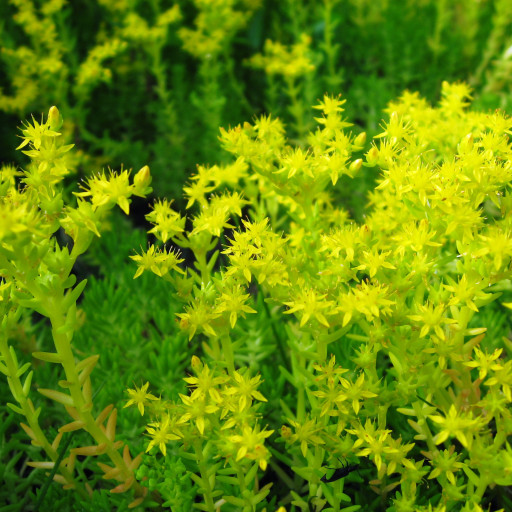
Plant Overview
Often called the Mexican Stonecrop, this vibrant succulent looks like a burst of neon sunshine spilled across the ground. It is beloved by gardeners for its ability to transform dull, dry corners into lush, lime-green carpets. While it hails from the warm climates of Mexico, it has become a global favorite for its "tough-as-nails" attitude and brilliant star-shaped blooms.
🔍 How to Identify
- 🌿 The Foliage: Features needle-like, fleshy leaves that grow in tight whorls around the stems. The color is a distinct chartreuse or "electric lime" that stands out against darker plants.
- 🌼 The Flowers: In late spring and early summer, the plant is covered in tiny, bright yellow, five-pointed stars that attract pollinators.
- 🌱 Growth Habit: It has a low-growing, spreading habit, typically reaching only 3-5 inches in height but sprawling outward to form a dense, moss-like mat.
🏡 In Your Garden
- ☀️ The Sun-Seeker: While it loves full sun to maintain its neon glow, this Sedum is surprisingly versatile and can handle partial shade, though it may turn a deeper forest green in lower light.
- 🧱 Urban Survivor: It is the perfect candidate for "hellstrips" (the dry area between the sidewalk and the street) or rock gardens, as it thrives in poor, rocky soil where other plants might wither.
- ✂️ Easy Sharing: This is a classic "pass-along" plant. If a piece breaks off and falls on the soil, it will likely sprout roots and start a new colony within weeks.
⚠️ Safety & Toxicity
- 🐾 Pet Safety: Sedum mexicanum is generally considered non-toxic to dogs, cats, and horses. It is a much safer alternative for groundcover than many other ornamental plants.
- 👄 Mild Irritation: While not deadly, the sap inside the fleshy leaves can cause mild skin irritation for some people, and if ingested in large quantities, it may cause a minor stomach ache. It’s best as a feast for the eyes, not the plate.
✨ Fun Fact
The Mexican Stonecrop is so resilient that it is often used in "Green Roof" projects. Its ability to store water in its leaves allows it to survive extreme heat and wind on top of buildings where most other plants would perish!

Detailed Care Instructions
To grow Sedum Mexicanum, also known as Mexican Stonecrop, follow these steps:
- Choose a suitable location: Sedum Mexicanum thrives in full sun to partial shade. Ensure the location has well-draining soil as the plant does not like overly wet conditions. If you have heavy clay soil, amend it with some sand and organic matter to improve drainage.
- Propagation: Sedum Mexicanum can be grown from seeds, stem cuttings, or division of established plants. If propagating from stem cuttings, cut a healthy stem near the base and remove the lower leaves. Let the cutting dry for a day or two, then insert it into a well-draining potting mix or directly into the ground.
- Planting: When planting sedums, space them 6 to 12 inches apart to allow enough room for growth. Dig a hole slightly larger than the root ball and place the plant in, making sure the crown is slightly above the soil surface. Backfill the hole with soil and gently firm it around the plant. Water thoroughly after planting.
- Watering: Sedum Mexicanum is a drought-tolerant plant, so water sparingly. Check the soil moisture before watering and allow it to dry out between waterings. Overwatering can lead to root rot and other diseases. It's better to underwater than overwater this plant.
- Fertilizing: Sedums are generally low-maintenance and do not require much fertilization. If desired, you can apply a balanced, slow-release fertilizer in early spring or use a diluted liquid fertilizer during the growing season.
- Pruning: Sedum Mexicanum does not require regular pruning. However, if you notice any dead or damaged stems, you can trim them back to maintain a tidy appearance.
- Winter care: Mexican Stonecrop is hardy in USDA zones 9-11. In colder regions, it is best grown as a container plant so you can bring it indoors during the winter. Place the pot in a bright location and reduce watering. Alternatively, in-ground plants can be protected with a layer of mulch to insulate the roots.
By following these steps, you can successfully grow Sedum Mexicanum and enjoy its beautiful foliage and flowers.

Place in a bright room that is sun drenched almost all day. Or directly in a south-facing window.

Sedum Mexicanum is a type of plant that typically requires moderate watering. You can water the plant by using a watering can or a hose, making sure to apply the water at the base of the plant. When watering, it is important to avoid getting water on the leaves of the plant, as this can lead to disease and rot. Additionally, you should only water the plant when the soil has dried out completely, as over-watering can also be harmful. It’s recommended to water the plant every one to two weeks, but the frequency may vary depending on the climate and the amount of sunlight the plant receives.
To fertilize this plant, mix a balanced, water-soluble fertilizer with water according to the package instructions. Apply the diluted fertilizer to the soil around the base of the plant, being careful not to get any on the leaves. Repeat this process every 2-3 weeks during the growing season. In the winter, reduce or stop fertilizing as the plant typically enters a dormant phase.
For optimal growth and health of the Sedum Mexicanum plant, it is recommended to use well-draining soil that is comprised of a mixture of coarse sand and organic matter. The soil should have good aeration and drainage properties to avoid waterlogging and root rot. A pH level of 6.0-7.5 is ideal for these plants. Fertilizer can be added to the soil sparingly during the growing season, but it is not necessary for the plant's survival. Additionally, it is important to place the plant in a location that receives full sun or partial shade, depending on the specific variety of Sedum Mexicanum being grown.
To propagate this particular plant, one would need to take cuttings of the stem and allow them to dry out for a few days. Once they have calloused over, they can be planted into well-draining soil and kept in a bright, indirect light. Watering should be done sparingly until new growth begins to appear.
Common pests of the mexican stonecrop include Mealybugs, aphids. Make a habit of checking your mexican stonecrop frequently for pests so that any infestations can be caught and managed early.








