Plant Overview
Often called the Red Stonecrop, this petite Mexican native is a master of transformation. Growing in tight, moss-like mats, it paints rocky outcrops with vibrant greens and fiery reds. It is a favorite for rock gardens and "living walls" because it behaves like a living carpet that shifts its color palette based on the weather.
🔍 How to Identify
- 🍃 Tiny Foliage: It features very small, plump, bead-like leaves that are packed tightly along creeping stems, resembling a miniature succulent moss.
- 🎨 Chameleon Colors: While usually a bright lime green in the shade, the leaves take on a dramatic bronze or scarlet hue when "stressed" by intense sunlight or chilly winter temperatures.
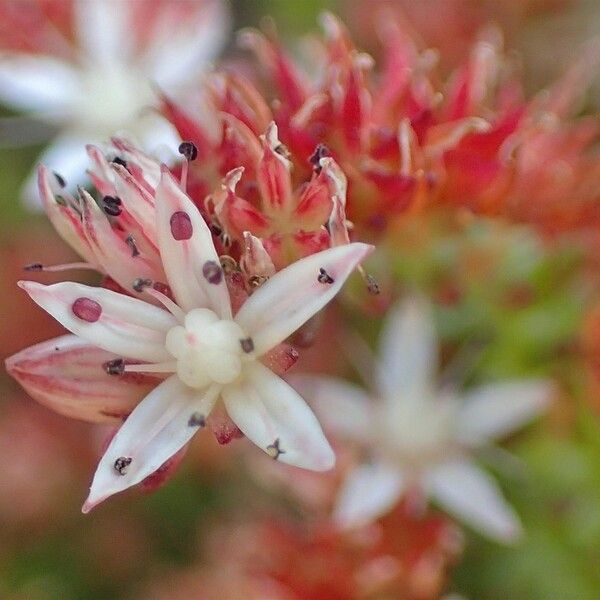
- 🌸 Starry Blooms: In mid-to-late summer, the plant is crowned with clusters of delicate, five-petaled white flowers that look like tiny stars fallen onto a ruby bed.
🏡 In Your Garden
- ⛰️ Mountain Roots: Hailing from the high altitudes of Mexico, this plant thrives in gritty, rocky soil. It doesn’t just tolerate poor soil; it actually prefers it, as too many nutrients can make the plant grow "leggy" and lose its compact, jewel-like shape.
- 💧 Drought Strategy: Because its leaves store water so efficiently, it hates "wet feet." It is best planted on a slope, in a rock crevice, or in a porous terracotta pot to ensure water never pools around its roots.
⚠️ Safety & Toxicity
- 🐾 Pet Friendly: Sedum moranense is generally considered non-toxic to cats, dogs, and horses, making it a worry-free choice for low-level groundcover.
- 👶 Mild Irritant: While not poisonous, the sap of many succulents can cause very mild skin irritation or an upset stomach if large quantities are ingested by curious toddlers.
✨ Fun Fact
🏔️ Altitude Champion: Sedum moranense is named after the Mina de Morán in Mexico and can be found growing naturally at elevations of nearly 10,000 feet, making it much more cold-hardy than many of its tropical succulent cousins!

Detailed Care Instructions
| Humidity | Dry |
| Lighting | Full Sun |
| Difficulty | Easy |
| Hibernation | Cold Period |
| Hardiness Zones | 5 - 9 |
Here are some tips to help you grow Sedum moranense plants:
- Select the right location: Sedum moranense prefers bright, indirect sunlight. Place your plant near a window that receives partial sunlight throughout the day.
- Provide well-draining soil: Sedum moranense prefers sandy or gritty soil that drains well. Use a cactus or succulent soil mix or add perlite or sand to regular potting soil to improve drainage.
- Water sparingly: Sedums are drought-tolerant plants. Allow the soil to dry out completely between waterings. Overwatering can lead to root rot and other diseases.
- Avoid overfertilizing: Sedums do not require frequent fertilization. Use a balanced, water-soluble fertilizer diluted to half strength once every few months during the growing season.
- Propagate through stem or leaf cuttings: Sedum moranense can be propagated easily through stem or leaf cuttings. Simply cut a healthy stem or leaf from the plant and allow it to callus for a few days. Plant the cutting in well-draining soil and keep it slightly moist until roots develop.
- Prune as needed: Sedums have a tendency to become leggy or floppy. Pruning them back will help maintain a compact, neat appearance. Prune in spring or early summer before new growth starts.
- Protect from frost: Sedum moranense is not frost-tolerant. If you live in a colder climate, grow it indoors or provide frost protection during winter months.
By following these care instructions, you should be able to successfully grow Sedum moranense plants.

Place in a bright room that is sun drenched almost all day. Or directly in a south-facing window.

Sedum Moranense is a succulent plant that requires proper watering to thrive. To water this plant, you should first wait until the soil is completely dry. Then, thoroughly water the plant until the water runs out of the drainage holes in the pot. It is essential to avoid overwatering as this can cause the roots to rot. Always make sure that the soil is completely dry before watering again. Additionally, it is recommended to use a well-draining soil mix and to provide proper drainage for the pot. This plant also prefers to be watered from the bottom rather than from above, to prevent water from getting trapped in the center of the plant. Overall, proper watering is crucial for the health and growth of Sedum Moranense.
To fertilize this plant, apply a balanced, water-soluble fertilizer once every month during the growing season, which typically falls between spring and early autumn. Mix the fertilizer with water according to the package instructions, and then pour the solution around the base of the plant, being careful not to get any on the leaves or stem. Make sure to water the plant thoroughly before and after fertilizing to help the nutrients soak into the soil. Avoid over-fertilizing, as this can cause damage or even kill the plant.
The ideal soil for this plant should be well-draining and sandy, with a pH level between 6.5 and 7.5. It should also have a good amount of organic matter and nutrients to support healthy growth. It is important to avoid heavy or clay soils, as these can retain too much moisture and lead to root rot. This plant also prefers a soil that is slightly alkaline. Adding perlite or sand to the soil mixture can help improve drainage.
To propagate this plant, you can take stem or leaf cuttings. First, choose a healthy stem or leaf from the parent plant and make a clean cut using sharp, sterile scissors. Then, allow the cutting to dry for a few days until a callus forms over the cut. This will help prevent the cutting from rotting when it is planted.
Once the callus has formed, place the cutting in well-draining soil and water it lightly. Keep the soil moist but not waterlogged, and place the pot in a bright, indirect light. The cutting should develop roots and begin growing within a few weeks as long as it is kept in a warm and humid environment.
It is important to avoid overwatering the cutting, as Sedum Moranense is susceptible to rot if the soil is too wet. Once the cutting has developed roots and is growing well, it can be transferred to a larger pot or planted outdoors in a well-draining soil.








