Plant Overview
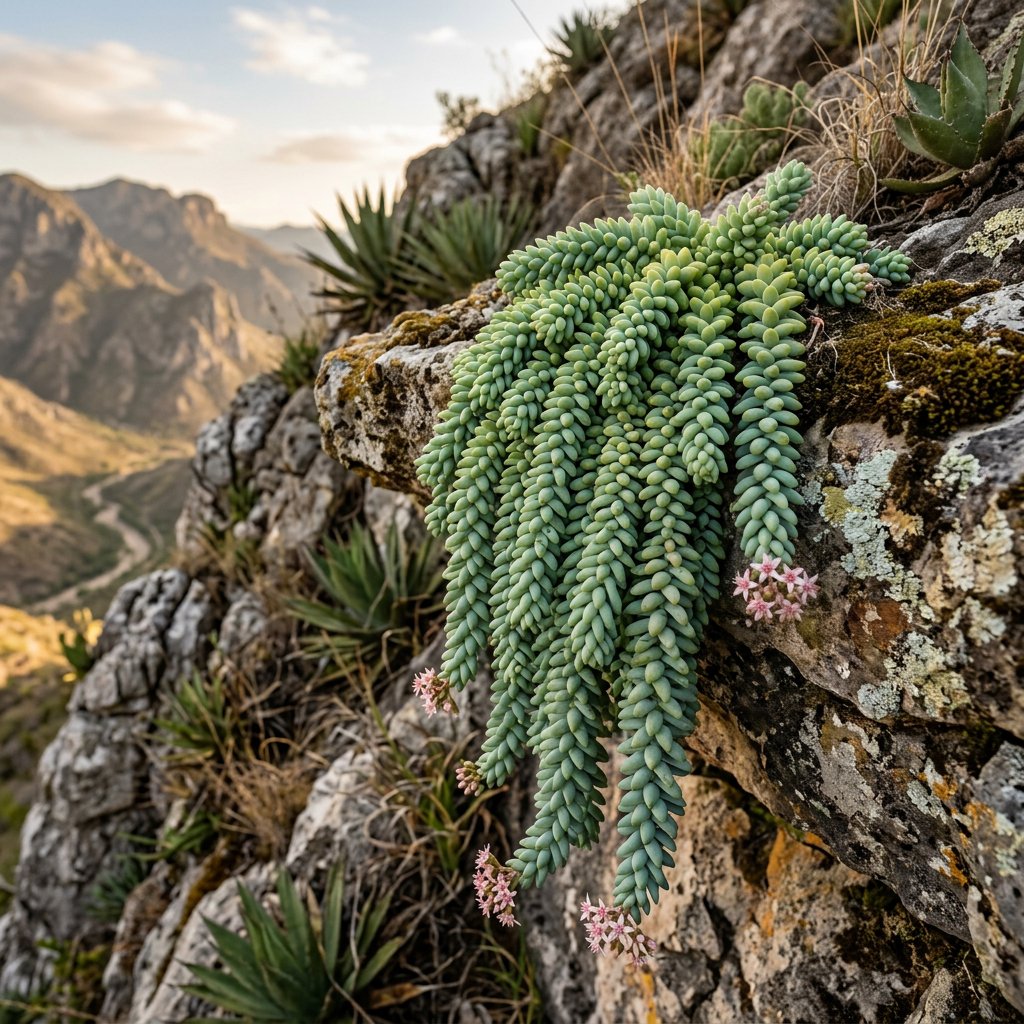
Often called the "Burro’s Tail" or "Donkey’s Tail," this Mexican native is the ultimate "waterfall" succulent. Its long, trailing stems are densely packed with plump, teardrop-shaped leaves that create a stunning architectural effect in hanging baskets. While it looks hardy, this plant is actually quite a delicate soul that prefers to be admired from a distance rather than handled.
🔍 How to Identify
- 🍃 Trailing Stems: Long, pendulous branches that can reach up to 4 feet in length, resembling a braided or beaded tail.
- 💧 Succulent Leaves: Fleshy, lance-shaped leaves coated in a powdery "farina" (wax) that gives them a soft, silvery-blue or pale green hue.
- 🌸 Star-Shaped Flowers: In late spring or summer, it may produce tiny, terminal clusters of pinkish-red blossoms at the very tips of the tails.
🏡 In Your Garden
- 👐 The "Look but Don't Touch" Rule: The most important thing to know is that the leaves are notoriously fragile; they will pop off at the slightest bump, making transplanting a slow and steady task.
- ☀️ Light Nuance: It thrives in bright, indirect light. While it loves the sun, intense afternoon rays can actually "sunburn" the leaves, turning them yellow or scorched.
- 🪴 Drought Strategy: Because those thick leaves are essentially water storage tanks, this plant is incredibly drought-tolerant but will rot instantly if its "feet" stay wet in heavy soil.
⚠️ Safety & Toxicity
- 🐾 Pet-Friendly: Great news for animal lovers—the Burro’s Tail is officially listed by the ASPCA as non-toxic to dogs, cats, and horses.
- 👶 Physical Fragility: While non-poisonous, the leaves fall off so easily that they can be a nuisance for curious toddlers who might try to eat the "jellybean" shaped leaves, posing a minor choking hazard.
✨ Fun Fact
- 🌵 Accidental Propagation: This plant has turned "clumsiness" into a survival trait. Because the leaves fall off so easily, in the wild, those dropped leaves quickly sprout roots where they land, creating a carpet of new baby clones around the mother plant.

Detailed Care Instructions
| Color | Red, White, Yellow |
| Soil Ph | Neutral To Acidic |
| Lighting | Part Sun |
| Toxicity | Non-Toxic |
| Soil Type | Loamy, Sandy |
| Bloom Time | Late Summer |
| Plant Type | Evergreen Succulent |
| Mature Size | 1–4 Ft. Long, 1–2 Ft. Wide |
| Native Area | North America |
| Sun Exposure | Full |
| Hardiness Zones | 10-11 |
To grow Sedum morganianum, or also called the donkey's tail or burro's tail plant, you can follow these steps:
- Choose a suitable pot: Select a pot with drainage holes at the bottom to prevent waterlogged soil, as this can cause root rot. A clay or terracotta pot is preferable as it will help with drainage.
- Soil: Select a well-draining soil mix specifically designed for cacti and succulents. Alternatively, you can mix regular potting soil with perlite or coarse sand to improve drainage.
- Lighting: Place the pot in a spot that receives bright, indirect sunlight. Sedums prefer bright light, but direct sunlight can scorch the leaves. A sunny windowsill or a spot outdoors with partial shade during the hottest hours of the day are ideal.
- Watering: Allow the soil to dry out between waterings. Overwatering is one of the common mistakes in caring for succulents. Sedums have thick leaves that store water, so they are drought-tolerant. Water deeply, allowing the excess water to drain out of the pot, and then wait until the soil is dry before watering again. Usually, it is better to underwater than to overwater.
- Humidity: Sedums prefer low humidity levels, so avoid placing them in very humid environments. Normal household humidity is usually acceptable.
- Temperature: Sedum morganianum prefers average room temperatures between 65-75°F (18-24°C). They can withstand slightly cooler temperatures, but avoid exposing them to frost or extreme cold.
- Fertilizer: Feed the plant with a balanced, diluted succulent fertilizer during the growing season (spring and summer) according to the instructions on the fertilizer package. Avoid fertilizing in winter when the plant is dormant.
- Propagation: Sedums are easy to propagate. You can propagate them by taking leaf or stem cuttings and placing them in a well-draining soil mix. Make sure to allow the cuttings to callus over before planting them. Once planted, water sparingly until they develop roots.
- Pruning: Sedum morganianum rarely requires pruning. However, if your plant becomes leggy or you want to control its size or shape, you can prune it back. Use clean, sharp scissors or pruning shears, and trim the stems to the desired length.
Remember to regularly inspect your Sedum morganianum for pests such as mealybugs or spider mites. If you notice any, treat them with an appropriate insecticidal soap or horticultural oil.
By following these guidelines, your Sedum morganianum should grow and thrive!

Place in a window with dappled sun or a spot in the middle of a room. Or directly in a window facing west or east.

To properly water this plant, you should first assess the soil by touching it to ensure that it has dried out completely. Once the soil is dry, take care to water the plant gently at the base, avoiding the leaves and stems as much as possible. It is important not to overwater the plant, as this can lead to root rot, but also not to let it dry out completely for long periods of time, as this can cause stress and damage to the plant. A good rule of thumb is to water thoroughly and then allow the soil to dry out completely before watering again. It is also important to use well-draining soil and a container with drainage holes to prevent water from pooling at the roots.
To fertilize this plant, it is recommended to use a balanced liquid fertilizer diluted to half strength. Apply the fertilizer once a month during the growing season, which is typically from spring to summer. Do not fertilize during the plant's dormant period, which is usually in winter. Be sure to water the plant thoroughly before and after fertilization to prevent the roots from being burned by the fertilizer.
The ideal soil for this plant is a well-draining and porous mixture that is both aerated and moisture-retentive. The soil should be slightly acidic, with a pH range of 6.0 to 6.5. This plant prefers a soil that is low in nutrients and organic matter. A recommended soil mix is a combination of coarse sand, perlite, and peat moss. This type of soil mix allows for good drainage and aeration, which helps prevent root rot and over-watering. It's important to avoid using heavy garden soils or compost, as they can retain too much water and cause the plants to suffer. Additionally, using a soil mix that is high in nutrients can cause excessive growth that may make the plant look leggy or spindly.
To propagate this plant, take a cutting from a healthy stem using clean, sharp pruning shears or scissors. The cutting should be approximately 3-4 inches long and have several sets of leaves. Remove the lower leaves from the cutting, leaving only the top few sets of leaves. Allow the cutting to dry and callus over for a few days, then place it in a small pot with well-draining soil. Water the cutting sparingly and place it in a bright, indirect light location. Keep the soil moist, but not waterlogged. After a few weeks, the cutting should begin to root and new growth will appear. Over time, the plant will grow and can be transferred to a larger pot or planted in a garden bed.








