Plant Overview
Known as the "Naked Stonecrop," Sedum nudum is a resilient little gem hailing from the sun-drenched, rocky cliffs of the Madeira archipelago. Unlike its fuzzier or more ornate cousins, this plant earns its name from its smooth, "bare" stems and waxy, minimalist foliage. It is a master of survival, evolved to cling to volcanic crevices while enduring salty Atlantic breezes and intense island sun.
🔍 How to Identify
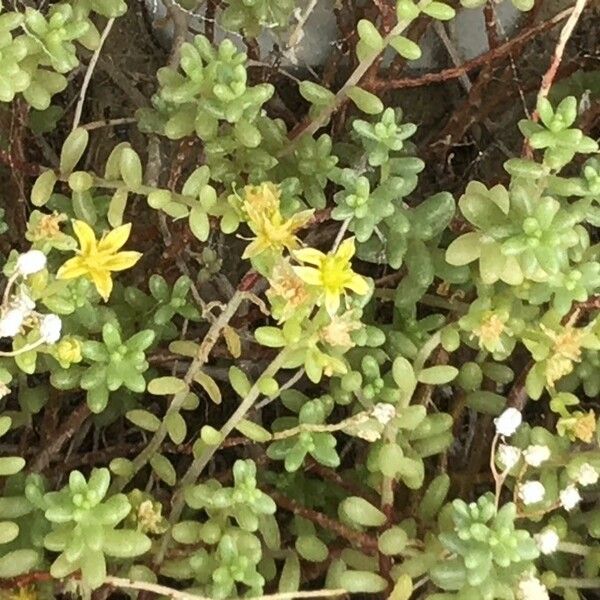
- 🍃 Fleshy Foliage: The leaves are small, cylindrical, and club-shaped, looking almost like tiny green jellybeans packed tightly along the stems.
- 🌿 Growth Habit: It forms low-growing, mounding shrubs that can eventually trail or spill over edges, with stems that turn slightly woody as they age.
- ⭐ Starry Blooms: During its flowering season, it produces clusters of vibrant, five-pointed yellow flowers that stand out brilliantly against its green backdrop.
🏡 In Your Garden
- 🌋 The Rock Star: Because it is a "lithophyte" (a plant that grows on rocks), it absolutely hates "wet feet." In a garden setting, it requires incredibly gritty, fast-draining soil—think of it as a desert plant trapped in an island body.
- ☀️ Sun-Kissed Colors: While it is naturally a deep, vibrant green, this Sedum has a hidden talent; when exposed to intense sun or slight cold "stress," the leaf tips often blush with beautiful bronze or reddish tints.
⚠️ Safety & Toxicity
- 🟢 General Safety: Sedum nudum is considered non-toxic to humans and most common household pets like cats and dogs.
- 👄 Mild Irritation: While not poisonous, the sap can occasionally cause mild skin irritation for those with sensitive skin, and if a curious pet eats a large amount, it may lead to a minor stomach upset. It is best kept as a decorative piece rather than a snack!
✨ Fun Fact
Sedum nudum is an "endemic" species, meaning it originally evolved and grew naturally nowhere else on Earth except for the Madeira Islands of Portugal. It is a living piece of Atlantic island history!

Detailed Care Instructions
To grow Sedum Nudum successfully, follow these guidelines:
- Choose a suitable location: Sedum Nudum thrives in full sun to partial shade. Ensure the selected area receives at least six hours of direct sunlight each day.
- Prepare the soil: This succulent thrives in well-draining soil with a slightly acidic to neutral pH. If the soil in your garden is heavy or clayey, work in organic matter like compost or peat moss to improve drainage.
- Planting: Dig a hole that is slightly wider and deeper than the root ball of the Sedum Nudum. Place the plant in the hole, ensuring it sits at the same depth as it was planted in the nursery pot. Backfill the hole with soil, gently firming it around the base of the plant.
- Watering: Initially, water the plant thoroughly after planting, and then water regularly until the roots are established. After that, Sedum Nudum is drought-tolerant and requires infrequent watering. Water deeply whenever the soil feels dry, usually every couple of weeks.
- Fertilization: Sedums, including Sedum Nudum, don't require much fertilization. However, you can give them a slow-release or balanced fertilizer in spring to encourage growth, following the instructions on the package.
- Pruning: Sedum Nudum generally doesn't require extensive pruning. However, if there are dead or damaged stems, you can trim them back using garden shears. Pruning can be done in late winter or early spring before new growth appears.
- Propagation: Sedum Nudum can be propagated through stem cuttings or division. To propagate through stem cuttings, select healthy stems, cut them about 2-3 inches long, and allow the cut ends to callus over for a day or two. Then, plant the cut ends in well-draining soil and keep them slightly moist until they root.
- Winter care: Sedum Nudum is hardy and can withstand cold temperatures. However, if you live in an area with extremely harsh winters, adding a layer of mulch around the base of the plant can help protect it from frost.
Follow these guidelines, and with proper care, you can enjoy the beautiful growth of your Sedum Nudum plant.
To water this particular species of plant, it is recommended to use the soak and dry method. This entails watering the plant until the soil is completely saturated, and then allowing it to dry out before watering again. This plant prefers well-draining soil, so it is important not to overwater and to ensure that the soil is not constantly moist. It is best to water this plant in the early morning or late afternoon to avoid evaporation and minimize water loss. Additionally, it is important not to get water on the leaves or stems of the plant, as this can lead to disease or rot.
For best results, fertilize this plant during the growing season, which typically ranges from spring to early fall. Use a balanced fertilizer with equal parts nitrogen, phosphorus, and potassium. Dilute the fertilizer with water according to the package instructions and apply it directly to the soil around the base of the plant. Avoid fertilizing the foliage as this can damage the plant. Use caution not to over-fertilize, as this can cause burning of the roots and harm the plant.
It is recommended to use a well-draining soil mixture for Sedum Nudum plant. The soil should be slightly alkaline with a pH between 6.5 and 7.5. The ideal soil mixture should include sand, perlite, and peat moss in equal parts. This will ensure that the soil is light and airy which will allow for good drainage and air circulation around the roots. Additionally, Sedum Nudum plant requires a soil that is rich in organic matter to provide the necessary nutrients for healthy growth. It is important to avoid using heavy clay soils that will become water-logged and retain too much moisture.
To propagate this particular plant, you will need to first identify a healthy stem or leaf node from the parent plant. Using sharp, sanitized pruning shears, carefully cut the stem or node at a 45 degree angle. Allow the cutting to dry out for several days in a cool and shaded location, until a callus forms over the cut end.
Next, prepare a potting mix of well-draining soil and perlite or sand, and moisten it slightly. Make a small hole in the soil and insert the callused end of the cutting, pressing gently to secure it in place. Water the cutting sparingly, keeping the soil slightly moist but not waterlogged.
Place the pot in a bright and indirect light location, avoiding direct sunlight. Maintain a consistent temperature between 60-75°F (15-23°C), and provide good air circulation. Over time, roots will begin to form and new growth will emerge from the top of the cutting. Once the new plant has established a strong root system and several sets of leaves, it can be transplanted into a larger container or outdoor garden location.








