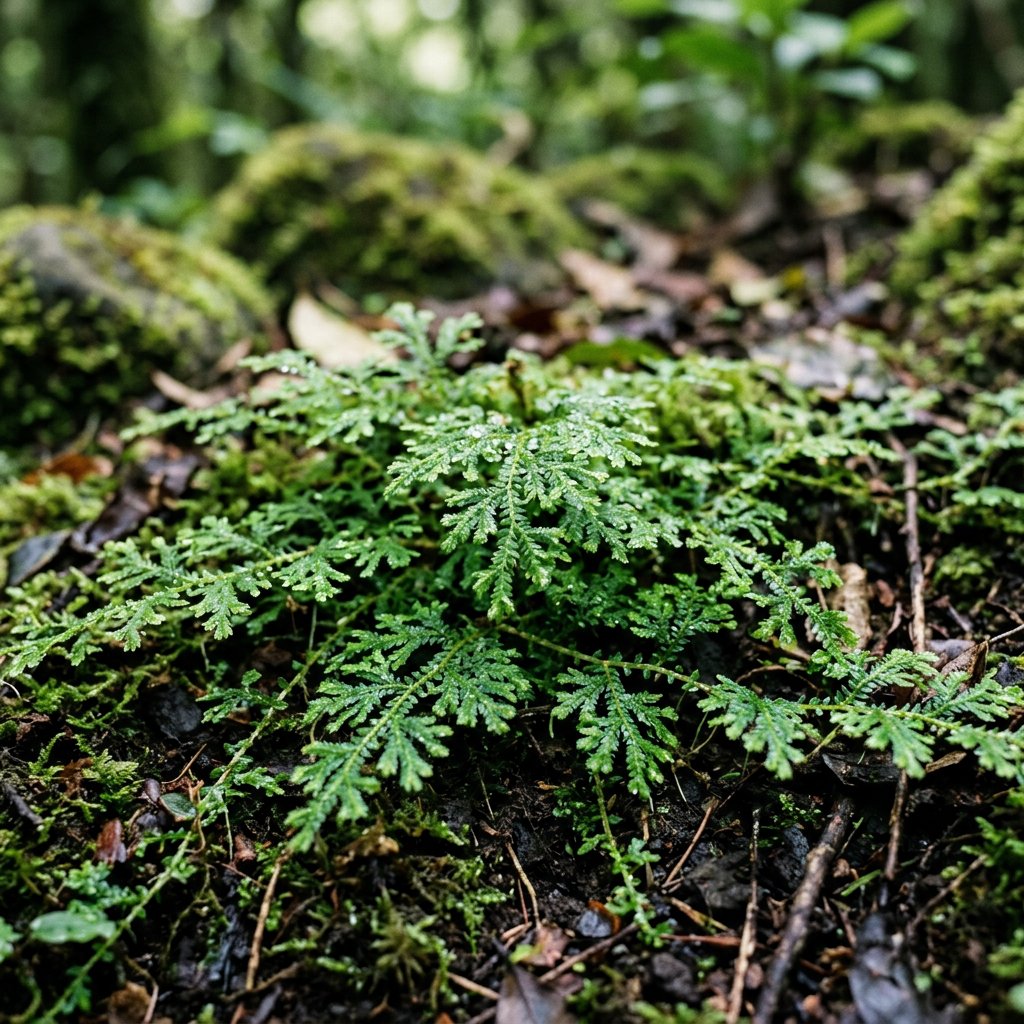
Plant Overview
Often called the "African Clubmoss" or "Trailing Spikemoss," this lush, mat-forming beauty looks like a delicate cross between a fern and a moss. Despite its soft appearance, it is a rugged survivor from a prehistoric lineage that predates the dinosaurs. In the home, it acts as a vibrant living carpet, perfect for adding a touch of ancient forest floor to your space.
🔍 How to Identify
- 🌿 The Foliage: Features tiny, scale-like leaves (microphylls) that are densely packed and arranged in four rows along the stems, giving it a lacy, intricate texture.
- 🌱 Growth Habit: A low-growing, creeping plant that "walks" across the soil. It sends out tiny root-like structures called rhizophores that anchor it as it spreads.
- 🧬 Reproduction: You won't find flowers here. As a "fern ally," it reproduces via microscopic spores tucked into cone-like structures at the tips of its branches.
🏡 In Your Garden
- 💧 The Humidity Requirement: This plant is often called a "humidity hog." Because its leaves are incredibly thin, it loses moisture rapidly. It is the gold standard for terrariums or humid bathrooms where the air mimics a misty tropical floor.
- 🪴 Sensitive Rooting: It possesses a very shallow root system. This is the "why" behind its care: it cannot tolerate drying out because it has no deep roots to seek out moisture reserves. If the top inch of soil dries, the plant may collapse quickly.
⚠️ Safety & Toxicity
- ✅ Non-Toxic Status: Selaginella kraussiana is generally considered safe and non-toxic for both curious cats and dogs, as well as humans.
- 🧤 Physical Fragility: While it isn't poisonous, it is physically delicate. High-traffic areas or spots where pets might tread can easily crush the brittle stems, so it’s best placed in a protected container or glass vessel.
✨ Fun Fact
- 🦖 An Ancient Ancestor: Selaginella is a "living fossil." It belongs to one of the oldest lineages of vascular plants on Earth, dating back over 400 million years. While today’s versions are small and creeping, their ancient ancestors grew into massive, scale-covered trees that dominated the coal swamps of the Carboniferous period!

Detailed Care Instructions
| Humidity | High |
| Invasive | Weed |
| Lighting | Part Sun |
| Difficulty | Hard |
| Temperature | 20°C - 27°C |
| Hardiness Zones | Min 6A |
To grow Selaginella Kraussiana, also known as Krauss's spikemoss or peacock moss, follow these steps:
- Choose the right conditions: Selaginella Kraussiana grows best in moderate to bright indirect light. Avoid direct sunlight, as it can scorch the leaves. The plant prefers a humid environment, so you can place it in a naturally moist area or use a pebble tray or humidifier to increase humidity.
- Select a suitable container: Use a well-draining container that has drainage holes at the bottom. This helps prevent overwatering and root rot.
- Prepare the potting mix: Selaginella Kraussiana prefers a slightly acidic soil mix that is rich in organic matter. You can use a combination of peat moss, perlite, and sand to create a well-draining mix.
- Planting: Place the Selaginella Kraussiana into the prepared pot, ensuring that the roots are covered, but the crowns (where the stems meet the roots) are slightly exposed. Gently press the soil around the plant to secure it.
- Watering: Keep the soil consistently moist, but not waterlogged. Allow the top inch of soil to dry out slightly before watering again. Overwatering can lead to root rot, while underwatering can cause the plant to dry out and wither.
- Fertilize: Selaginella Kraussiana doesn't require frequent fertilization, but you can use a balanced liquid fertilizer diluted to half the recommended strength once a month during the growing season (spring and summer).
- Pruning: Trim any dead or yellow foliage to maintain the plant's appearance and overall health.
- Propagation: Selaginella Kraussiana can be propagated by dividing the plant into smaller sections. Gently separate the sections at the roots and replant them in separate pots, ensuring they have adequate moisture.
Remember to regularly monitor your plant's growth and wellbeing, adjusting watering and lighting as needed. With proper care, your Selaginella Kraussiana should flourish and grow into a beautiful and vibrant plant.

Place in a window with dappled sun or a spot in the middle of a room. Or directly in a window facing west or east.

To provide adequate moisture for the Selaginella Kraussiana plant, one may want to use lukewarm or room temperature water in order to avoid shocking the plants with extreme temperatures. Watering should be done in moderate amounts, as over-watering can lead to root rot. The soil should be kept consistently moist, but not waterlogged, and any excess water should be drained away to prevent stagnation. One may also want to consider using a humidifier or misting the plant occasionally to increase humidity levels around the plant.
To fertilize this plant, mix a balanced, water-soluble fertilizer with water at half strength. Apply the solution to the soil every two weeks during the growing season, reducing frequency to once a month in the winter. Make sure to water the plant before and after fertilizing to prevent root burn. Avoid over-fertilization, as this can lead to toxicity and damage.
Selaginella Kraussiana plant prefers a well-draining potting mix that contains perlite and peat moss. The soil should be kept moist, but not excessively wet, as the plant prefers slightly acidic soil with a pH between 5.0 and 6.5. Avoid using heavy soils or those containing large amounts of clay, as these can lead to waterlogging and root rot. Additionally, adding fertilizer to the soil can help promote healthy growth, but it should be done sparingly and only during the plant's active growth periods.
Propagation of this plant is best done through division of its existing plant material. Beginning the process by preparing a suitable container with well-draining soil and filling it with water. Carefully remove the plant from its existing pot, taking caution not to jostle or damage the plant too much. Gently tease apart the roots of the plant with a clean utensil, being careful not to damage the plant tissue. Once the roots have been separated, they can be planted into the prepared container. Place the container in a bright area, but not in direct sunlight, and keep the soil moist while the new roots establish themselves. With the proper care and attention, the plant will flourish and produce a new generation of Selaginella Kraussiana.








