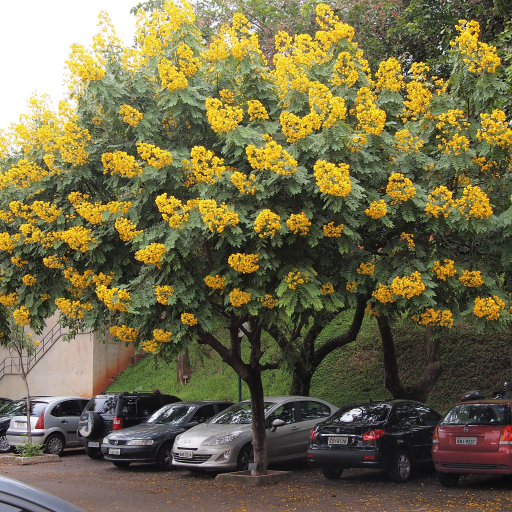
Plant Overview
Often called the Golden Wonder Tree, Senna spectabilis is a visual masterpiece that truly lives up to its name. Native to the tropical Americas, this fast-growing beauty is cherished for its umbrella-like canopy that virtually disappears under a blanket of sunshine-yellow blooms during the flowering season. It is a favorite for large landscapes where it acts as a vibrant, living sunbeam.
🔍 How to Identify
- 🌼 Floral Display: It produces massive, upright clusters (racemes) of bright yellow, five-petaled flowers that can reach nearly 2 feet in length.
- 🌿 Feathery Foliage: The leaves are "paripinnate," meaning they look like long, delicate green feathers composed of 10 to 15 pairs of narrow, oval leaflets.
- 🌳 Spreading Crown: It typically develops a low-branching, rounded shape that is often as wide as it is tall, providing deep, dappled shade.
🏡 In Your Garden
- ☀️ The Sun Factor: This tree is a dedicated sun-worshipper. To get that iconic "Golden Wonder" explosion of flowers, it must be placed in a spot that receives full, unobstructed sunlight.
- 🌬️ Brittle Beauty: Because it grows so rapidly, its wood can be somewhat soft and brittle. It’s best to plant it in a location protected from high winds to prevent branches from snapping during storms.
- 🌱 Root Room: It has a vigorous root system and a wide-reaching canopy. Avoid planting it too close to sidewalks or pipes, as it likes to claim its territory as it matures.
⚠️ Safety & Toxicity
- 🐾 Mildly Toxic: The seeds and pods contain anthraquinones, which act as a potent laxative. Keep an eye on curious dogs or toddlers who might be tempted by the fallen seed pods.
- 🧤 Skin Sensitivity: While not common, some gardeners may experience mild skin irritation when pruning the foliage; wearing gloves is a good precaution.
✨ Fun Fact
- 🦋 Butterfly Nursery: This tree is a primary "host plant" for many species of Sulphur butterflies. The butterflies lay their eggs on the leaves, and the resulting caterpillars are often the exact same shade of yellow as the flowers to help them hide from birds!

Detailed Care Instructions
To grow Senna spectabilis, also known as the cassia spectabilis or golden shower tree, follow these steps:
- Climate and location: Senna spectabilis thrives in tropical or subtropical regions and requires full sun exposure. Choose a location that receives ample sunlight throughout the day.
- Soil requirements: The plant prefers well-draining soil with a pH range of 5.5 to 7.5. Amend the soil with organic matter such as compost to improve drainage and nutrient content.
- Propagation: Senna spectabilis can be grown from seeds or cuttings. If using seeds, scarify them by gently rubbing them with sandpaper or soaking them in hot water for a few hours before planting.
- Planting: Dig a hole that is twice as wide and deep as the plant's root ball. Place the plant in the hole, ensuring that it is planted at the same depth it was in the container. Fill the hole with soil, firming it gently around the roots.
- Watering: Water the plant regularly, especially during the first few months after planting. However, avoid overwatering as this can lead to root rot. Allow the top few inches of soil to dry out between waterings.
- Fertilization: Feed the plant with a balanced, slow-release fertilizer once every spring. Follow the manufacturer's instructions for dosage and application methods.
- Pruning: Prune the plant in early spring or after flowering to maintain its shape and promote healthy growth. Remove dead, damaged, or overcrowded branches. Cutting back the plant by one-third can also help stimulate new growth and increase blooming.
- Pest and disease control: Senna spectabilis is generally resistant to pests and diseases, but occasional issues such as aphids or leaf spot may arise. If necessary, treat with appropriate insecticides or fungicides following label instructions.
- Mulching: Apply a layer of organic mulch around the base of the plant, keeping it a few inches away from the trunk. Mulching helps conserve moisture, inhibit weed growth, and maintain consistent soil temperature.
With proper care and maintenance, your Senna spectabilis plant should flourish and provide beautiful golden-yellow flowers.

Place in a bright room that is sun drenched almost all day. Or directly in a south-facing window.

To water this plant, make sure to check the soil moisture regularly by sticking your finger an inch deep into the soil. If the soil feels dry, it is time to water the plant. Slowly pour water at the base of the plant until the soil is moist but not waterlogged. Make sure there is proper drainage in the pot or planting area to prevent water buildup. Avoid overwatering as it can lead to root rot and other diseases. In addition, during the winter season when the plant goes dormant, reduce watering frequency to allow the plant to rest.
To fertilize Senna Spectabilis, provide a balanced fertilizer with equal amounts of nitrogen, phosphorus, and potassium. Apply the fertilizer in early spring before planting or in late fall after leaves turn yellow. Avoid over-fertilization, as it can cause damage to the plant. Water the plant deeply after fertilization to help the nutrients absorb into the soil.
When planting this particular plant, it is important to use well-draining soil that is slightly acidic with a pH between 5.5 and 6.5. The soil should also be rich in organic matter and have a good balance of nutrients. It is recommended to mix in some compost or other organic material before planting. Additionally, ensure that the soil is loose and allows for good airflow to the root system. It is considered a good idea to choose a site that has full sunlight to partial shade for optimal growth.
To propagate this particular plant, it is important to gather fresh seeds from the plant. The seeds should be processed by removing the outer casing and drying in a cool and dry area. Once the seeds are dry, they can be sown into well-draining soil and kept in a warm and moist environment to encourage germination. The seedlings should be watered regularly and kept in a sunny area to promote growth. Once mature enough, the new plants can be transplanted into their desired location.








