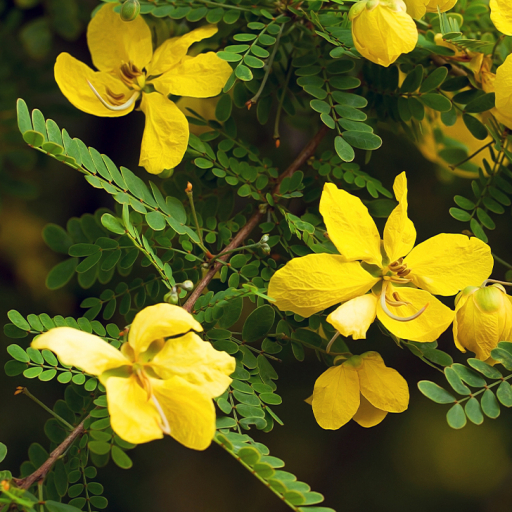
Plant Overview
Known as the "Golden Wonder" of the legume family, Senna plants are celebrated for their brilliant butter-yellow blossoms and feathery, tropical-looking foliage. From the towering "Candlestick Plant" to the whimsical "Popcorn Cassia," these sun-loving shrubs are more than just pretty faces; they have been prized for centuries in traditional medicine and are vital players in the life cycles of many beloved butterflies.
🔍 How to Identify
- 🌼 Sunny Blooms: Look for five-petaled, cup-shaped flowers that usually appear in dense, upright clusters. The color is almost always a vibrant, saturated yellow.
- 🌿 Pinnate Leaves: The foliage is "pinnately compound," meaning small oval leaflets grow in pairs along a central stem, creating a delicate, ladder-like appearance.
- 🫛 Seed Pods: As members of the pea family, they produce long, flat, or cylindrical green pods that eventually turn brown and brittle as they mature.
🏡 In Your Garden
- 🦋 Butterfly Magnet: Senna is the primary "host plant" for several species of Sulphur butterflies. If you see small green caterpillars munching on the leaves, don't reach for the pesticide—they are the future yellow butterflies of your garden!
- ☀️ Sun Seeker: These plants have a high metabolic rate and require full sun to produce their iconic flowers. They are famously drought-tolerant once established, making them perfect for xeriscaping or low-maintenance borders.
- 🌱 Soil Improver: Like many legumes, Senna has a symbiotic relationship with soil bacteria that allows it to "fix" nitrogen. This means it actually improves the soil quality for neighboring plants as it grows.
⚠️ Safety & Toxicity
- 🐕 Pet Warning: Senna contains compounds called anthraquinones (sennosides). If ingested by dogs, cats, or horses, it can cause significant gastrointestinal distress, including vomiting and diarrhea.
- 👶 Human Caution: While Senna is used in regulated over-the-counter laxatives, the raw plant parts should never be consumed. Contact with the sap may also cause mild skin irritation in sensitive individuals.
✨ Fun Fact
One specific variety, Senna didymobotrya, is nicknamed the "Popcorn Cassia" because its foliage smells exactly like hot, buttery popcorn when you gently rub the leaves between your fingers!

Detailed Care Instructions
To grow Senna plants, follow these steps:
- Choose a suitable location: Senna plants prefer full sun, so select a spot in your garden that receives at least 6-8 hours of direct sunlight each day. Ensure the soil is well-draining.
- Prepare the soil: Senna plants can thrive in a range of soil types but prefer slightly acidic to neutral soil. Loosen the soil by tilling it to a depth of 8-10 inches and remove any weeds or grass from the area.
- Sow the seeds: Senna plants can be grown from seeds or propagated from cuttings. If using seeds, sow them directly into the prepared soil, about 1/4 inch deep, and space them about 6-12 inches apart. If propagating from a cutting, take a 4-6 inch cutting from a healthy Senna plant and plant it in well-draining soil, ensuring that at least two leaf nodes are below the soil.
- Watering: Water the newly planted seeds or cuttings gently but thoroughly until the soil is evenly moist. Water the plants regularly, allowing the soil to slightly dry out between waterings. Avoid overwatering, as Senna plants can be prone to root rot.
- Fertilizing: Apply a balanced fertilizer once a month during the growing season, following the package instructions. This will help provide the necessary nutrients for healthy growth.
- Pruning: Prune the Senna plant in early spring to remove dead or damaged branches and promote bushier growth. You can also shape the plant to your desired size or form.
- Pests and diseases: Senna plants are generally resistant to pests and diseases. However, keep an eye out for aphids, caterpillars, or mealybugs, and take appropriate measures to control them if necessary.
- Harvesting: If you want to harvest the leaves or seeds for medicinal or culinary purposes, wait until the plant is mature (usually after 2-3 years). Harvest the leaves in the morning when the essential oils are most potent, and allow them to dry before use.
Remember to check the specific care requirements for the particular Senna plant variety you are growing, as some variations may have slightly different preferences.

Place in a bright room that is sun drenched almost all day. Or directly in a south-facing window.

The best way to water this particular plant is to thoroughly drench the soil in the pot until water starts to drain out of the bottom. This will ensure that the roots receive an adequate amount of moisture without drowning the plant. It's important to avoid allowing the soil to completely dry out between waterings, as this can stress the plant and stunt its growth. However, over-watering can also be detrimental, so it's important to strike a balance and only water when the top inch of soil feels dry to the touch. Additionally, it's best to avoid getting water on the leaves or stem of the plant, as this can promote fungal growth. Instead, aim to water directly at the base of the plant.
To fertilize this plant, you should first ensure that it is planted in well-draining soil. Then, apply a balanced fertilizer with equal N-P-K ratios and micronutrients, once a month during the growing season (spring and summer) and once every two months during the dormant season (fall and winter). Avoid over-fertilizing or using fertilizer with high nitrogen content as it can lead to excessive growth and diminish flowering. Water the plant deeply after applying the fertilizer, and avoid getting it on the foliage to prevent burning.
When growing a certain plant from the genus Senna, it is important to choose the appropriate soil. This type of plant prefers well-draining and fertile soil. A soil mixture with high organic matter content is recommended as it promotes healthy root growth and overall plant vigor. The pH level of the soil should be slightly acidic, with a range of 6.0-7.5. This helps ensure optimal nutrient uptake and reduces the risk of disease. It is also important to avoid soil that is too heavy or compacted, as this can cause poor drainage and hinder the growth of the plant. In summary, when selecting soil for a Senna plant, it is best to choose a well-draining, fertile, and slightly acidic soil mix with high organic matter content.
Propagation of this plant can be done through a variety of methods such as seed propagation, stem cuttings, and division of existing plants. For seed propagation, remove the seeds from the matured pods and soak them overnight in warm water. Sow the seeds in a mixture of compost and sand, keeping it moist and warm to encourage germination.
For stem cuttings, take a healthy stem with a few leaves and remove any lower leaves. Dip the cut end in rooting hormone and plant in a well-draining potting mix. Keep the soil moist and the cutting in a warm, humid environment until roots form.
Division of existing plants involves separating the roots and shoots of an established plant into smaller sections. This can be done in the early spring or fall, when the plant is dormant. Carefully dig up the plant and use a sharp knife to separate the sections, making sure each section has a healthy root system. Plant each section in a well-draining potting mix and keep the soil moist until new growth appears.







