Plant Overview
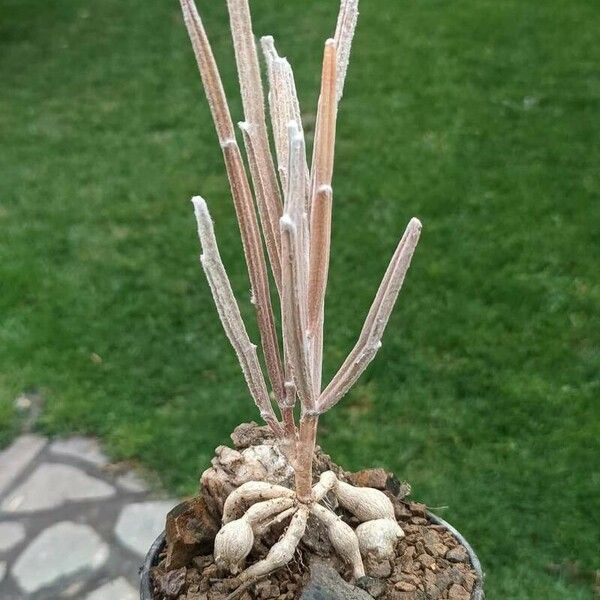
Hailing from the dry thickets of Madagascar, Seyrigia humbertii looks less like a living plant and more like a collection of ghostly, silver-dusted pipe cleaners. Often called the "Silver Medusa," this extraordinary succulent belongs to the cucumber family (Cucurbitaceae), though it has traded juicy fruits and broad leaves for a bizarre, leafless life in the desert sun.
🔍 How to Identify
- ⬜ Velvety Stems: The most striking feature is its square-shaped, silver-white stems. This "felted" texture is actually a dense layer of tiny hairs that protect the plant from intense UV rays.
- 🍃 Ephemeral Leaves: It technically has leaves, but they are microscopic and fall off almost immediately to prevent water loss, leaving the stems to do all the photosynthesis.
- 🌼 Tiny Blooms: In the right conditions, it produces very small, yellowish-green flowers that emerge from the corners of its angular stems.
🏡 In Your Garden
- 🧗 A Natural Climber: While it can sprawl across the ground, Seyrigia humbertii loves to climb. In its natural habitat, it weaves through shrubs. At home, providing a small trellis or allowing it to trail from a hanging basket mimics its wild behavior.
- 💧 The "Less is More" Rule: Because it comes from arid regions, it has a very shallow root system and is highly prone to rot. It thrives in gritty, cactus-mix soil and needs to dry out completely between waterings—think of it as a desert survivor, not a tropical vine.
⚠️ Safety & Toxicity
- 🟢 Generally Safe: Seyrigia humbertii is not known to be toxic to humans or common household pets like cats and dogs.
- 🧤 Skin Sensitivity: While not poisonous, the fine white hairs (trichomes) on the stems can sometimes cause mild skin irritation for people with very sensitive skin if handled excessively. It is always best to wash your hands after pruning.
✨ Fun Fact
Despite its alien, cactus-like appearance, this plant is a distant cousin of the Watermelon and the Pumpkin! It is a "caudiciform" plant, meaning it can develop a thick, woody base or underground tuber to store water during long Madagascan droughts.

Detailed Care Instructions








