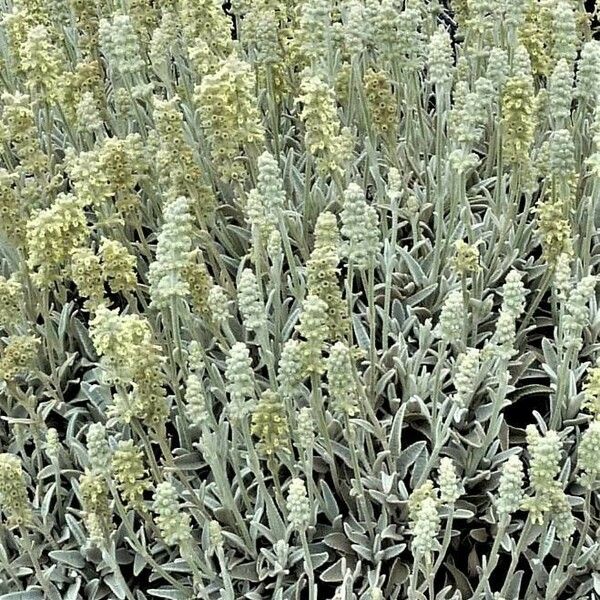
Plant Overview
Commonly known as Chahorra de Cumbre or "Gran Canaria Mountain Tea," this silvery shrub is a hardy survivor of high volcanic ridges. It belongs to the legendary Sideritis genus, famous throughout the Mediterranean as "Ironwort," used for centuries in traditional herbal infusions. Endemic to the Canary Islands, this specific variety looks more like a soft, grounded cloud than a typical garden plant, having adapted perfectly to the intense sun and wind of the mountains.
🔍 How to Identify
- ☁️ Woolly Foliage: The leaves and stems are densely covered in soft, white-to-grey "felted" hairs, giving the plant a distinct velvety or silvery-white appearance.
- 📏 Growth Habit: It grows as a woody sub-shrub, forming a compact, rounded mound that usually stays under 3 feet (1 meter) in height.
- 🌼 Flower Spikes: In late spring, it sends up vertical flowering stalks. The tiny, pale yellow or cream-colored flowers are tucked away inside protective, hairy bracts that look like stacked little cups.
🏡 In Your Garden
- 🌋 The Volcanic Preference: In the wild, this plant thrives in rocky, nutrient-poor volcanic soil. In a garden setting, it hates "wet feet." It requires exceptionally well-draining soil—think cactus mix or a rock garden setup—to prevent root rot.
- ☀️ Sun and Silver: The silver "fuzz" on the leaves acts like a natural sunscreen. To keep that beautiful metallic luster, it needs full, direct sun. In the shade, the plant will turn a dull green and lose its compact, attractive shape.
- 🌬️ Air Circulation: Because it is a mountain native, it loves breezy spots. High humidity or stagnant air can lead to fungal issues within its dense, woolly foliage.
⚠️ Safety & Toxicity
- ✅ Status: Generally non-toxic and historically significant.
- 🍵 Human Use: Related species are widely used for "Mountain Tea" (Shepherd's Tea). While Sideritis dasygnaphala has been used in local folk medicine for respiratory or digestive comfort, you should never consume wild-harvested plants without expert confirmation.
- 🐾 Pets and Kids: There are no recorded toxicities for cats, dogs, or horses. However, the fibrous and woolly texture of the leaves might cause mild mouth irritation or an upset stomach if a large amount is chewed.
✨ Fun Fact
The genus name Sideritis comes from the Greek word for "iron." In ancient times, plants in this family were believed to be a miraculous cure for wounds caused by iron weapons, such as swords and spears, earned on the battlefield!

Detailed Care Instructions
To water this plant, one should ensure that the soil is thoroughly dry before watering. This can be determined by sticking a finger about an inch into the soil. If it feels dry, it is time to water. The plant should be watered until the water runs out of the drainage holes at the bottom of the pot. It is important not to let the plant sit in standing water as this can lead to root rot. Additionally, this plant prefers to be watered from the bottom rather than from the top. This can be achieved by placing the plant in a tray filled with water and allowing the water to be absorbed through the drainage holes. It is important to only water this plant when it needs it, as overwatering can harm the plant.
The ideal soil for Sideritis Dasygnaphala plant is a well-draining mix that is rich in organic matter. It should have a slightly acidic to neutral pH level and be able to retain moisture without becoming waterlogged. A mix of equal parts perlite, peat moss, and coarse sand will provide the right balance of drainage and moisture retention. It is also important to ensure that the soil is free of any contaminants such as pesticides or chemicals, as the plant is sensitive to these substances.








