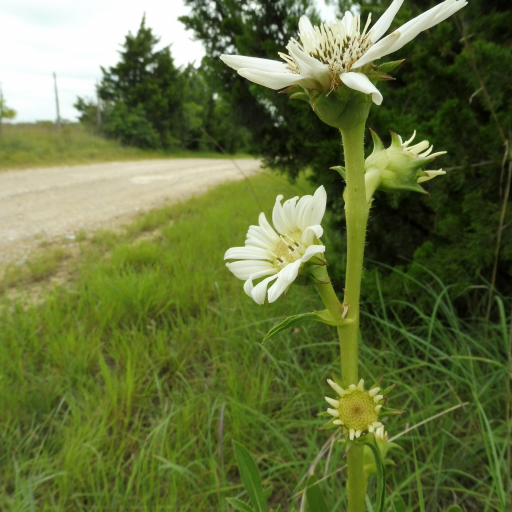
Plant Overview
Known as the White Rosinweed, this Texas native is a striking outlier in the Silphium family. While most of its cousins flaunt sunny yellow petals, this rugged perennial produces creamy white blooms that look like glowing stars against the prairie grass. It is a symbol of the untamed Southern plains, built to survive extreme heat and drought where more delicate flowers would quickly wither.
🔍 How to Identify
- ⚪ The Blooms: Large, sunflower-like flowers with creamy white ray petals surrounding a dense yellow center. They typically bloom in early to mid-summer.
- 🍃 Leathery Leaves: The leaves are deeply lobed and incredibly stiff. They have a distinctive "pinnatifid" shape, meaning they are cut almost to the midrib, looking somewhat like giant, rigid snowflakes.
- 🌵 Sandpaper Texture: Both the stems and leaves are covered in stiff, bristly hairs. Touching them feels exactly like running your hand over high-grit sandpaper.
🏡 In Your Garden
- 🏗️ The Deep Anchor: This plant is famous for its massive taproot, which can extend several feet into the earth. Because of this, it is nearly impossible to transplant once established. Choose its "forever home" carefully!
- 🪨 Limestone Lover: It thrives in rocky, alkaline, or clay-heavy soils where other plants struggle. It is a champion of "tough love" gardening—the less you fuss over it, the better it performs.
- 🦋 Pollinator Magnet: While it’s a slow grower (often taking a few years to produce its first flowers), it is a high-value target for native bees, butterflies, and even birds who enjoy the oil-rich seeds in autumn.
⚠️ Safety & Toxicity
- ✅ Non-Toxic: Silphium albiflorum is generally considered non-toxic to humans, dogs, and cats.
- 🧤 Skin Irritation: The primary safety concern is its texture. The "hispid" (stiff) hairs can cause mechanical irritation or tiny scratches on sensitive skin. It is best to wear gardening gloves when pruning or handling the foliage.
✨ Fun Fact
The name "Rosinweed" comes from the thick, resinous sap found inside the stems. Historically, both Native Americans and early pioneers used the dried, hardened clumps of this resin as a natural chewing gum to clean teeth and sweeten breath!

Detailed Care Instructions
To grow Silphium albiflorum, also known as white rosinweed, you can follow these steps:
- Choose a suitable location: Silphium albiflorum prefers full sun to partial shade. Choose a location in your garden that receives at least 6-8 hours of direct sunlight daily.
- Prepare the soil: Silphium albiflorum thrives in well-draining soil. Amend the soil by adding compost or well-rotted organic matter to improve drainage and fertility.
- Start from seeds: You can start Silphium albiflorum plants from seeds. Stratify the seeds by chilling them in the refrigerator for 2-4 weeks before sowing. Sow the seeds directly into the prepared soil in the spring, after the last frost date. Lightly cover the seeds with soil, as they need light to germinate.
- Watering: Water the seeds and young plants regularly to keep the soil consistently moist but not soaked. Once established, Silphium albiflorum is relatively drought-tolerant and can withstand some periods of dryness.
- Maintenance: Silphium albiflorum is a hardy plant and requires minimal care. Remove any weeds that may compete for nutrients and water. Since it grows tall, staking may be necessary to prevent stem breakage in windy areas.
- Finishing touches: Silphium albiflorum produces attractive yellow flowers in late summer. Enjoy the blooms and consider leaving them during the winter for wildlife to feed on the seeds. You can also deadhead the spent flowers to encourage prolonged blooming.
Remember to check your local regulations before collecting or sowing seeds of native plants to ensure you are not violating any laws or regulations regarding seed collection.

Place in a bright room that is sun drenched almost all day. Or directly in a south-facing window.

To water this plant, it is recommended to use a watering can or a hose with a gentle spray nozzle. Before watering, it is important to check the soil moisture level by sticking a finger about 2 inches into the soil. If the soil feels dry, it is time to water. Make sure to water around the base of the plant, avoiding getting water on the leaves or flowers. Water deeply, allowing the water to penetrate the soil and reach the roots. It is essential not to overwater as it can lead to root rot. The frequency of watering depends on the plant's environment and the weather conditions. In general, it is better to water deeply and less frequently than to water shallowly and frequently.
For best results, apply a balanced, slow-release fertilizer in the early spring before new growth emerges. Follow the instructions on the fertilizer package for application rates. Water the plant thoroughly after fertilizing to help distribute the nutrients. Avoid over-fertilization, which can lead to weak growth and disease susceptibility.
Silphium Albiflorum is a plant that requires well-draining soil to thrive. The ideal soil for this plant is a mixture of organic matter and a sandy loam soil. The pH level of the soil should be between 6.0 and 7.0. The plant prefers soils that are slightly acidic to slightly alkaline. The soil should be moist but not waterlogged, and it should not be allowed to completely dry out between watering. The plant does not tolerate heavy or clay soils, as they do not drain well and can lead to root rot. Adding organic matter to the soil can improve its drainage and water-holding capacity, which is important for the health and vitality of the plant.
Silphium Albiflorum can be propagated in a few different ways. One method is by collecting the seeds from the plant when they have matured. The seeds can then be planted in a well-draining soil mix and kept moist until they germinate.
Another method is by dividing the plant, which involves digging up the parent plant and separating the roots into smaller sections with a sharp tool. Each section should have at least a few healthy roots and some green growth. The divided sections can then be planted in their own pots or directly into the soil.
Silphium Albiflorum can also be propagated through stem cuttings. Choose a healthy stem and cut it at an angle with clean, sharp scissors. Remove any leaves from the lower portion of the stem and dip the cut end into rooting hormone. Place the cutting into a well-draining soil mix and keep it moist until roots begin to develop.
Propagation should be done in the spring or fall when the plant is actively growing. It is important to keep newly propagated plants well-watered and protected from excessive sunlight until they establish themselves.








