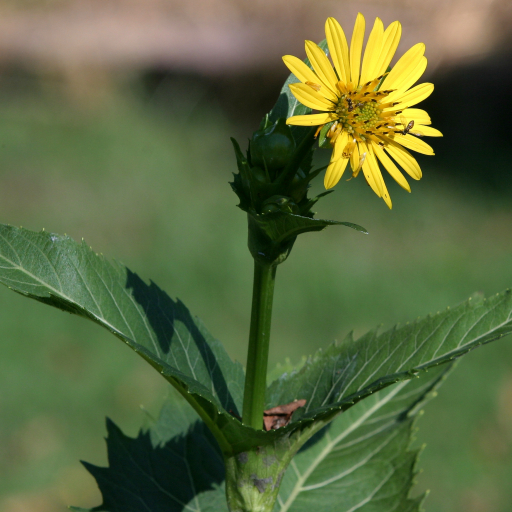
Plant Overview
The Cup Plant (Silphium perfoliatum) is a true giant of the North American prairie, often towering over its neighbors at heights of up to eight feet. It earned its common name from its most distinctive architectural feature: pairs of leaves that join together to form a literal "cup" around the central stem. This natural reservoir catches rainwater, providing a vital watering station for birds and insects during the heat of summer.
🔍 How to Identify
- 🥤 The Water Cup: Large, triangular leaves grow in opposite pairs and are fused at the base, creating a basin that can hold several tablespoons of water.
- 🟦 Square Stems: If you run your fingers along the main stalk, you’ll notice it is remarkably sturdy and distinctly four-sided (square), rather than round.
- 🌻 Sunny Blooms: The plant produces numerous bright yellow flowers that resemble small sunflowers or daisies, typically appearing from mid-summer to early autumn.
🏡 In Your Garden
- 🏗️ Back-of-Border Giant: Because of its immense height and coarse texture, this plant is best suited for the very back of a garden bed or as a natural living fence. It needs plenty of room to spread.
- 🦋 Pollinator Magnet: It is an ecological powerhouse, attracting everything from tiny sweat bees to majestic Monarch butterflies. Goldfinches are also frequent visitors, as they love to feast on the ripening seeds.
- ⚓ Deep Roots: Once established, it develops a massive taproot that makes it incredibly drought-tolerant but very difficult to move. Choose its "forever home" carefully!
⚠️ Safety & Toxicity
- ✅ Status: Generally non-toxic to humans, dogs, and cats.
- 🧤 Skin Irritation: The leaves and stems are covered in tiny, stiff hairs that feel like sandpaper. While not poisonous, handling the plant without gloves can cause mild skin redness or "grass burns" on sensitive skin.
✨ Fun Fact
Native American tribes once used the dried resin from the stems as a natural chewing gum. It was prized for its ability to clean teeth and freshen breath, much like a prehistoric version of peppermint gum!

Detailed Care Instructions
Cup plants are native to the United States, so they are not technically invasive. They are vigorous growers, though, and they will tend to overtake areas of your landscape, including smaller plants, if not kept in check.
How tall do cup plants get?
Cup plants can grow as tall as 8 feet, making them a candidate for landscape edges, fence lines, or borders behind smaller plants.
Are cup plants good for pollinators?
Yes—like sunflowers, cup plants attract all sorts of pollinators like butterflies, bees, and moths. The flowers also hold water like little cups, so birds also come to cup plants to drink.
To grow Silphium Perfoliatum, also known as cup plant or Indian cup, you can follow these steps:
- Choose the right location: Silphium Perfoliatum prefers full sun but can tolerate some shade. Select a spot in your garden with well-draining soil.
- Prepare the soil: Loosen the soil and remove any weeds or grass from the planting area. Enrich the soil with compost or organic matter to improve fertility and drainage.
- Plant the seeds: You can start Silphium Perfoliatum from seeds directly in the garden or indoor seed trays several weeks before the last frost. Plant the seeds about 1/4 to 1/2 inch deep and spaced about 12 to 18 inches apart. Water gently after planting.
- Watering and maintenance: Keep the soil consistently moist but not waterlogged until the seedlings emerge. Once established, Silphium Perfoliatum is relatively drought-tolerant. Water deeply when the top few inches of soil feel dry. Mulching around the plants can help conserve moisture and suppress weed growth.
- Fertilization: Silphium Perfoliatum generally does not require much additional fertilization. However, you can apply a balanced, slow-release fertilizer in early spring if desired.
- Support: As the plant grows, it can reach heights of 4-10 feet. You may need to provide support, such as stakes or a trellis, to prevent the tall stems from falling over in strong winds.
- Pruning: If the plant gets too tall or starts to sprawl, you can prune it to maintain a desired shape and size. Pruning is best done in early spring before new growth begins.
- Pests and diseases: Silphium Perfoliatum is generally resistant to pests and diseases. However, occasionally, it may attract aphids or slugs. Monitor the plant regularly and treat any infestations promptly.
- Propagation: Silphium Perfoliatum can also be propagated by division. Dig up the plant in early spring and carefully separate the clumps into smaller sections. Replant the divisions, and they should establish themselves quickly.
- Enjoy the blooms: Silphium Perfoliatum produces vibrant yellow flowers that are attractive to pollinators like bees and butterflies. Enjoy the beautiful blooms and the wildlife they attract.
Remember to check your local gardening zone to ensure Silphium Perfoliatum is well-suited to your climate and to adjust the planting and care schedule accordingly.

Place in a bright room that is sun drenched almost all day. Or directly in a south-facing window.

Silphium Perfoliatum is a perennial plant that requires regular watering to thrive. When watering this plant, it is important to ensure that the soil is moist but not waterlogged. Watering should be done deeply and infrequently, rather than frequently and shallowly.
To water Silphium Perfoliatum, begin by checking the soil moisture level – inserting a finger at least an inch deep into the soil can help determine how dry it is. Water the plant thoroughly if the top inch of soil is dry to the touch. When watering, apply water slowly and evenly over the entire root zone of the plant, being careful not to let water pool around the base of the stem.
During hot weather or prolonged dry spells, Silphium Perfoliatum may require additional watering to prevent stress or wilting. Keep in mind that the frequency of watering may depend on the soil type, drainage, and overall growing conditions. As a general rule of thumb, Silphium Perfoliatum should be watered deeply once a week, or more often if necessary.
Finally, it is worth noting that Silphium Perfoliatum is a plant that can tolerate some drought, so be careful not to overwater it as this can lead to root rot or other issues. By following these basic watering guidelines, Silphium Perfoliatum can thrive and produce vibrant flowers throughout the growing season.
For best results with this plant, fertilize it in the spring before it starts actively growing, and then again in mid-summer. Use a general-purpose fertilizer with equal parts nitrogen, phosphorus, and potassium. Be sure to follow the instructions on the fertilizer package, and don't over-fertilize. Too much fertilizer can cause the plant to become too lush and floppy, and can reduce its hardiness.
When planting Silphium perfoliatum, it is recommended to use well-draining soil that is rich in organic matter. The ideal soil pH should be slightly acidic to neutral, ranging from 6.0 to 7.5. The soil should be moist but not waterlogged, so it is important to ensure proper drainage. Silphium perfoliatum can tolerate a wide range of soil types, including sand, loam, and clay, as long as it is not compacted. It is best to avoid heavy clay soil, as it may cause root rot. It is recommended to amend the soil with compost or well-rotted manure before planting, to provide additional nutrients to the plant. Adequate soil preparation and replenishment will lead to healthy growth and luxurious flowering of Silphium perfoliatum.
Here is a detailed explanation on how to propagate Silphium Perfoliatum plant without using its common names:
Silphium Perfoliatum is a hardy perennial plant that belongs to the Asteraceae family. It is well-known for its yellow flowers that attract bees and butterflies. Propagating Silphium Perfoliatum can be done through division or seeds.
To propagate Silphium Perfoliatum through division, you will need to follow these steps:
- Choose a healthy and well-established plant to divide. It is best to do this in the fall or early spring when the plant is dormant.
- Dig up the entire plant and gently shake off any excess soil to expose the roots.
- Use a sharp, sterile knife to cut the root ball into sections. Each section should have several stems and a good amount of roots.
- Replant each section in a new location, making sure to space them apart to allow room for growth.
- Water the newly planted sections well and continue to water them regularly until they are established.
To propagate Silphium Perfoliatum through seeds, you will need to follow these steps:
- Collect the seeds from a mature plant in the fall after the flower heads have dried and turned brown.
- Store the seeds in a cool, dry place until the following spring.
- In the early spring, sow the seeds in a prepared garden bed or in seed-starting containers indoors.
- Cover the seeds with a thin layer of soil and water them lightly.
- Keep the soil moist and warm until the seeds germinate, which can take up to two weeks.
- Once the seedlings are a few inches tall, transplant them to a new location in the garden or into individual pots.
- Continue to water the young plants regularly until they are established.
Common pests of the cup plant include Spider mites, aphids, thrips, whiteflies. Make a habit of checking your cup plant frequently for pests so that any infestations can be caught and managed early.








