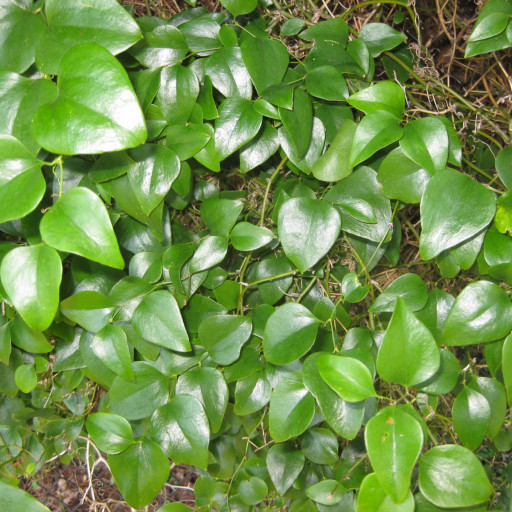
Plant Overview
Known as the "Catbrier" or "Common Greenbrier," Smilax rotundifolia is the architect of the impenetrable thicket. This native North American vine is both a hiker’s nemesis and a songbird's best friend. While its sturdy thorns are legendary for snagging denim, its glossy, heart-shaped leaves and deep blue berries provide essential winter charm and wildlife support.
🔍 How to Identify
- 🍃 Leaf Texture: The leaves are famously glossy, leathery, and heart-shaped to nearly circular, featuring prominent parallel veins that run from the base to the tip.
- ⚔️ The Prickles: Unlike roses, these "thorns" are technically prickles—stout, sharp, and green-tipped, scattered along a zig-zagging woody stem.
- 🫐 Fruit Clusters: In autumn, female plants produce tight clusters of small, waxy, blue-black berries that often stay on the vine throughout the winter.
🏡 In Your Garden
- 🧗 The Climbing Habit: It uses paired tendrils (looking like curly telephone wires) to hitchhike up trees and fences. In a wilder garden, it provides an excellent "living fence" for privacy and security.
- 🍠 The Underground Fortress: This plant grows from massive, starchy woody tubers buried deep underground. If you try to remove it by simply cutting the vine, it will likely "resurrect" itself within weeks; true removal requires digging up the heavy rootstock.
⚠️ Safety & Toxicity
- 🩹 Physical Hazard: The primary danger is the sharp prickles. Always wear heavy-duty leather gloves when pruning, as the thorns can easily pierce standard gardening gloves and cause painful scratches.
- 🐾 Pet Safety: The plant is generally considered non-toxic to cats and dogs, though the sharp thorns can cause oral or skin injuries if a pet tries to run through or chew on the stems.
- 🫐 Berry Warning: While not known to be deadly, the berries are not considered palatable for humans and may cause mild digestive upset if eaten.
✨ Fun Fact
🥤 The Original Root Beer: The thick, tuberous roots of various Smilax species were historically used to flavor sarsaparilla and traditional root beers. Additionally, the young, tender growing tips of the vine in spring are actually edible and are often described as having a flavor similar to mild asparagus!

Detailed Care Instructions
To grow Smilax Rotundifolia, also known as greenbrier or roundleaf greenbrier, you can follow these steps:
- Choose a suitable location: Smilax Rotundifolia thrives in partial shade to full sun, preferably in moist soil. It can tolerate a variety of soil conditions, including clay, loam, or sandy soil.
- Prepare the soil: Work the soil in the chosen area to ensure it is loose, well-draining, and fertile. You can add organic matter like compost or aged manure to improve the soil structure and fertility.
- Plant the rhizomes: Smilax Rotundifolia spreads through rhizomes, so you will need to plant these underground stems. Dig a hole that is twice the size of the rhizome and place the rhizome horizontally in the hole. Cover it with soil, leaving the growing tip exposed above the soil surface.
- Water regularly: Keep the soil consistently moist, especially during the first year when establishing the plant. Water deeply and regularly but avoid overwatering, as it can lead to root rot.
- Mulch the area: Apply a layer of organic mulch, such as wood chips or straw, around the base of the plants. Mulching helps to conserve moisture, suppress weeds, and maintain a cool root environment.
- Provide support: Smilax Rotundifolia is a climbing plant that benefits from support, especially if you want it to grow vertically. You can provide trellises, stakes, or a fence for the vines to climb and attach themselves to.
- Prune if necessary: Smilax Rotundifolia can become tangled and overgrown, so periodic pruning might be required. Remove any dead or damaged stems, and trim back excess growth to maintain the desired shape or size.
- Fertilize sparingly: Smilax Rotundifolia generally doesn't require much fertilizer. However, you can apply a balanced, slow-release fertilizer in early spring to provide some nutrients if desired.
- Monitor for pests and diseases: Keep an eye out for common pests like aphids, scale insects, or spider mites. Treat any infestations promptly with organic or chemical pesticides if necessary. Smilax Rotundifolia is generally resistant to diseases.
- Allow for natural spreading: Smilax Rotundifolia will naturally spread through rhizomes, forming dense patches. If desired, you can divide the rhizomes every few years to control the plant's size or propagate new plants.
Remember that Smilax Rotundifolia can be an aggressive grower, so be mindful of its spreading habit and provide adequate space for its growth.

Place in a window with dappled sun or a spot in the middle of a room. Or directly in a window facing west or east.

The optimal way to give moisture to this plant is to water it evenly and consistently, being careful not to over-water or drown the roots. It is best to water once the top inch of soil has dried out, but not too much at one time to avoid waterlogging the soil. Before watering, it is advisable to check the soil's dryness with a moisture meter or by inserting your fingers into the soil. When watering, it is essential to avoid getting water onto the leaves and stems since this can cause plant diseases. It is also advisable to use room temperature water that has been allowed to sit for 24 hours or more so that any chlorine in the water can dissipate. Finally, it's recommended to avoid letting the plant sit in water in its bottom tray.
To fertilize this plant, apply a balanced fertilizer with equal parts of nitrogen, phosphorus, and potassium. Apply the fertilizer during the growing season, which is typically in the spring and summer months. Spread the fertilizer evenly around the base of the plant and water it in well to ensure it penetrates the soil and reaches the plant's roots. Avoid over-fertilizing as this can lead to excess growth and may harm the plant.
For optimal growth of the plant, it is recommended to use a well-draining, rich soil that is loamy and contains a good amount of organic matter. The soil should have a slightly acidic to neutral pH ranging from 6.0-7.0. It is important to avoid soils that are too sandy or too dense as these can lead to poor root development and nutrient uptake. The plant also prefers soil that is consistently moist but not waterlogged. Adding a layer of mulch around the base of the plant can help retain moisture and improve soil structure.
Smilax Rotundifolia is a perennial plant that belongs to a genus of plants known for their vines and thorny stems. To propagate Smilax Rotundifolia, you will need to gather seeds or take cuttings from the plant.
To gather seeds, wait until the plant's small berries turn from green to black. Collect the ripe berries and crush them to remove the seeds. Clean the seeds of any fruit pulp and store them in a cool, dry place until planting time.
To take cuttings, choose a mature and healthy stem on the plant. Cut the stem at a 45-degree angle using a sharp, sterile knife. Remove any lower leaves from the stem, leaving only a few leaves at the top. Dip the cut end of the stem into rooting hormone and plant it in a pot with moist soil. Keep the soil moist and provide indirect sunlight until roots form and new growth appears.
Whether using seeds or cuttings, Smilax Rotundifolia plants prefer well-draining soil, partial shade, and regular watering. With proper care, your propagated plants should thrive and produce their characteristic vines and thorns.
Common pests of the common greenbrier include Spider mites, aphids, thrips, larvae. Make a habit of checking your common greenbrier frequently for pests so that any infestations can be caught and managed early.








