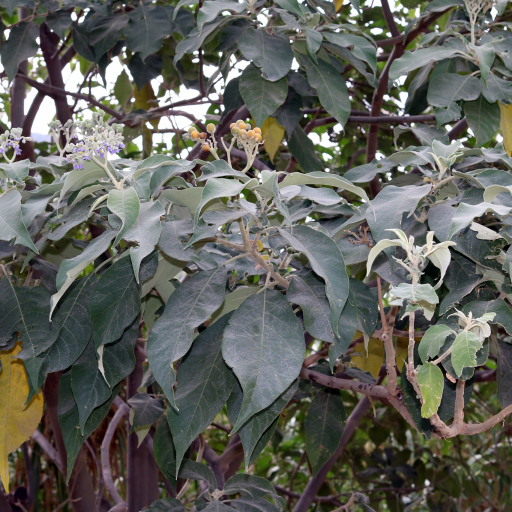
Plant Overview
Known as the Woolly Nightshade or Bugweed, this South American native is a bold, fast-growing member of the potato family that has traveled far from its home. Its most striking feature is its incredibly soft, velvety texture, which earned it the nickname "Flannel Weed." While it might look like a cozy garden giant, it is a hardy pioneer species that often takes over disturbed landscapes with impressive speed.
🔍 How to Identify
- 👂 The "Ears": Look for small, ear-shaped leaves (stipules) at the base of the larger leaf stalks. This is the hallmark of the species and the reason for its Latin name, auriculatum.
- ☁️ Velvety Foliage: The large, oval leaves are covered in a dense carpet of grayish-green hairs, making them feel like thick felt or flannel to the touch.
- 🍇 Cluster Berries: It produces bunches of small, round berries that start green and turn a dull, dusty yellow as they ripen.
- 💜 Starry Flowers: Typical of the nightshade family, it displays clusters of purple, star-shaped flowers with bright yellow centers that point outward.
🏡 In Your Garden & Landscape
- 🚜 Pioneer Spirit: In many regions outside South America, this plant is considered a stubborn weed. It loves "empty" spaces like forest edges or cleared land, where its deep taproot makes it very difficult to remove once it settles in.
- 👃 A Pungent Presence: If you crush the leaves, don't expect a floral scent; they emit a strong, slightly unpleasant odor often described as a mix of kerosene, diesel, or old tobacco.
- 🐦 Bird Magnet: Despite being toxic to humans, many birds love the yellow berries. This is how the plant spreads so quickly—birds eat the fruit and "deposit" the seeds miles away.
⚠️ Safety & Toxicity
- 🚫 High Toxicity: Every part of the Woolly Nightshade is toxic if ingested. The berries are particularly dangerous to humans, especially children, and can cause severe stomach upset or worse.
- 🧤 Skin & Lung Irritant: The fine, "woolly" hairs on the leaves can easily break off. Handling the plant without gloves often leads to skin irritation, and breathing in the dust while clearing the plant can cause respiratory discomfort and sneezing.
- 🐾 Pet Warning: Keep curious dogs and livestock away; the glycoalkaloids in the plant can be fatal to animals if consumed in large quantities.
✨ Fun Fact
In its native Brazil, the Woolly Nightshade isn't just a weed; it’s a vital part of the ecosystem. However, in countries like New Zealand and South Africa, it is such a fierce invader that it's nicknamed "the kerosene plant" because it burns intensely hot during bushfires due to the oils in its leaves!

Detailed Care Instructions
To water this particular plant, it is important to consider the soil type and drainage. It prefers well-draining, slightly acidic soil. Water should be provided regularly, but not to the point of waterlogging the soil. It is better to water deeply but infrequently rather than shallowly and frequently. The plant should be watered at the base, and not overhead, to prevent fungal growth. Drought-tolerant once established, but too long without water can cause it to stress or even start to wilt. The frequency of watering will depend on several factors, including the size of the plant, the temperature, and humidity of the environment.
Solanum auriculatum is a plant that belongs to the Solanaceae family and has specific soil requirements to grow successfully. It prefers soil with a pH level of 6 to 7.5, which is slightly acidic to slightly alkaline. The soil should be well-draining, which means it should not hold water for too long, as this can cause the roots to rot. It should also be rich in organic matter, such as compost or well-rotted manure, which helps to provide essential nutrients to the plant. Additionally, the soil should be loose and friable, allowing the roots to grow easily and absorb nutrients and water efficiently. It is recommended to avoid using heavy clay soils or soils that are too sandy for this plant as they may cause drainage problems and nutrient deficiencies. Proper soil preparation is crucial for healthy growth and optimal flower production.








