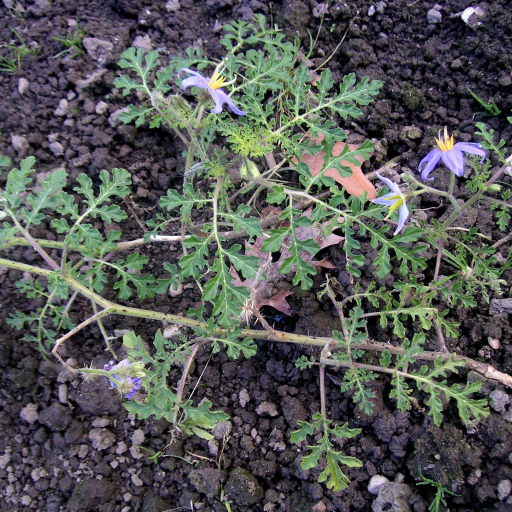
Plant Overview
Often called the Watermelon-leaf Nightshade or Melon-leaf Nightshade, this plant is a master of botanical disguise. At first glance, its deeply lobed foliage looks like a harmless patch of melons, but one touch reveals its prickly secret. Native to the arid regions of the Southern United States and Mexico, it is a rugged survivor that balances delicate, star-shaped beauty with a fierce, thorny defense.
🔍 How to Identify
- 🌿 The Foliage: The leaves are the namesake feature—vivid green and deeply divided into rounded lobes, looking almost identical to the leaves of a watermelon vine.
- 🟣 The Blooms: It produces striking violet to sky-blue flowers with five petals. In the center, you'll find a cluster of bright yellow anthers, one of which is usually longer and curved like a beak.
- 🌵 The Armor: Nearly every part of the plant—the stems, the leaf veins, and even the "husk" surrounding the fruit—is covered in sharp, straw-colored prickles.
🏡 In Your Garden
- ☀️ Sun-Loving Pioneer: This plant thrives in disturbed, sandy soils and craves full sun. It is highly drought-tolerant, making it a common sight in dry fields or along roadsides where other plants might wither.
- 🐝 Buzz Pollination: While the thorns keep many away, the flowers are a goldmine for bumblebees. They perform "buzz pollination," vibrating their bodies at a specific frequency to release the pollen trapped inside the yellow anthers.
⚠️ Safety & Toxicity
- 🚫 Toxic Status: Highly toxic if ingested. Like many members of the Nightshade family, it contains solanine and other glycoalkaloids.
- 🐾 Pet & Child Safety: Every part of the plant, including the small green berries, is poisonous and can cause severe gastrointestinal distress or neurological issues. Additionally, the sharp spines pose a physical puncture risk to curious paws and small hands.
✨ Fun Fact
The Solanum citrullifolium belongs to a specific group of nightshades known as "weedy pioneers." It is often one of the first plants to grow back after a fire or soil disturbance, acting as nature's way of quickly covering bare earth—though its thorns ensure it isn't easily stepped on!

Detailed Care Instructions
To grow Solanum citrullifolium, also known as watermelon nightshade or bitter apple, follow these steps:
- Choose a planting location: Select a sunny spot in your garden that receives at least 6-8 hours of direct sunlight daily. Also, ensure the soil is well-drained and rich in organic matter.
- Prepare the soil: Before planting, work the soil with a garden fork or tiller to improve its texture and remove any weeds or debris. Add compost or well-rotted manure to enrich the soil.
- Start seeds indoors (optional): Watermelon nightshade can be started from seeds indoors about 6-8 weeks before the last expected frost date. Plant the seeds in seed trays or small pots filled with seed-starting mix. Keep the soil moist and provide warmth and good lighting. Transplant them outdoors once all danger of frost has passed.
- Direct sowing: Alternatively, you can directly sow the seeds outdoors after the frost-free date. Sow the seeds 1/4 inch deep and space them 12-18 inches apart.
- Watering: Water the plants regularly, keeping the soil consistently moist but not waterlogged. Mulch around the base of the plants to retain moisture and suppress weed growth.
- Fertilization: Apply a balanced, slow-release fertilizer or a compost tea every 4-6 weeks to provide essential nutrients for healthy growth.
- Supporting the plant: As the Solanum citrullifolium plant grows, it may benefit from staking or trellising to keep it upright and support sprawling branches.
- Pruning: For better air circulation and to encourage bushier growth, you can prune the plant by removing any dead or damaged branches. Pinching back the tips of the plant can also promote more branching.
- Pest and disease control: Monitor your plants for any signs of pests such as aphids or tomato hornworms. Use organic insecticides or pest control methods to manage pest issues. Protecting the plants from fungi and diseases can be achieved by spacing the plants properly, providing good air circulation, and avoiding overhead watering.
- Harvesting: The fruits of Solanum citrullifolium are ready to harvest when they turn from green to yellow or orange and are slightly soft to the touch. Be cautious, as the fruits are toxic when unripe, so only consume them when fully mature.
Remember to check the specific requirements of Solanum citrullifolium in your region, as growing conditions may vary depending on your location.

Place in a bright room that is sun drenched almost all day. Or directly in a south-facing window.

1. Determine the watering needs of the plant: The amount of water required by Solanum Citrullifolium depends on factors such as the plant's age, size, location, and environmental conditions. Plants in hotter, drier conditions may require more frequent watering than those in cooler, more humid conditions.
2. Check the soil: Before watering the plant, always check the soil moisture level to determine if watering is necessary. This can be done by inserting a finger into the soil to a depth of about an inch. If the soil feels dry to the touch, it's time to water the plant.
3. Water at the right time: The best time to water Solanum Citrullifolium is in the morning or early evening when the weather is cooler. This will allow the water to soak in before the sun becomes too hot, reducing the risk of evaporation.
4. Water at the base: When watering the plant, aim to water directly at the soil or mulch around the base of the plant. This will help ensure the water gets to the roots where it is needed.
5. Water slowly and deeply: It is important to water Solanum Citrullifolium slowly and deeply to allow the water to permeate the soil and reach the roots. This can be achieved by using a slow trickle of water from a watering can or by using a drip irrigation system.
6. Avoid overwatering: Overwatering can cause root rot and other problems, so it's important not to water the plant too much. Always err on the side of underwatering, and avoid watering again until the soil has had a chance to dry out.
To fertilize this plant, choose a balanced, slow-release fertilizer with equal amounts of nitrogen, phosphorus, and potassium. Apply the fertilizer once every three months during the growing season, which typically runs from spring to fall. Water the plant thoroughly before and after fertilizing to avoid root burn. Follow the manufacturer's instructions for dosage and method of application. Avoid over-fertilizing, as this can cause damage to the plant and the surrounding soil.
Solanum Citrullifolium is a plant that prefers well-drained soil that is rich in nutrients. The soil should not be too heavy or compact as this can restrict root growth and cause the plant to suffer. Ideally, the soil should have a pH of between 6.0 and 7.0, which is slightly acidic to neutral. It is also important to ensure that the soil has good aeration and is able to retain moisture without becoming waterlogged. Adding organic matter such as compost or well-rotted manure can help to improve soil fertility and structure, while also enhancing moisture retention. However, it is important not to over-fertilize the soil as this can lead to excessive growth and reduce the plant's ability to produce fruit. Overall, the soil should be well-balanced and provide the plant with the necessary nutrients and growing conditions to thrive.
To propagate this plant, you will first need to gather healthy stem cuttings from the parent plant. Choose cuttings that are at least six inches long and have a few leaves attached.
Trim the leaves from the bottom half of the stem, leaving a few at the top. Dip the cut end of the stem in rooting hormone powder to promote root growth.
Next, plant the cutting in a well-draining soil mix and water thoroughly. Keep the soil moist but not waterlogged and place the pot in a bright, indirect light.
After a few weeks, the cutting should begin to root and show signs of new growth. Once the plant has established a strong root system, it can be transplanted into a larger pot or into the garden.








