Plant Overview
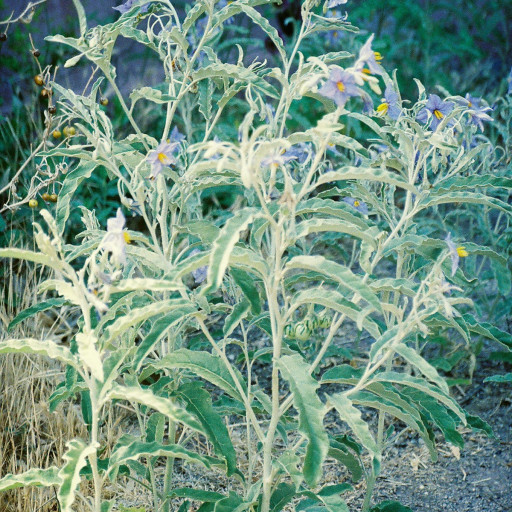
Often called the Silverleaf Nightshade or "White Horse-nettle," this tough-as-nails plant is a resilient survivor of the arid Americas. It wears a cloak of silvery-grey velvet, making it look ghostly and beautiful against desert sands or roadside ditches. While it produces charming, star-like blossoms, it is famously known as a "super-weed" due to its incredible ability to thrive where other plants wither.
🔍 How to Identify
- 🌫️ Silver Foliage: The leaves and stems are covered in a dense layer of tiny, star-shaped hairs that give the plant its signature metallic, silvery-green sheen.
- 💜 Starry Blooms: It produces five-lobed flowers that are typically a vibrant violet or pale blue, though white variants exist, always featuring a prominent "beak" of bright yellow anthers in the center.
- 🟡 Marble Berries: After flowering, the plant produces smooth, round berries that start green with darker stripes and ripen into a dull yellow or orange-brown, resembling tiny cherry tomatoes.
🏡 In Your Garden
- 🌵 Deep-Rooted Resilience: This plant is nearly impossible to pull by hand because it possesses a massive taproot that can dive over 6 feet deep into the earth. If you leave even a small piece of the root behind, a new plant will likely emerge.
- 🚫 An Unwanted Guest: While the flowers are pretty, most gardeners treat this as an invasive pest. It competes fiercely for nutrients and can quickly take over a flower bed or vegetable patch if not managed early.
⚠️ Safety & Toxicity
- 🚫 Toxic Status: All parts of the Silverleaf Nightshade are toxic if ingested, containing various glycoalkaloids, including solanine.
- 🐾 Risk to Animals: It is particularly dangerous for livestock (horses, cattle, and sheep) and curious pets. Ingestion can cause respiratory distress, trembling, and severe gastrointestinal upset.
- 🧤 Skin Irritation: The stems often hide small, sharp prickles that can easily puncture skin, so always wear gloves if you plan to clear it from your yard.
✨ Fun Fact
Native American tribes, such as the Pima and Navajo, discovered a clever use for the toxic berries; they used the juice as a vegetable "rennet" to curdle milk for cheese-making, as the enzymes in the fruit could separate curds from whey!

Detailed Care Instructions
| Humidity | Dry |
| Lighting | Full Sun |
| Toxicity | Poisonous |
| Difficulty | Medium |
| Hibernation | Cold Period |
| Temperature | 20°C - 34°C |
To grow Solanum elaeagnifolium, also known as silverleaf nightshade, you can follow these steps:
- Choose a location: Solanum elaeagnifolium prefers full sun and well-draining soil. Select a spot in your garden or a container with enough sunlight.
- Soil preparation: Prepare the soil by removing any weeds or debris. Loosen the soil using a garden fork or tiller, ensuring good drainage.
- Seed sowing: You can start growing Solanum elaeagnifolium from seeds or from cuttings. If using seeds, sow them directly into the prepared soil. Scatter the seeds evenly and cover them lightly with a thin layer of soil.
- Watering: Keep the soil consistently moist, but avoid overwatering. Water the plants thoroughly when the top one inch of soil feels dry to the touch.
- Fertilization: Solanum elaeagnifolium doesn't require much fertilizer. However, you can use a balanced, slow-release fertilizer once or twice during the growing season to provide a small nutrient boost.
- Mulching: Apply a layer of organic mulch around the plants to help retain moisture, suppress weeds, and regulate soil temperature.
- Pruning: Regularly prune or pinch back the plants to control their size and encourage bushier growth. This will also prevent the plant from becoming invasive.
- Support: If the Solanum elaeagnifolium plant becomes top-heavy or starts to sprawl, you can use stakes or a trellis to provide support.
- Pest and disease control: Monitor the plants for common pests like aphids, whiteflies, or spider mites. Treat any infestations promptly using organic insecticides or soap sprays. Also, watch out for diseases such as powdery mildew. Proper air circulation and avoiding excessive overhead watering can help prevent fungal infections.
- Harvesting: Solanum elaeagnifolium produces small, round fruits that turn yellow when ripe. You can harvest the fruits for consumption or to extract seeds for future planting.
Remember, Solanum elaeagnifolium is considered an invasive weed in many regions, so take necessary precautions to prevent its spread beyond your intended growing area.

Place in a bright room that is sun drenched almost all day. Or directly in a south-facing window.

To water this plant, you should first check the moisture level of the soil by inserting your finger into the soil up to the first knuckle. If the soil feels dry, it is time to water the plant. Use a watering can or hose to pour water slowly at the base of the plant until the soil is moist but not waterlogged. Avoid watering the leaves or stem of the plant as this can lead to fungal growth or rotting. Water the plant thoroughly once or twice a week, depending on the weather conditions and the moisture needs of the plant. If the soil is consistently wet or the plant shows signs of water stress, such as yellowing or wilting leaves, adjust the watering schedule accordingly.
- Choose a balanced N-P-K fertilizer with an equal or slightly higher N value than P and K values.
- Fertilize the Solanum Elaeagnifolium plant with a slow-release fertilizer every four months during the growing season.
- Apply the fertilizer evenly around the base of the plant, staying clear of the stem and leaves.
- Water the plant thoroughly after fertilizing to help distribute the nutrients.
- Avoid over-fertilizing the plant, as this can lead to excessive growth and decreased flower production.
Solanum Elaeagnifolium plant requires a well-draining nutrient-rich soil. A soil mixture that is rich in organic matter, sand and loam is best suited for the plant's growth and development. The soil should be prepared with compost or aged manure to add nutrients and improve the soil's water-holding capacity. The plant prefers slightly alkaline soil with a pH level in the range of 6.5 to 7.5. The soil should also have good drainage to prevent waterlogging, root rot, and fungal diseases. Potting mixtures, such as those containing peat moss or perlite, can be used for container-grown plants. It is important to avoid using heavy or clay-based soils, as these can lead to poor drainage and stunted growth. Proper soil preparation and maintenance is essential for the health and success of the Solanum Elaeagnifolium plant.
Propagation of this plant can be done through stem cuttings. Select a healthy stem, and cut it at an angle with a sharp tool. Remove the leaves from the bottom half of the stem, leaving only one or two at the top. Dip the cut end of the stem into rooting hormone and plant it in soil, making sure to cover at least half of the stem with soil. Keep the soil moist and place the pot in a bright, warm location. The stem should start developing roots in a few weeks, and once it has established a strong root system, it can be transplanted to a larger pot or directly into the garden.
Common pests of the silverleaf nightshade include Spider mites, aphids, whiteflies, larvae. Make a habit of checking your silverleaf nightshade frequently for pests so that any infestations can be caught and managed early.








