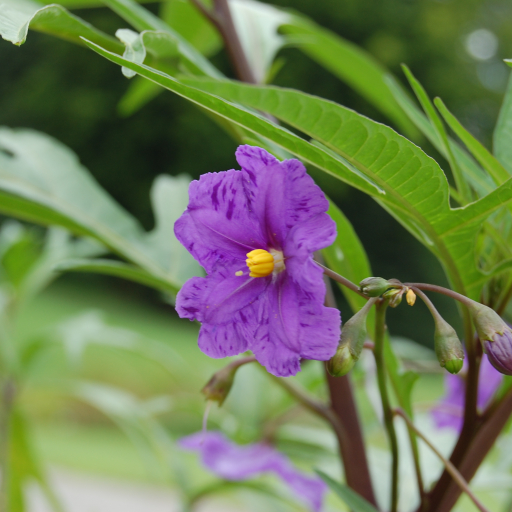
Plant Overview
Commonly known as the Kangaroo Apple or Large Kangaroo Apple, Solanum laciniatum is a fast-growing, architectural shrub native to Australia and New Zealand. It earns its nickname from its distinctive leaves, which are deeply lobed and bear a striking resemblance to the shape of a kangaroo's footprint. With its vibrant violet-blue flowers and glossy foliage, it is a favorite for gardeners looking to add a touch of "wild" elegance to their landscape.
🔍 How to Identify
- 🦘 The Foliage: The most famous feature—dark green, lance-shaped leaves that split into several long "fingers," mimicking a large paw.
- 💜 The Bloom: Star-shaped flowers in a rich shade of purple or violet, each featuring a bright yellow "beak" of stamens in the center.
- 🥚 The Fruit: Oval berries that hang in clusters. They begin a toxic bright green and eventually ripen to a soft, translucent yellow-orange or reddish color.
🏡 In Your Garden
- 🌱 The Pioneer Spirit: This plant is a "pioneer species," meaning it is designed by nature to grow incredibly fast in disturbed soil. It is perfect for filling gaps in a new garden quickly, though it tends to be short-lived (usually 5 to 6 years).
- 🌬️ Resilience: It is surprisingly tough against coastal winds and light salt spray, making it an excellent choice for seaside gardens where other delicate shrubs might wither.
- ✂️ Pruning Needs: Because it grows so aggressively, it can become "leggy" or sparse at the base. Regular light tipping after flowering helps maintain a bushy, lush shape.
⚠️ Safety & Toxicity
- 🚫 Status: Highly Toxic When Green. Like many members of the Nightshade family, the unripe fruits, leaves, and stems contain high levels of solanine.
- 🐾 Details: All parts of the plant are toxic to dogs, cats, and horses. While some indigenous cultures traditionally ate the fruit only when it was so ripe it was falling off the branch, it is strongly advised that home users treat the fruit as purely ornamental. Ingesting green berries can cause severe digestive distress and neurological issues.
✨ Fun Fact
- 💊 Medical History: In the mid-20th century, Solanum laciniatum was commercially cultivated in parts of Europe and Russia. The plant contains a compound called solasodine, which was extracted and used as a base material for producing early contraceptive pills and steroid treatments!

Detailed Care Instructions
| Humidity | High |
| Lighting | Full Sun |
| Toxicity | Poisonous |
| Difficulty | Medium |
| Hibernation | Cold Period |
| Hardiness Zones | 10 - 11 |
Here are some steps to help you grow Solanum Laciniatum plant:
- Choose a suitable location: Solanum Laciniatum plants prefer full sun exposure, so find a spot in your garden that receives at least 6-8 hours of direct sunlight each day.
- Prepare the soil: These plants prefer well-draining soil with a pH level around 6-7. Amend the soil with organic matter like compost or well-rotted manure to improve its fertility and drainage.
- Propagation: Solanum Laciniatum can be propagated from seeds or stem cuttings. If using seeds, sow them indoors in seed trays or pots during spring. Cover the seeds lightly with soil and keep them moist until germination. For stem cuttings, take a 4-6 inch healthy cutting from an established plant and place it in a pot of well-draining soil. Keep the soil consistently moist until the cutting roots.
- Planting: Once the seedlings have grown a few inches tall or the cutting has rooted, you can transplant them to the garden or larger pots. Dig a hole slightly larger than the root ball, place the plant in the hole, backfill it with soil, and gently pat it down to remove air pockets.
- Watering: Solanum Laciniatum plants require regular watering, especially during hot and dry periods. Water deeply, but allow the top inch of soil to dry out between waterings to avoid waterlogging.
- Fertilizing: Apply a balanced, slow-release fertilizer in spring to promote healthy growth. Additionally, you can use a liquid fertilizer every 2-3 weeks during the growing season to provide essential nutrients.
- Pruning: Solanum Laciniatum plants can become quite large and sprawling. Regularly prune to maintain a more compact shape and remove any dead or diseased branches. Pruning also helps in promoting more flowering and fruiting.
- Mulching: Apply a layer of organic mulch around the base of the plants to help retain soil moisture, suppress weed growth, and regulate temperature.
- Pests and diseases: Solanum Laciniatum plants can be susceptible to aphids, whiteflies, and fungal diseases like powdery mildew. Monitor your plants regularly and take appropriate measures to control pests and diseases.
- Harvesting: Solanum Laciniatum plants produce small, orange fruits that are edible when fully ripe. Harvest the fruits when they turn soft and have a sweet aroma. Always consume ripe fruits as unripe ones can be toxic.
Remember to research specific care requirements for Solanum Laciniatum plants in your specific climate and growing conditions, as they may vary slightly.

Place in a bright room that is sun drenched almost all day. Or directly in a south-facing window.

To properly water this plant, it is important to consider its specific water needs. The best way to do this is to carefully observe the soil and the plant itself. This will help determine when it needs to be watered and how much water it requires.
Start by checking the soil moisture level. Insert your finger into the soil up to the second knuckle and feel for moisture. If the soil feels dry at this depth, it is time to water the plant. Avoid overwatering, as this can lead to root rot and other issues.
When watering, aim to moisten the soil down to the plant's roots. Use a watering can or hose and water until the excess water begins to drain from the bottom of the pot or soil. Ensure that the water is evenly distributed around the plant.
It is important to note that this plant requires regular but moderate watering. Avoid allowing the soil to dry out completely between waterings, as this can stress the plant. On the other hand, avoid watering too frequently, as this can also lead to issues such as root rot.
Overall, the key is to observe the plant's water needs and adjust watering accordingly. With proper care, this plant can thrive and grow healthy and strong.
To properly fertilize this plant, you should first prepare a soil that is rich in organic matter. This can be achieved by working compost, aged manure, or leaf mold into the soil before planting.
During the growing season, you can provide additional nutrients by applying a balanced fertilizer that contains equal amounts of nitrogen, phosphorus, and potassium. This can be done once or twice a month, depending on the growth rate of the plant.
Be careful not to over-fertilize, as this can lead to excessive vegetative growth at the expense of flowers and fruit. It is also important to water the plant thoroughly after each application of fertilizer.
Finally, it is recommended to stop fertilizing the plant in early fall, to allow it to enter a period of dormancy before the winter months.
For Solanum Laciniatum plant, it is recommended to use a soil that is well-draining yet moisture-retaining. The soil should ideally have a pH level ranging between 5.5 and 7.5. It is advisable to use sandy loam soil enriched with organic matter such as compost or aged manure. The soil should be loose and friable, allowing air and water to penetrate easily. This plant prefers soils that are moderately fertile and rich in nutrients. Avoid using heavy clay soils as they can retain too much water, leading to root rot and other soil-borne diseases. If transplanting, it is advisable to add extra organic matter to the soil to give the plant a good start. In summary, the recommended soil for Solanum Laciniatum plant is well-draining, moisture-retaining, loose, friable, moderately fertile, with a pH level ranging between 5.5 and 7.5, and enriched with organic matter.
To propagate this plant, you will need to first take a stem cutting that is about 4-6 inches long. Make sure the cutting includes at least one leaf node. Remove any leaves on the bottom half of the stem. Dip the cut end into rooting hormone and then plant it into moist, well-draining soil. Cover the cutting with a plastic bag to create a humid environment and place it in a warm, bright location. Keep the soil moist and mist the cutting occasionally. After a few weeks, the cutting should begin to root and new growth will appear. Gradually remove the plastic bag and continue to care for the plant until it can be transplanted into its permanent location.
Common pests of the kangaroo apple include Spider mites, aphids, whiteflies, larvae. Make a habit of checking your kangaroo apple frequently for pests so that any infestations can be caught and managed early.








