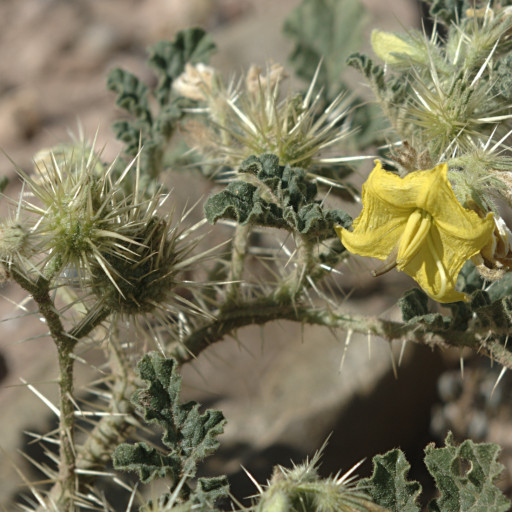
Plant Overview
Often called the Buffalobur Nightshade or "Kansas Thistle," this plant is the ultimate "look but don’t touch" resident of the North American plains. Covered head-to-toe in golden armor, it earned its name because its prickly seed pods famously hitched rides in the thick fur of roaming bison. While its bright yellow flowers are cheerful, its fierce defense system tells a story of survival in harsh, rugged environments.
🔍 How to Identify
- 🌼 Sunny Flowers: It produces bright yellow, five-petaled blossoms. If you look closely, you'll notice one stamen is significantly longer and more curved than the others, resembling a bird's beak.
- 🌵 Golden Armor: Every single part of the plant—the stems, the leaves, and even the fruit—is densely covered in straight, sharp, yellow spines that glow when caught in the sunlight.
- 🍃 Lobed Foliage: The leaves are deeply "pinnatifid" (lobed like a kale or melon leaf) and are roughly textured, with prickly spines running right along the midrib and veins.
🏡 In Your Garden
- ☀️ The Sun-Seeker: You won't usually plant this on purpose; it’s a pioneer species that loves disturbed soil, gravel, and full, punishing sun. It thrives where other plants wilt, thanks to a deep taproot that locks into the earth.
- 💨 The Tumbleweed Strategy: As an annual, the plant dies back in winter. The dried, prickly skeleton often breaks off at the base and rolls with the wind, acting like a tumbleweed to scatter thousands of seeds across the landscape.
⚠️ Safety & Toxicity
- 🚫 Toxic Status: Like many members of the Nightshade family, the Buffalobur contains solanine and is toxic to humans, horses, and cattle if ingested.
- 🧤 Physical Hazard: The primary danger is mechanical. The spines are incredibly sharp and can easily pierce thin gardening gloves or a pet's paw. If you find one in your yard, use heavy-duty leather gloves and a shovel to remove it from the root.
✨ Fun Fact
This prickly character is the "original" host of the notorious Colorado Potato Beetle. Before humans began planting massive fields of potatoes, the beetle lived exclusively on the Buffalobur!

Detailed Care Instructions
To grow Solanum rostratum, also known as buffalobur or spiny nightshade, follow these steps:
- Obtaining seeds: You can collect seeds from mature buffalobur plants or purchase them from a reputable seed supplier or nursery.
- Preparing soil: Buffalobur requires well-draining soil. Prepare a planting bed or container with loose soil mixed with compost or organic matter to improve drainage and nutrient content.
- Planting seeds: Plant the seeds directly into the soil in spring after the last frost date. Sow the seeds at a depth of about 0.25-0.5 inch (0.6-1.3 cm) and space them about 18-24 inches (45-60 cm) apart. Alternatively, you can start seeds indoors 6-8 weeks before the last frost date and transplant them outdoors once the risk of frost has passed.
- Providing sunlight: Solanum rostratum prefers full sun exposure, so choose a spot in your garden that receives at least 6-8 hours of direct sunlight per day.
- Watering: Keep the soil consistently moist but not waterlogged. Water the plants thoroughly when the top inch (2.5 cm) of soil feels dry. During hot and dry periods, you may need to water more frequently.
- Mulching and weed control: Apply a layer of organic mulch, such as straw or wood chips, around the plants to retain moisture and suppress weed growth. Regularly remove any weeds that compete for nutrients and space.
- Fertilizing: Buffalobur plants typically do not require additional fertilization if the soil is rich in nutrients. However, if your soil lacks fertility, you can apply a balanced slow-release fertilizer according to package instructions.
- Pruning and staking: Buffalobur plants tend to sprawl and may need support or staking to prevent them from trailing on the ground. Prune back any overgrown or dead branches to maintain a tidy appearance.
- Pest and disease control: Solanum rostratum is generally resistant to pests and diseases. However, keep an eye out for common garden pests like aphids, spider mites, or flea beetles. If necessary, treat with insecticidal soap or organic pest control methods.
- Harvesting seeds: Allow the flowers to bloom, and they will eventually develop into spiky seed pods. Harvest the seed pods when they turn brown and begin to dry out. Collect the pods, remove the seeds, and store them in a cool, dry place for future use or to share with other gardeners.
Remember to check with your local agricultural extension office or consult gardening experts for specific advice based on your location and climate conditions.
To water this plant, it is important to only provide water when the soil feels dry to the touch. Overwatering can lead to root rot, so it is important to be cautious. When watering, aim to water deeply, allowing water to penetrate down to the roots. It is also important to avoid getting water on the leaves, as this can encourage fungal growth. Use a watering can or hose with a gentle spray nozzle to water the base of the plant. Water in the morning or early evening to prevent evaporation in the heat of the day.
To fertilize this plant, it is recommended to use a balanced fertilizer with equal amounts of nitrogen, phosphorus, and potassium. Apply the fertilizer once every two weeks during the plant's growing season. Be careful not to over-fertilize, as this can lead to leaf burn and damage to the plant. Water the plant well before and after fertilizer application.
When planting Solanum Rostratum, it is important to use well-draining soil that is high in organic matter. The soil should have a pH between 6.0 and 7.5 and be rich in nutrients like nitrogen, phosphorus, and potassium. A good mix of soil would include compost, sand, and peat moss. It is also important to ensure that the soil is free of pests and diseases that may harm the plant. Soil that is too wet or too dry could harm the plant and reduce its growth and fruit production. Therefore, it is important to maintain consistent moisture levels in the soil and ensure proper drainage.
To propagate this plant, you will first need to obtain a healthy specimen and carefully remove one of its stems or branches. Be sure to choose a branch that is at least 6 inches long and has several healthy leaves.
Next, remove the lower leaves from the stem, leaving only a few at the top. Then, dip the end of the stem into a rooting hormone powder to encourage root growth.
Fill a small pot with well-draining soil and make a hole in the center. Insert the stem into the hole and gently press the soil around it to hold it in place. Water the soil thoroughly and place the pot in a warm, bright location.
Continue to water the soil regularly to keep it moist but not waterlogged. In a few weeks, you should start to see signs of new growth, indicating that roots are forming.
Once the plant has established roots, it can be transplanted into a larger pot or planted directly into the ground. Be sure to give it plenty of space to grow and provide adequate sunlight, water, and nutrients for healthy growth.








