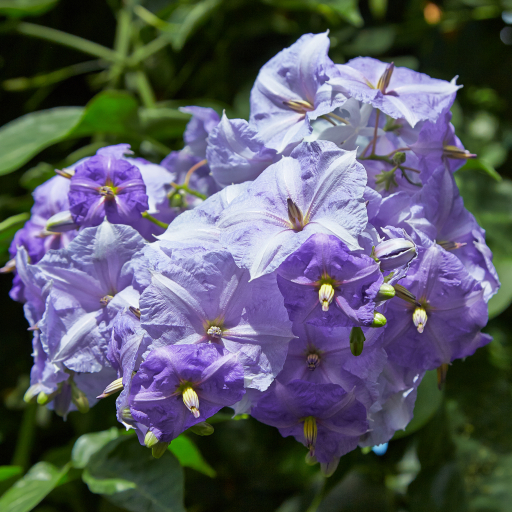
Plant Overview
Known as the Giant Potato Creeper or the Costa Rican Nightshade, Solanum wendlandii is a show-stopping climber that brings a touch of tropical drama to any landscape. Native to the lush forests of Central America, this vigorous vine is famous for its massive, pendulous clusters of lavender-blue flowers. It is a true "maximalist" plant, growing with such speed and enthusiasm that it is sometimes jokingly called the "Divorce Vine" because of the arguments it causes when it tries to take over the garden!
🔍 How to Identify
- 🌸 The Blooms: It produces enormous, plate-sized clusters of star-shaped flowers that transition from deep violet to a soft, pale lavender as they age.
- 🍃 Variable Foliage: The leaves are a glossy, bright green. Interestingly, the lower leaves are often deeply lobed (like a bird's foot), while the newer leaves near the flower clusters are simple and heart-shaped.
- 🪝 Hooked Prickles: The stems and even the midribs of the leaves are armed with small, sharp, recurved thorns that help the plant "hook" onto structures as it climbs.
🏡 In Your Garden
- 🏗️ Heavy-Duty Support: This is not a plant for a flimsy plastic trellis. Because of its weight and rapid growth, it requires a sturdy pergola, a stone wall, or a heavy-duty fence to support its massive woody vines.
- ☀️ Sun & Space: It thrives in full sun and rich, well-draining soil. While it is incredibly drought-tolerant once established, it needs plenty of room to spread—expect it to reach lengths of 20 to 30 feet in a single season in warm climates.
⚠️ Safety & Toxicity
- 🚫 Status: Toxic to Ingest.
- 🐾 Details: As a member of the Solanaceae (Nightshade) family, all parts of the plant—especially the green berries—contain solanine. It is toxic to dogs, cats, and humans if eaten. Additionally, the sharp prickles on the stems can cause physical scratches, so wear gloves when pruning.
✨ Fun Fact
Despite its delicate-looking flowers, Solanum wendlandii is a close relative of the common potato and tomato! While those cousins were bred for food, this species spent its evolution perfecting the art of "floral fireworks" to attract pollinators in the Costa Rican canopy.

Detailed Care Instructions
To grow Solanum wendlandii, also known as the Giant Potato Vine, follow these steps:
- Climate: Ensure that you are in a suitable climate where Solanum wendlandii can thrive. It prefers warm temperatures and requires frost protection if temperatures drop below 24°F (-4°C).
- Location: Choose a location that receives full sun or partial shade. Solanum wendlandii prefers well-draining soil.
- Soil preparation: Prepare the soil by incorporating organic matter such as compost or well-rotted manure. This will improve soil fertility, drainage, and water-holding capacity.
- Planting: Plant the Solanum wendlandii either from seeds or cuttings. If using seeds, sow them in pots or trays filled with moist potting soil and keep them warm (around 70°F or 21°C). Once the seedlings have grown a few inches tall, transplant them into the desired location. If using cuttings, take semi-hardwood cuttings (4-6 inches long) from a healthy plant, remove the lower leaves, dip the cut end in rooting hormone, and plant in well-draining soil/potting mix.
- Support: Giant Potato Vine is a vigorous climber, so provide a sturdy support structure like a trellis, fence, or pergola for it to grow on.
- Watering: Water the plant regularly to keep the soil moist but not waterlogged. Solanum wendlandii requires regular watering, especially during dry spells.
- Fertilization: Feed the plant with a balanced liquid fertilizer every two weeks during the growing season (spring and summer). This will promote healthy growth and abundant flowering.
- Pruning: Prune Solanum wendlandii regularly to control its size and shape. Remove dead or damaged branches and cut back excessive growth to encourage bushiness and better flowering.
- Pest and disease control: Monitor for common pests like whiteflies, spider mites, and aphids. If necessary, use organic pest control methods to manage infestations.
- Winter care: If you live in a colder climate, provide protection during winter months. Mulch around the base of the plant to insulate the roots, and cover the plant with a frost blanket or move it to a sheltered location.
With proper care and attention, your Solanum wendlandii plant should grow well and provide beautiful purple-blue flowers during the growing season.

Place in a bright room that is sun drenched almost all day. Or directly in a south-facing window.

Solanum Wendlandii is a species of plant that requires regular watering to thrive. When watering the plant, it is important to avoid overwatering as it can lead to root rot and other issues.
To water the plant, begin by checking the soil moisture level. This can be done by inserting a finger into the soil to a depth of about 2 inches. If the soil feels dry at this depth, it is time to water the plant.
When watering, use a watering can or hose to apply water evenly to the base of the plant. Avoid getting water on the leaves or flowers as this can lead to fungal diseases. Water the plant until the soil is moist but not waterlogged.
During the growing season, which typically runs from spring through fall, Solanum Wendlandii may require watering several times per week, depending on the weather conditions. In the winter, watering can be reduced to once per week or less.
It is also important to fertilize the plant regularly during the growing season to promote healthy growth. This can be done using a balanced fertilizer or one that is high in potassium to encourage flowering.
To promote healthy growth of this plant, it should be fertilized with a balanced, slow-release fertilizer with equal amounts of nitrogen, phosphorous, and potassium. Fertilizer should be applied in a ring around the plant at the beginning of each growing season and watered thoroughly afterwards. It is important not to over-fertilize, as this can cause damage to the plant and potentially harm surrounding vegetation. Additionally, it is recommended to incorporate organic matter into the soil to improve nutrient availability and soil structure. Maintenance fertilization may be necessary throughout the growing season, but it is important to limit the amount of fertilizer used and avoid applying it during periods of drought or extreme heat.
The ideal soil for Solanum wendlandii plant should be well-draining and rich in nutrients. It should have a slightly acidic to neutral pH level, preferably between 6.0 and 7.0. The soil should be loamy with adequate organic matter content to promote root growth and retain moisture. Sandy soils that tend to drain water quickly should be avoided, as they may cause water stress in the plant. Similarly, heavy clay soils that retain moisture for a long time can lead to root rot and suffocation in the Solanum wendlandii plant. Therefore, the soil should be well-prepared before planting by adding compost or other organic matter to improve its fertility, structure, and drainage. It is recommended to mulch around the base of the plant to keep the soil moist and reduce weed growth that can compete with the plant for nutrients and water. Additionally, the soil should be tested regularly to ensure that the nutrient levels are adequate, and pH levels are within the recommended range for Solanum wendlandii plant growth.
To propagate this plant, you first need to take a cutting from a healthy parent plant. Choose a stem that is about 4-6 inches long and has several leaves along its length. Make a clean cut with sharp, sterile scissors or pruning shears.
Next, strip the lower leaves from the cutting, leaving 1-2 leaves at the top. Dip the cut end of the stem into rooting hormone to encourage root growth.
Prepare a small pot with well-draining soil and make a hole in the center. Place the cutting into the hole and gently pack the soil around the stem. Water the cutting thoroughly and cover it with a plastic bag to create a humid environment.
Place the pot in a bright, indirect light location and keep the soil moist but not waterlogged. After a few weeks, check for signs of new growth which indicate the cutting has rooted. Once the roots have developed, you can remove the plastic bag and move the plant to a larger pot or a permanent location in your garden.








