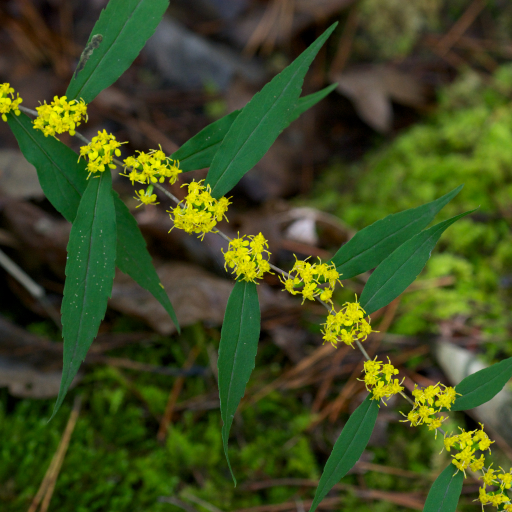
Plant Overview
Often called the Blue-stemmed Goldenrod or Wreath Goldenrod, this elegant wildflower is the "quiet cousin" of the goldenrod family. While its relatives often dominate sunny meadows with aggressive growth, Solidago caesia prefers the dappled light of the forest, showing off unique waxy stems that glow with a subtle bluish-purple hue.
🔍 How to Identify
- 🌿 The Stem: Unlike most plants, the stem has a distinctive waxy, bluish-purple coating (called a "bloom") that can often be rubbed off with your thumb.
- 🌼 Flower Arrangement: Instead of a big plume at the top, the tiny yellow flowers grow in small, cheering clusters right where the leaves meet the stem (axillary clusters).
- 🍃 Leaf Shape: The leaves are long, narrow, and sharply toothed, arranged alternately along the arching, wiry stems.
🏡 In Your Garden
- 🧚 Woodland Charm: This is the perfect goldenrod for shade gardeners. It thrives in the "edge" environments of your yard, such as under large deciduous trees where other flowering plants might struggle for light.
- 🐝 Pollinator Buffet: It provides a critical late-season nectar source for native bees and migrating Monarch butterflies, blooming when many other garden flowers have already faded.
- 🌱 Well-Behaved: Unlike the "Canada Goldenrod" which can take over a yard, the Blue-stemmed variety is clump-forming and stays exactly where you plant it, making it ideal for structured perennial borders.
⚠️ Safety & Toxicity
- ✅ Safe Status: Solidago caesia is considered non-toxic to humans and common household pets like cats and dogs.
- 🤧 The Allergy Myth: Goldenrods are often unfairly blamed for hay fever. Because their pollen is heavy and sticky (designed to be carried by bees, not the wind), the real culprit is usually the inconspicuous Ragweed that blooms at the same time.
- 🐾 Pet Interaction: While not poisonous, sensitive pets might experience mild stomach upset if they decide to graze on the leaves in large quantities.
✨ Fun Fact
In the 19th century, this plant was frequently used to create decorative floral wreaths because its flexible, arching stems hold their shape beautifully even after being cut, earning it the nickname "Wreath Goldenrod."

Detailed Care Instructions
To grow Solidago caesia, commonly known as blue-stemmed goldenrod, you can follow these steps:
- Choose the right location: Solidago caesia prefers full sun to partial shade, so choose an area that receives at least 6-8 hours of direct sunlight per day. The soil should be well-draining.
- Prepare the soil: Goldenrod plants adapt well to various soil types but prefer moist, fertile soil. Prepare the planting area by loosening the soil and removing any weeds or grass. You can also add organic matter, such as compost, to improve soil fertility and drainage.
- Sow seeds: Goldenrod can be grown from seeds. Sow the seeds in early spring or fall, directly in the prepared soil. Scatter the seeds and lightly press them into the soil, ensuring good seed-to-soil contact. Aim for a spacing of about 12-18 inches between plants.
- Watering: Keep the soil consistently moist but not waterlogged. Water the plants regularly, especially during hot, dry periods. Once established, goldenrod is relatively drought-tolerant.
- Mulching: Apply a layer of mulch around the plants to help retain moisture, suppress weed growth, and protect the roots in extreme temperatures.
- Fertilization: Goldenrod generally doesn't require much fertilization. However, you can apply a balanced, slow-release fertilizer in spring to promote healthy growth.
- Pruning: Solidago caesia doesn't require extensive pruning. Remove any dead or damaged stems to promote new growth and maintain the plant's shape. Cut back the plant to about 6 inches above the ground in late winter or early spring to encourage stronger, bushier growth.
- Pest and disease control: Goldenrod is generally pest and disease-resistant. Monitor the plants regularly for any signs of pests or diseases, and take appropriate measures if necessary.
- Propagation and dividing: Goldenrod can be propagated through division. After a few years, when the plant has become overcrowded, dig up the clump and carefully separate the rooted sections. Replant the divided portions in a well-prepared soil.
- Enjoy the blooms: Solidago caesia typically blooms in late summer to early fall, producing clusters of small yellow flowers. Enjoy their beauty and provide support if necessary, as some varieties can become floppy as they grow.
Remember that goldenrod can spread rapidly, so regular monitoring and maintenance may be required to prevent overgrowth in gardens or unwanted areas.

Place in a bright room that is sun drenched almost all day. Or directly in a south-facing window.

Solidago Caesia is a perennial plant that requires regular watering to grow and thrive. To water this plant, you should aim to keep the soil evenly moist, but not waterlogged. It is best to water the plant deeply, at the base of the stem, rather than watering the leaves or flowers. When watering, take care not to wet the foliage, as this can lead to fungal diseases.
One effective way to water Solidago Caesia is to use a soaker hose or drip irrigation system. This allows water to slowly seep into the soil, ensuring that it reaches the roots and doesn't evaporate or run off. Alternatively, you can water the plant by hand using a watering can or hose, being careful to avoid splashing water on the leaves.
In general, Solidago Caesia should be watered more frequently during hot, dry weather, and less often during periods of cooler, wetter weather. As a rule of thumb, aim to water the plant deeply once or twice a week during the growing season, and adjust the frequency as needed based on weather conditions and soil moisture levels.
Overall, providing consistent, careful watering is key to keeping Solidago Caesia healthy and thriving.
To fertilize this perennial plant, use a balanced fertilizer with an N-P-K ratio of 10-10-10. Apply the fertilizer in the early spring before new growth appears, and then again in mid-summer. Be sure to follow the instructions on the fertilizer label for the correct amount and method of application. Avoid fertilizing too late in the season, as it can stimulate new growth that may not have time to harden off before the winter months.
Solidago Caesia is a perennial plant that prefers well-drained soil with a pH level between 5.5 and 8.0. It also requires soil that is rich in organic matter, which means adding compost or aged manure to the soil before planting. The ideal soil texture for Solidago Caesia is loamy, which means a mixture of sand, silt, and clay.
It's important to note that Solidago Caesia is native to North America, so using soil that is indigenous to your area would be best. Before planting, make sure the soil has good drainage, as this plant does not tolerate standing water. Adding sand or perlite to the soil can help improve drainage.
Solidago Caesia is a hardy plant and can tolerate different soil types, but it grows best in soils that are well-drained, rich in nutrients and organic matter, and have a pH level within the preferred range.
Propagation of this plant is typically done through root division. In the spring or fall, carefully dig up the root ball of the plant and use a sharp knife to separate the roots into sections. Each section should have a few healthy roots and a shoot. Plant these divisions individually in a well-draining soil mix and water thoroughly. Keep the new plants in a shaded area for a few weeks until they establish themselves. You can also propagate this plant from seed, which can be sown in the fall or spring.








