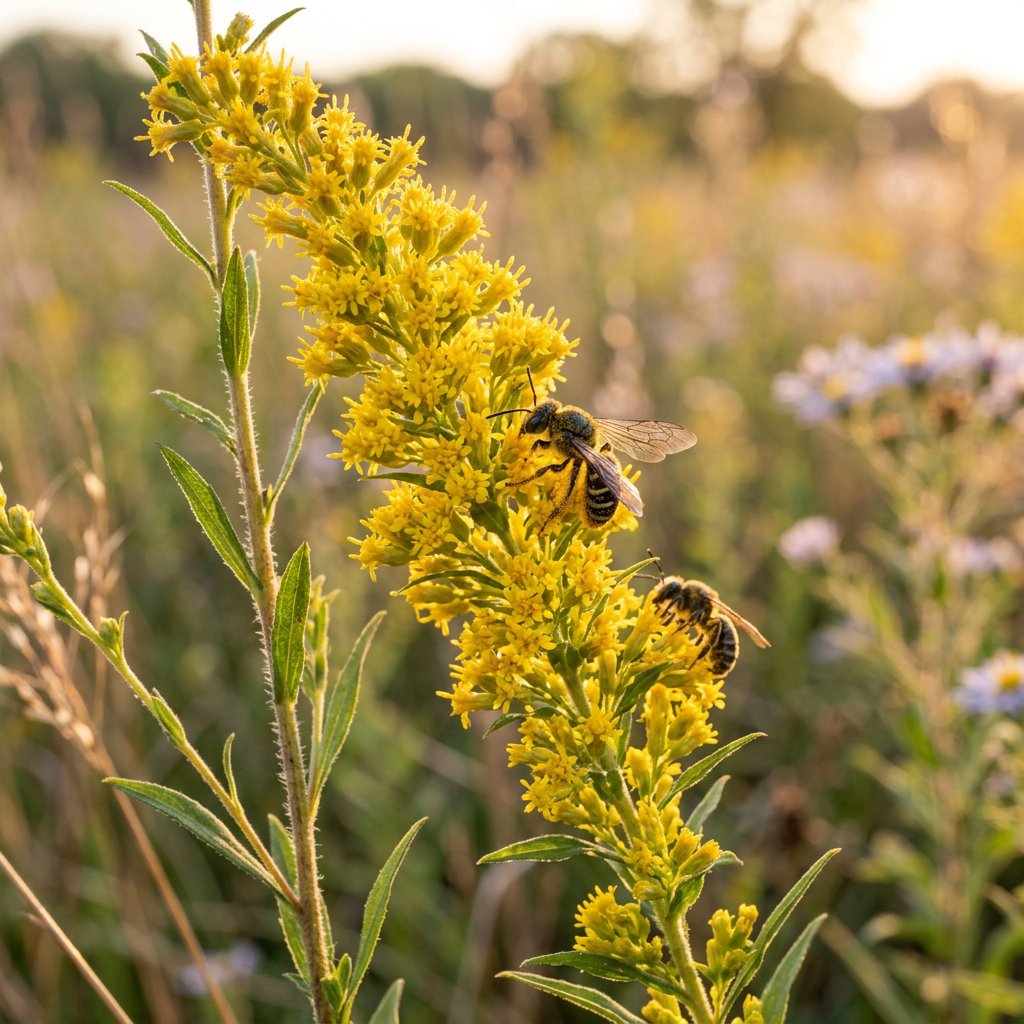
Plant Overview
Often unfairly blamed for seasonal sneezing, Solidago canadensis, or Canada Goldenrod, is actually a misunderstood hero of the late-summer landscape. This hardy perennial paints meadows in shades of molten gold just as other flowers begin to fade, providing a vital nectar "filling station" for migrating Monarch butterflies. While it’s a North American native, its vigorous spirit has seen it travel the globe, becoming a prized (and sometimes cheeky) guest in gardens worldwide.
🔍 How to Identify
- 🌼 The Golden Plume: Look for tiny, bright yellow flower heads arranged in dense, pyramid-shaped clusters that often arch gracefully at the tips.
- 🍃 Lance-Like Leaves: The leaves are narrow, sharply pointed (lanceolate), and usually feature three prominent parallel veins and finely serrated edges.
- 📏 Sturdy Stature: It grows tall and proud, often reaching between 3 to 7 feet, with grayish-green stems that are occasionally covered in fine, soft hairs.
🏡 In Your Garden
- 🏃 A Fast Runner: This plant spreads enthusiastically via underground rhizomes. While it’s excellent for filling large "wild" corners or stabilizing slopes, be prepared to "corral" it in smaller garden beds to prevent it from out-competing its neighbors.
- ☀️ The Leaner, the Better: Goldenrod thrives in full sun and isn't picky about soil. In fact, giving it too much "love" with rich fertilizer can make the stalks tall and weak, causing them to flop over under the weight of their own golden glory.
⚠️ Safety & Toxicity
- ✅ Safe & Non-Toxic: Solidago canadensis is generally considered non-toxic to humans, cats, and dogs.
- 🌾 The Allergy Myth: It is rarely the cause of hay fever! Its pollen is heavy and sticky (designed to be carried by bees), whereas the true culprit—Ragweed—blooms at the same time with lightweight, wind-blown pollen that irritates the nose.
- 🍵 Skin Sensitivity: While rare, some sensitive individuals may experience mild skin irritation when handling the foliage extensively; gardening gloves are always a good idea.
✨ Fun Fact
In the 1920s, the famous inventor Thomas Edison worked with Henry Ford to turn Goldenrod into a domestic source of rubber! He even bred a giant variety that grew 12 feet tall, eventually producing a high-quality latex from the plant's leaves.

Detailed Care Instructions
| Color | Golden-Yellow |
| Soil Ph | 5.5 To 7.5 |
| Lighting | Full Sun |
| Soil Type | Well-Drained |
| Bloom Time | August To October |
| Plant Type | Perennial |
| Mature Size | Over 5 Feet Tall |
| Native Area | North America |
| Sun Exposure | Full To Partial Sun |
| Hardiness Zones | 2 To 8 |
To grow Solidago canadensis, also known as Canada goldenrod, follow these steps:
- Picking a suitable location: Solidago canadensis prefers to grow in full sun areas, but it can also tolerate partial shade. Choose a location with well-draining soil.
- Soil preparation: Prepare the soil by loosening it with a garden fork or tiller. Remove any weeds, roots, or rocks from the area. Adding organic matter like compost or aged manure can enhance the soil fertility.
- Planting: Solidago canadensis can be grown from seeds or transplants. If using seeds, sow them directly on the prepared soil surface in early spring, after the last frost date. Lightly cover the seeds with a thin layer of soil. If using transplants, dig a hole slightly larger than the root ball and place the plant in the hole. Backfill the hole with soil and gently firm it around the plant.
- Watering: Keep the soil moist but not waterlogged until the plants are established. Once established, goldenrod is drought-tolerant and can withstand dry conditions. Water deeply when the soil feels dry several inches below the surface.
- Mulching: Apply a layer of organic mulch, such as wood chips or straw, around the plants to help retain moisture, suppress weeds, and regulate soil temperature. Leave a small gap around the stem to prevent moisture buildup and crowding.
- Maintenance: Goldenrod requires minimal maintenance. Remove any weeds that may compete with the plants for nutrients and water. Deadhead the flowers after they bloom to encourage additional blooming and prevent self-seeding if unwanted.
- Pruning: In late fall or early spring, cut back the spent flower stalks and remove any dead or damaged stems. This will help maintain the plant's shape and promote its growth for the following season.
- Pests and diseases: Solidago canadensis is generally pest and disease resistant. However, you may occasionally encounter aphids or leaf spot diseases. Monitor your plants regularly and apply appropriate organic pest control if necessary.
Remember to check your local regulations, as Solidago canadensis is considered invasive in some areas. It is always best to choose native plants for your region to promote biodiversity and avoid potential invasiveness.

Place in a window with dappled sun or a spot in the middle of a room. Or directly in a window facing west or east.

To water this plant, it is important to first check the soil moisture level by inserting a finger into the soil. If the soil feels dry to the touch, it is time to water. Use a watering can or a hose with a gentle spray nozzle to water the roots, avoiding getting water on the foliage. Water thoroughly until the water drains from the bottom of the pot. Avoid overwatering, which can lead to root rot. It is best to water this plant regularly but only when the soil is dry to the touch.
To fertilize this particular plant, it is recommended to use a slow-release fertilizer with a balanced N-P-K (nitrogen, phosphorus, and potassium) ratio. Apply the fertilizer in the early spring, just before the growing season begins, and again after the plant flowers. Use only the recommended amount and avoid over-fertilizing as it can damage the plant's growth and development.
Solidago Canadensis plant prefers to grow in well-drained soil that is rich in nutrients. It thrives in soils with a pH range of 5.5 to 7.5 and requires a moderate amount of moisture to grow. It is recommended to use a soil mix that contains a combination of compost, peat moss, and perlite to ensure adequate drainage and aeration. It is also important to avoid using soil mixes that have high levels of clay or sand as they can retain too much moisture or prevent proper drainage. Additionally, adding organic matter such as leaf mold or rotted manure can help improve the soil quality and fertility for optimal growth.
To propagate this plant, one can take stem cuttings in the spring or fall. The cuttings should be 4-6 inches long and taken from the base of the plant. Remove any leaves from the lower two-thirds of the stem, and dip the cut end into rooting hormone. Plant the stem cutting in a well-draining soil mixture and keep it moist. It should root in about 4-6 weeks and can then be transplanted into a larger pot or the garden.








