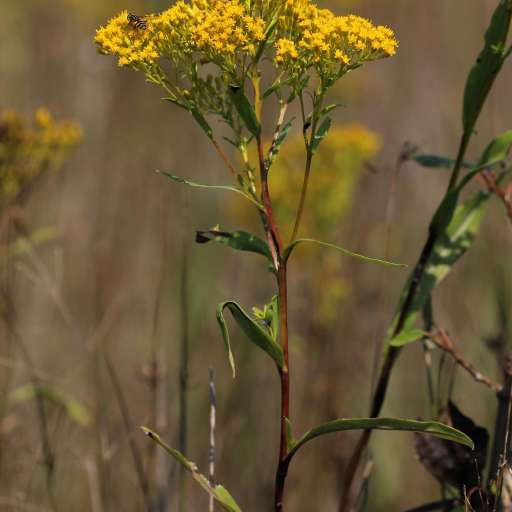
Plant Overview
Often called the "Gold of the Great Lakes," the Ohio Goldenrod is a vibrant perennial that brings a late-season burst of sunshine to damp meadows and shorelines. Unlike its more aggressive cousins, this species is well-behaved in the garden and serves as a vital pit stop for migrating butterflies. For decades, it has been wrongly accused of causing hay fever, but this "guilty by association" myth hides its true identity as a pollinator hero.
🔍 How to Identify
- 🌼 Flat-Topped Flowers: Unlike the plume-like clusters of common goldenrods, this species features dense, flat-topped yellow clusters (corymbs) that look like tiny golden platforms.
- 🌿 Smooth Stems: The stems are remarkably smooth and hairless, reaching about 2 to 3 feet in height, which distinguishes it from many "fuzzy" goldenrod varieties.
- 🍃 Sword-Like Leaves: Its leaves are long, narrow, and strap-like, often staying green at the base of the plant long after others have faded.
🏡 In Your Garden
- 💧 Moisture Lover: Native to fens and wet prairies, this plant thrives in soil that stays consistently moist. It is the perfect choice for a rain garden or a low-spot in your yard where other plants might get "wet feet."
- 🦋 Pollinator Banquet: It is a high-value nectar source for honeybees, native bees, and migrating Monarch butterflies. Planting this is like setting up an all-you-can-eat buffet for the beneficial insects in your neighborhood.
⚠️ Safety & Toxicity
- ✅ Non-Toxic: Solidago ohioensis is generally considered safe and non-toxic for humans, cats, and dogs.
- 🤧 The Allergy Myth: It is almost never the cause of seasonal allergies. Its pollen is heavy and sticky (designed to be carried by bees, not wind). The real culprit is usually Ragweed, which blooms at the same time but has inconspicuous green flowers.
✨ Fun Fact
The Ohio Goldenrod is a "calciphile," meaning it has a special love for calcium-rich, alkaline soils. In the wild, it is often used by ecologists as an "indicator species" to identify rare alkaline fen ecosystems!

Detailed Care Instructions
To grow Solidago Ohioensis, also known as Ohio goldenrod or Ohio tickseed, you can follow these steps:
- Choose a suitable location: Select a location that receives full sun to partial shade. The soil should be well-draining but moist. Avoid areas with standing water or excessive dryness.
- Prepare the soil: Prior to planting, work the soil to a depth of 6-8 inches and remove any weeds or grass. Incorporate organic matter like compost or well-rotted manure to improve soil fertility.
- Planting: Plant the Solidago Ohioensis seeds or seedlings in the prepared soil. If using seeds, lightly cover them with a thin layer of soil. Space the plants about 12-18 inches apart to allow for their spreading habit.
- Watering: Keep the soil consistently moist but not waterlogged to promote germination and healthy growth. Provide regular watering, especially during hot and dry periods.
- Mulching: Apply a layer of organic mulch, like shredded bark or wood chips, around the plants. This will help retain moisture, suppress weeds, and regulate soil temperature.
- Fertilizing: Solidago Ohioensis generally does not require heavy fertilization. However, you can apply a balanced slow-release fertilizer in early spring to promote vigorous growth.
- Pruning: After the plants have finished flowering, you can trim back the stems to encourage bushier growth. Cut them down to about half of their height. This will also prevent the plant from self-seeding excessively.
- Protecting from pests: Solidago Ohioensis is generally not prone to many pest problems. However, keep an eye out for aphids, caterpillars, or leaf miners. If necessary, use insecticidal soap or organic pest control methods to manage infestations.
- Winter care: Ohio goldenrod plants are perennials and will die back in the winter. Provide a layer of mulch around the base of the plants to help insulate the roots and protect them from freezing temperatures.
- Divide and propagate: As the plants mature, they may become crowded. Every 3-4 years, divide the clumps in early spring or late fall. Dig up the clump, separate into smaller sections, and replant them at the same depth.
Solidago Ohioensis is a hardy plant and should thrive with minimal care once established. Enjoy the vibrant yellow blooms that attract bees, butterflies, and other pollinators to your garden.

Place in a bright room that is sun drenched almost all day. Or directly in a south-facing window.

Solidago Ohioensis is a plant that requires regular watering to stay healthy. When watering, it is important to moisten the soil thoroughly, but not to the point of waterlogging the plant. This can be achieved by watering deeply and allowing the soil to dry out slightly between waterings.
It is best to water the plant in the morning or evening when the temperatures are cooler to reduce evaporation. Additionally, it is important to avoid getting water on the leaves to prevent fungal diseases.
When assessing whether or not the plant needs water, check the soil by sticking your finger into it to a depth of one inch. If it feels dry, it is time to water.
Overall, consistent and appropriate watering is key to keeping Solidago Ohioensis healthy and thriving.
To fertilize this plant, apply a slow-release granular fertilizer containing balanced proportions of nitrogen, phosphorus, and potassium. Apply the fertilizer around the base of the plant in early spring, before new growth emerges. Water the plant thoroughly after applying the fertilizer to help dissolve and distribute it evenly. Avoid fertilizing too late in the growing season, as this can encourage excessive growth that may not be hardy enough to survive winter.
The ideal soil for this plant should be well-draining and rich in organic matter. It should have a pH level ranging from slightly acidic to neutral (6.0 to 7.0). The soil should be moist, but not waterlogged, as this can lead to root rot. It is also important that the soil is not too compacted, as this can impede root growth. Loamy soils that are high in sand or clay can be amended with compost or other organic matter to improve their water and nutrient holding capacity. Additionally, the planting site should receive ample sunlight throughout the day.
The propagation of this plant can be done in several ways. One of the most common methods is to divide the root ball. This is usually done in the spring or fall when the plant is either dormant or has finished flowering for the season. To do this, carefully dig up the plant and separate the roots into smaller sections. Each section should have a healthy amount of roots and some stems or shoots.
Another method of propagation is by taking stem cuttings. This is best done in the summer when the plant is actively growing. Take a cutting that is around 4-6 inches long and remove the leaves from the lower half of the stem. Dip the cut end into rooting hormone and plant it in a pot filled with a mixture of peat moss and perlite. Keep the soil moist and the cutting in a warm, bright location until roots form.
Lastly, this plant can also be propagated by collecting and sowing its seeds. The best time to collect seeds is in late summer or early fall, when the plants have finished flowering. Collect the seeds before they fall to the ground and plant them in a well-draining soil mix. Keep the soil moist and in a warm, bright location until the seeds germinate and form seedlings.








