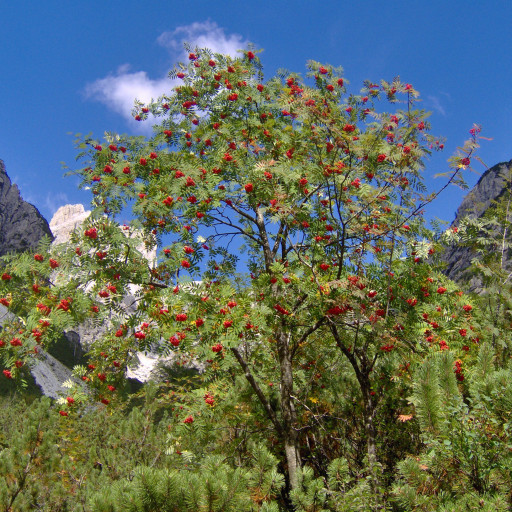
Plant Overview
Often hailed as the "Lady of the Mountains" or the "Witch Wood," Sorbus aucuparia is a tree steeped in ancient European folklore. Known most commonly as the Rowan, it was historically planted near doorways to ward off evil spirits and lightning. Today, it is cherished for its graceful, feathery appearance and the vibrant burst of scarlet berries that light up the landscape as autumn approaches.
🔍 How to Identify
- 🌿 The Foliage: Look for "pinnate" leaves, meaning each leaf is made up of 9–15 small, oval leaflets arranged in pairs along a central stalk, ending with a single leaflet at the tip. The edges are sharply toothed.
- 🌼 The Flowers: In late spring, the tree produces dense, flat-topped clusters of creamy-white flowers. They have a distinct, heavy scent that is highly attractive to pollinating flies and bees.
- 🍒 The Berries: By late summer, the tree yields heavy bunches of glowing orange-to-red berries (pomes). These are a signature feature and persist well into winter if birds don't get to them first.
🏡 In Your Garden
- 🐦 Wildlife Magnet: If you want to see birds, this is your tree. Thrushes, waxwings, and blackbirds will flock to your garden in autumn to feast on the berries, providing endless bird-watching opportunities.
- 🏔️ Hardy Nature: Despite its delicate look, the Rowan is incredibly tough. It thrives in cold climates and high altitudes (hence the name "Mountain Ash"), but it dislikes "wet feet." Ensure your soil is well-draining, as it prefers slightly acidic, sandy loams.
- 🌳 Compact Growth: Unlike massive oaks or maples, the Rowan remains relatively small and slender, making it an ideal choice for urban gardens or smaller backyards where space is at a premium.
⚠️ Safety & Toxicity
- 🐾 Pet Safety: The berries contain parasorbic acid, which can cause stomach upset, vomiting, or lethargy in cats and dogs if consumed in large quantities. The seeds also contain trace amounts of cyanogenic glycosides.
- 👶 Human Caution: Raw berries are very bitter and can cause indigestion, nausea, and vomiting if eaten straight from the tree. However, they are traditionally cooked down into "Rowan Jelly," as heat neutralizes the bitter compounds.
✨ Fun Fact
In Norse mythology, the Rowan is known as the "Deliverance of Thor." Legend says that the god Thor saved himself from being swept away by a fast-flowing river in the underworld by grabbing onto a Rowan branch. Since then, it has been considered a tree of rescue and protection.

Detailed Care Instructions
| Color | White |
| Humidity | Normal |
| Lighting | Part Sun |
| Toxicity | Poisonous |
| Bloom Time | May |
| Difficulty | Easy |
| Plant Type | Tree |
| Hibernation | Cold Period |
| Mature Size | 20–40 Feet Tall |
| Native Area | Asia And Europe |
| Sun Exposure | Full Sun |
| Hardiness Zones | Zones 3–7 |
To grow a Sorbus aucuparia plant, also known as rowan or mountain ash, follow these steps:
- Choose a suitable location: Select a sunny or partially shaded spot with well-draining soil. Rowan trees can tolerate a wide range of soil types but prefer slightly acidic to neutral soil.
- Obtain a healthy plant: Purchase a young Sorbus aucuparia sapling from a reputable nursery or garden center. Alternatively, you can propagate a rowan tree from seeds or hardwood cuttings, but this can be more challenging and time-consuming.
- Planting: Dig a hole that is wider and deeper than the root ball of the sapling. Place the plant in the hole, making sure the top of the root ball is level with the soil surface. Backfill the hole with soil and firm it gently around the roots. Water the plant thoroughly.
- Watering: Keep the soil evenly moist but not waterlogged during the plant's first year. Afterward, rowan trees are more drought-tolerant and usually don't require regular watering unless experiencing extremely dry periods.
- Mulching: Apply a layer of organic mulch, such as wood chips or compost, around the base of the tree. Mulching helps to conserve moisture, suppress weeds, and regulate soil temperature.
- Pruning: Prune the tree in late winter or early spring to remove any dead, damaged, or diseased branches. Thin out any crowded areas to improve airflow and light penetration.
- Fertilizing: Apply a balanced slow-release fertilizer in early spring, following the package instructions. Avoid over-fertilizing, as rowan trees generally thrive without excessive fertilization.
- Pest and disease control: Keep an eye out for common pests like aphids or sawfly larvae, and treat accordingly with insecticidal soap or other organic pest control methods. Diseases such as fire blight or powdery mildew can occasionally affect rowan trees, so monitor for symptoms and apply appropriate treatments if necessary.
- Harvesting berries: If you're interested in the tree's colorful berries, you can harvest them in the late summer or early fall when they turn bright red. Just be aware that rowan berries are usually quite bitter and are generally used for culinary purposes only after being cooked or processed into jams or jellies.
Remember, Sorbus aucuparia trees are hardy and adaptable, and with proper care, they can grow into beautiful and prolific additions to your garden.

Place in a bright room that is sun drenched almost all day. Or directly in a south-facing window.

To water this particular plant, you should first check the soil to make sure it is dry to the touch before watering. When watering, use room temperature water and pour it directly onto the soil. Avoid getting water on the leaves or trunk of the plant. Water thoroughly but make sure not to overwater as this can cause root rot. It is also important to note that this plant prefers well-draining soil, so be sure to avoid letting it sit in standing water. Depending on the climate and conditions, this plant may require more frequent watering in hotter or drier weather.
To fertilize Sorbus Aucuparia, apply a balanced granular fertilizer once in early spring as new growth emerges. Use a fertilizer with an equal ratio of nitrogen, phosphorus, and potassium, and apply it evenly around the base of the plant. Water the plant thoroughly after fertilizing. Avoid over-fertilizing, as it can lead to excessive vegetative growth and reduce flowering and fruit production.
It is recommended to use a well-draining soil mixture with good aeration for this plant. The soil should be acidic to neutral, with a pH range of 4.5-7.5. The soil should also be rich in organic matter, such as compost or peat moss, to provide nutrients for the plant. Avoid using heavy clay soils, as they can retain too much moisture and lead to root rot. Additionally, it is important to add a layer of mulch around the base of the plant to help retain moisture and prevent weed growth. Overall, the soil should provide a balance of nutrients, moisture, and oxygen for the healthy growth and development of the plant.
To propagate this plant, you will need to collect seeds from a mature plant during the Autumn months. These seeds should be chosen from healthy and robust fruit-bearing trees. Clean the seeds and soak them in water for about 24 hours. After that, you can stratify the seeds for around two to three months in a refrigerator at around 1-5 degrees Celsius.
After the stratification period has passed, sow the seeds in a pot or in the ground in the Spring when temperatures are mild. Place the seeds about 1-2 cm deep in the soil, and make sure the soil is well-draining and fertile. Mist the soil frequently with water so that it remains moist. Once the plants have grown a few sets of leaves and become well-established, they can be transplanted to a more permanent location.
Alternatively, you can also propagate Sorbus Aucuparia through hardwood cuttings taken from a healthy and mature tree during the dormant season. Cuttings should have a diameter of around 0.5-1cm, and should be around 20-30cm in length. Remove any leaves or stems from the lower half of the cutting, leaving only the top leaves.
Dip the cuttings into rooting hormone powder and plant them in a well-draining, fertile soil mixture. Keep the cuttings moist and in a bright but sheltered location, and they should root within a few weeks. Once the roots have grown and the plant has become established, it can be transplanted to its permanent location.








