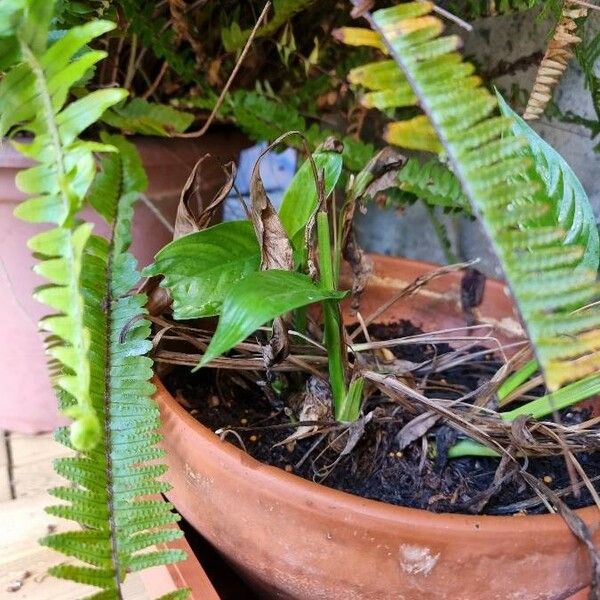
Plant Overview
Known commonly as the Canna-leaf Peace Lily, this elegant tropical beauty is a larger, more robust relative of the classic household Peace Lily. Its name is a nod to its striking resemblance to the Canna plant, celebrated for its broad, lush foliage. In many cultures, these plants are gifted as symbols of peace, purity, and the "white flag" of a fresh start.
🔍 How to Identify
- 🍃 Broad Ribbed Leaves: Unlike the thin, narrow leaves of standard varieties, these are wide, lance-shaped, and feature deep, prominent veins that give them a "pleated" or leathery texture.
- 🏳️ Sturdy White Spathes: The "flower" is actually a modified leaf called a spathe, which curves gracefully around a central, creamy-white spike (the spadix).
- 📏 Upright Growth: This species is an architectural standout, growing in dense, upright clumps that can reach up to 3 feet in height, making it much more substantial than the dwarf hybrids often found in grocery stores.
🏡 In Your Garden
- 💧 The "Dramatics": This plant is famous for its communication skills; it will dramatically wilt or "faint" the moment its soil dries out. While it looks dire, a quick watering usually sees it standing tall again within hours.
- ☁️ Humidity is Key: Coming from the rainforest understory, it craves moist air. If you notice the tips of those beautiful ribbed leaves turning brown and crispy, it’s likely a sign that the air in your home is too dry.
⚠️ Safety & Toxicity
- 🐾 Toxic to Pets: This plant is considered toxic to both cats and dogs.
- 👄 Insoluble Oxalates: It contains calcium oxalate crystals. If chewed or swallowed, it causes immediate mouth pain, swelling of the tongue, and drooling. It is best kept on a high plant stand away from curious pets and toddlers.
✨ Fun Fact
The Spathiphyllum was a star performer in NASA’s famous Clean Air Study! It was found to be one of the top plants for filtering indoor air, capable of breaking down common household toxins like benzene and formaldehyde.

Detailed Care Instructions
| Humidity | Normal |
| Lighting | Shade |
| Toxicity | Poisonous |
| Difficulty | Medium |
| Hibernation | Cold Period |
| Temperature | Min 18°C |
| Hardiness Zones | Max 9A |
To grow Spathiphyllum cannifolium (also known as peace lily or spath), follow these steps:
- Light: Place the plant in a location with bright, indirect light. Avoid direct sunlight as it can burn the leaves. A north or east-facing window is ideal.
- Temperature: Maintain a temperature range of 65-85°F (18-29°C). Keep the plant away from drafts or extreme temperature changes.
- Watering: Keep the soil consistently moist but not waterlogged. Water when the top inch of soil feels slightly dry. The plant may droop when it needs water, but it recovers quickly after watering. Overwatering can lead to root rot.
- Humidity: Spathiphyllum prefers high humidity levels. Increase humidity by misting the leaves with water or placing a tray of water near the plant. You can also use a humidifier.
- Fertilization: Feed the plant monthly during the growing season (spring and summer) with a balanced houseplant fertilizer diluted to half strength. Reduce or stop fertilization during winter.
- Repotting: The peace lily doesn't require frequent repotting. However, if the plant becomes rootbound and outgrows its current pot, you can repot it in a slightly larger container using a well-draining potting mix.
- Pruning: Remove any dead or yellowing leaves to maintain the plant's appearance. Trim off spent flowers to promote new blooms.
- Pest control: Watch out for common houseplant pests like aphids, spider mites, and mealybugs. Use insecticidal soap or neem oil to treat pests, if necessary.
Remember that Spathiphyllum cannifolium is toxic to pets if ingested, so keep it out of their reach. With proper care, your peace lily should grow and thrive.

Place in a dark room with little light, like a dark bedroom or a spot far away from a window or directly in a north-facing window.

Spathiphyllum cannifolium plant belongs to the Araceae family and requires moderate watering. It is important to keep the soil moist but not waterlogged. Watering should be done when the top layer of soil is dry to the touch. It is recommended to water the plant thoroughly until water drains out of the bottom of the pot, but excess water should be drained immediately to avoid root rot. During winter, the plant requires less water and may only need to be watered once a week. It is important to use room temperature water and avoid using water that is too cold or too hot as it may damage the plant.
To fertilize this plant, use a balanced, water-soluble fertilizer once every two weeks during the growing season (typically spring and summer), and reduce fertilization to once a month during the fall and winter. Dilute the fertilizer to half strength and apply it to the soil around the plant's roots, being careful not to get any on the leaves. Water the plant thoroughly after fertilizing. Avoid fertilizing a newly repotted plant for at least six months to allow it to establish its roots before introducing fertilizer.
For the Spathiphyllum Cannifolium plant, it is recommended to use well-draining soil that is rich in nutrients. The soil should be slightly acidic with a pH range between 5.5 and 7.0. A potting mix that is designed for indoor plants or a mixture of peat moss, perlite, and vermiculite can be used. It is important to avoid using heavy soils or soils that retain too much water, as this can lead to root rot. Additionally, adding organic matter or slow-release fertilizers to the soil can help to promote healthy growth. Overall, the soil should provide proper drainage and nutrient uptake for optimal plant health.
To propagate this plant, start by selecting a healthy and mature green leaf. Cut the leaf stem an inch or two away from the base and dip the cut end into rooting hormone. Plant this cutting in a well-draining potting mix made of peat moss and perlite.
Water the cutting thoroughly and place it in a warm and humid spot that receives indirect sunlight. Keep the soil moist but not soggy, and mist the cutting every few days to maintain humidity.
After a few weeks, you may notice new leaves sprouting from the base of the stem. This indicates that the cutting has successfully rooted. Once the new growth has grown a few inches tall, you can transplant it into a larger pot with regular potting soil.
Remember to keep the plant in a warm and humid environment for the first few weeks after transplanting to help it adjust to its new environment. With proper care, the propagated plant will continue to grow and thrive.








