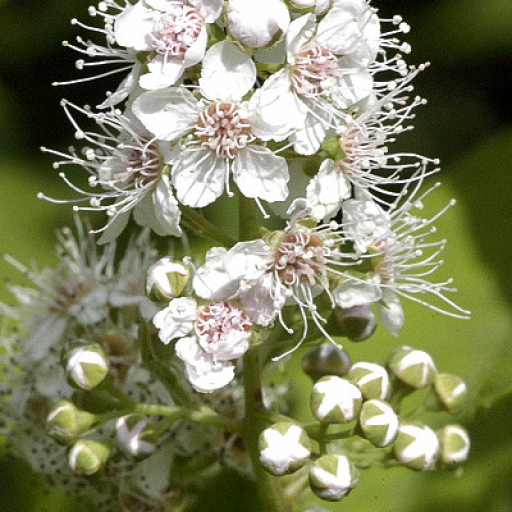
Plant Overview
Known affectionately as "White Meadowsweet" or "Narrow-leaf Meadowsweet," Spiraea alba is a resilient North American native that acts as a luminous beacon for pollinators. Historically, its fragrant stems were used as "strewing herbs" to freshen the air in homes, and its tough, flexible wood was once crafted into arrows. Today, it is celebrated for its ability to thrive in damp spots where other garden plants might struggle.
🔍 How to Identify
- 🌿 Flower Steeples: Look for upright, cone-shaped clusters (panicles) of tiny, five-petaled white flowers that bloom from the top of the plant in mid-to-late summer.
- 🍃 Narrow Foliage: The leaves are slender, oblong, and sharply toothed along the edges, arranged alternately along the stems.
- 🪵 Reddish Stems: The young branches are often a distinct reddish-brown or yellowish-brown, growing in a dense, twiggy thicket that reaches about 3 to 6 feet in height.
🏡 In Your Garden
- 💧 The Wet-Foot Wonder: This shrub is a champion of rain gardens and shoreline restoration. It naturally prefers "wet feet" and thrives in moist, boggy, or poorly drained soils that would cause root rot in other species.
- 🦋 A Pollinator Party: It is a high-value nectar source for various butterflies, including the Azure and Hairstreak varieties, and provides essential cover for nesting songbirds.
- ✂️ Pruning Nuance: Because it blooms on "new wood" (the current season's growth), you can prune it back hard in late winter or early spring without sacrificing the summer flower show.
⚠️ Safety & Toxicity
- ✅ Generally Safe: Spiraea alba is considered non-toxic to humans, dogs, and cats. It is a safe choice for family-friendly landscapes.
- 🍵 Aspirin Note: Like many members of the Rosaceae family, it contains compounds related to salicylic acid (the precursor to aspirin). While not hazardous to touch, those with severe aspirin allergies should avoid consuming any traditional teas made from the plant.
✨ Fun Fact
The genus name Spiraea comes from the Greek word "speira," meaning wreath or coil. This refers to the plant's flexible, wiry branches, which were historically twisted and woven into festive bridal garlands and floral crowns.

Detailed Care Instructions
| Humidity | Normal |
| Lighting | Full Sun |
| Difficulty | Medium |
| Hibernation | Cold Period |
| Temperature | 13°C - 18°C |
| Hardiness Zones | 3 - 8 |
To grow Spiraea alba, also known as meadowsweet, follow these steps:
- Choose the right location: Spiraea alba prefers full sun to partial shade. Ensure that the location has well-drained soil and good air circulation.
- Prepare the soil: Before planting, amend the soil with organic matter to improve its fertility and drainage. This can be done by incorporating compost or well-rotted manure into the soil.
- Plant the shrub: Dig a hole that is slightly wider and deeper than the plant's root ball. Place the plant in the hole and backfill with soil, gently firming it around the roots. Water thoroughly after planting.
- Watering: Keep the soil consistently moist, especially during the plant's first year of growth. Provide deep, thorough waterings rather than frequent light watering.
- Mulching: Apply a layer of organic mulch around the base of the shrub to conserve moisture, suppress weed growth, and maintain a more even soil temperature. Mulch should be kept a few inches away from the plant's stem to prevent rot.
- Pruning: After flowering, prune Spiraea alba by removing old or damaged branches. This will help maintain the plant's shape and encourage new growth. Light pruning can also be done in early spring to promote bushier growth.
- Fertilizing: Meadowspirea generally doesn't require much fertilization. Apply a balanced, slow-release fertilizer in early spring if necessary.
- Pest and disease control: Spiraea alba is typically resistant to pests and diseases. However, occasional issues with aphids, mealybugs, or powdery mildew may occur. Treat these issues using appropriate organic pest control methods or horticultural soap.
- Propagation: Meadowspirea can be propagated from seeds or through softwood cuttings in late spring or early summer. Seeds should be stratified (kept in moist cold conditions) for a few months before planting.
By following these steps, you can successfully grow Spiraea alba and enjoy its beautiful foliage and delicate white flowers.

Place in a window with dappled sun or a spot in the middle of a room. Or directly in a window facing west or east.

Spiraea Alba is a type of flowering plant that requires moderate watering to thrive. You should aim to water the plant once a week during the growing season, making sure that the soil is evenly moist but not waterlogged. When watering, try to avoid getting water on the leaves or flowers, as this can promote the growth of fungi and other plant diseases. Instead, aim to water at the base of the plant, using a watering can or a hose with a gentle spray nozzle. During periods of drought or extreme heat, you may need to water the plant more frequently to prevent it from drying out. In general, Spiraea Alba prefers well-draining soil and will not tolerate standing water or waterlogged conditions. As such, you should avoid overwatering or allowing water to accumulate in the plant's root zone.
To fertilize this plant, select a balanced fertilizer with a NPK ratio of around 10-10-10. Apply the fertilizer in the spring and again in midsummer. Follow the package instructions for the amount of fertilizer to use based on the size of your plant. Avoid fertilizing during the fall or winter months, when the plant is dormant. Spread the fertilizer evenly around the base of the plant, being careful not to touch the stems or leaves. Water the plant well after fertilizing.
Spiraea Alba is a plant that requires well-drained soil that is moist and fertile. The soil should have a moderately acidic to slightly alkaline pH level. The plant prefers loamy or sandy soil that is rich in organic matter. The soil should be nutrient-rich and have a depth of at least 12 inches. It is important to ensure that the soil does not become waterlogged or too dry as this can cause stress to the plant. A good soil mix would be a mixture of compost, peat moss, and sand. It is also important to fertilize the soil every year to maintain healthy growth of the plant.
To propagate this plant, take a stem cutting from a healthy mother plant. Select a stem that is at least 4-6 inches long and has several leaves and nodes. Cut the stem at a 45-degree angle with a clean, sharp pair of scissors or pruning shears. Remove any leaves from the bottom two-thirds of the stem and dip the cut end into rooting hormone powder.
Fill a small pot with a well-draining potting mix, such as a mixture of peat moss, perlite, and vermiculite. Make a hole in the soil with a pencil or similar tool and insert the stem cutting. Water the soil gently to settle it around the stem, but avoid overwatering which may cause the cutting to rot.
Place the pot in a bright, but not direct, location. It is important to keep the soil moist but not saturated. Also, ensure that the plant receives good air circulation, but avoid exposing it to harsh wind or cold drafts.
Within a few weeks, the cutting should begin to develop roots and new growth. After 4-6 weeks, check the roots by gently tugging on the stem. If you feel resistance, it means the plant has rooted and is ready to be transplanted to a larger pot or into the garden soil.
With proper care and maintenance, your new plant should grow into a healthy and beautiful spiraea alba plant.








