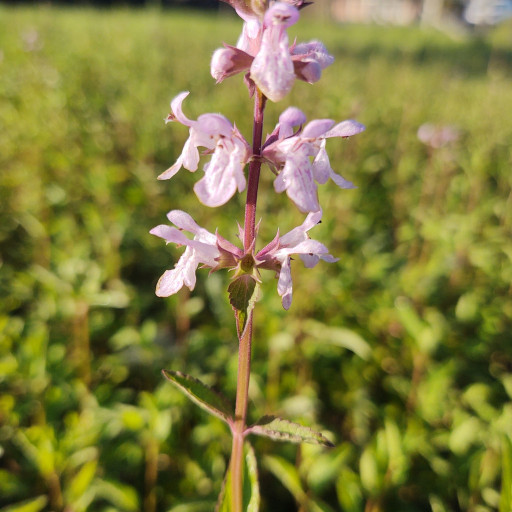
Plant Overview
Often called the "Rattlesnake Weed," Stachys floridana is a resilient member of the mint family native to the Southeastern United States. While many lawn-proud gardeners view its aggressive spreading as a persistent headache, foragers treasure it for its unique, crunchy tubers. It is a plant of dual identities—a "stubborn weed" to some and a "hidden delicacy" to others.
🔍 How to Identify
- 🌿 Square Stems: As a member of the mint family, it features distinct four-sided stems that are slightly hairy and grow upright.
- 🌸 Lavender Blooms: It produces delicate, tubular flowers in the spring that are pale purple or pink, often decorated with darker spots to guide pollinators.
- 🦴 The "Rattle" Tubers: The most iconic feature is hidden underground; it grows white, segmented tubers that look remarkably like the rattle on the tail of a rattlesnake.
🏡 In Your Garden
- 🌱 Aggressive Spreader: This plant thrives in loose, moist soil and spreads rapidly via underground runners. If you find one in your garden bed, there is likely a massive network of tubers hiding just beneath the surface.
- 🤺 Persistence: It is notoriously difficult to eradicate because the brittle tubers break apart easily when pulled. Each tiny segment left in the soil has the potential to sprout into a brand-new plant the following season.
⚠️ Safety & Toxicity
- ✅ Edible Tubers: The white, crisp tubers are entirely edible for humans. They have a texture similar to a water chestnut or a radish and can be eaten raw, pickled, or tossed into stir-fries.
- 🐾 Pet Safety: Florida Betony is generally considered non-toxic to cats and dogs. However, as with any plant, keep an eye on pets to ensure they don't develop an upset stomach from overindulging in the crunchy roots.
✨ Fun Fact
The tubers are often called "Florida Radishes." Many foragers describe their flavor as a mild, slightly sweet cross between a jicama and a radish—making them one of the few garden "weeds" that provides a free harvest!

Detailed Care Instructions
To grow Stachys Floridana plants, also known as Florida Hedgenettle or Florida Betony, follow these steps:
- Choose the right location: Stachys Floridana prefers partial shade to full sun, so select a spot in your garden that receives 4-6 hours of sunlight per day. It also prefers moist, well-draining soil.
- Prepare the soil: Before planting, amend the soil with organic matter like compost or aged manure to improve drainage and nutrient content. Remove any weeds or grass from the planting area.
- Planting: Dig a hole slightly larger than the plant's root ball. Loosen the soil in the hole and place the plant in, ensuring it sits at the same depth as it did in the nursery container. Gently backfill the hole with soil, pressing it down around the roots.
- Watering: Give the plant a thorough watering after planting to settle the soil and help establish the roots. Stachys Floridana prefers consistently moist soil, so water regularly to keep the soil evenly moist, but not waterlogged.
- Mulching: Apply a layer of organic mulch around the base of the plant to help retain moisture, suppress weeds, and regulate soil temperature. Be sure to keep the mulch a few inches away from the stem to prevent rot.
- Fertilizing: Stachys Floridana does not require heavy fertilization, but a balanced, slow-release fertilizer can be applied in spring to promote healthy growth. Follow the instructions on the fertilizer packaging for the correct dosage.
- Pruning: While Stachys Floridana doesn't require much pruning, you can trim back any dead or damaged foliage to maintain a tidy appearance. However, avoid excessive pruning as this plant may take some time to bounce back.
- Pests and Diseases: Stachys Floridana is typically resistant to pests and diseases. However, keeping the plant well-watered and properly spaced can help prevent issues like powdery mildew.
- Propagation: Stachys Floridana can be propagated through division or stem cuttings. Divide the plant in early spring, making sure each division has some roots attached. Alternatively, take stem cuttings in summer and place in a well-draining soil mix to root.
By following these guidelines, you can successfully grow Stachys Floridana plants in your garden and enjoy their attractive foliage and flowers.

Place in a window with dappled sun or a spot in the middle of a room. Or directly in a window facing west or east.

To water this plant, it is important to do so deeply and infrequently. This means that instead of watering it lightly every day, it is better to water it thoroughly once a week. Make sure the soil is moist but not waterlogged, and avoid getting water on the foliage as this can promote fungal growth. Check the soil regularly to make sure it is not drying out too much between waterings, especially during hot, dry weather. Use a drip irrigation system or a watering can with a narrow spout to direct water at the base of the plant and avoid wetting the leaves.
To fertilize Stachys Floridana plant, use a balanced slow-release fertilizer during the spring once new growth begins. Apply the fertilizer evenly around the plant, avoiding direct contact with the stem. Water thoroughly after applying. Avoid fertilizing in the fall or winter as it can encourage new growth that may not be able to withstand cold weather.
Stachys floridana is a plant that thrives best in well-draining soils that are rich in organic matter. The soil should be moist but not waterlogged, and it should have a slightly acidic to neutral pH level. It is recommended to use a potting mix that is composed of peat moss, vermiculite, and perlite. Alternatively, you can mix your garden soil with compost, sand, and perlite to ensure good drainage. Avoid using heavy clay soils as they tend to retain water and can cause root rot. It is also important to ensure that the soil is adequately aerated to promote healthy roots.
To propagate this plant, you can take stem cuttings from the plant. Select healthy stems and cut them at an angle with a clean, sharp knife. Remove the lower leaves from the stem cutting, leaving only the top leaves intact. Dip the cut end of the stem cutting in rooting hormone powder to promote root development. Place the stem cutting in a container filled with moist potting soil or perlite. Cover the container with plastic wrap to create a greenhouse-like environment. Keep the soil moist and provide bright, indirect light. After a few weeks, the stem cutting should begin to take root. Gradually remove the plastic wrap and increase the amount of light the cutting receives. Once the plant has developed a strong root system, it can be transplanted into a larger container or into the garden.








