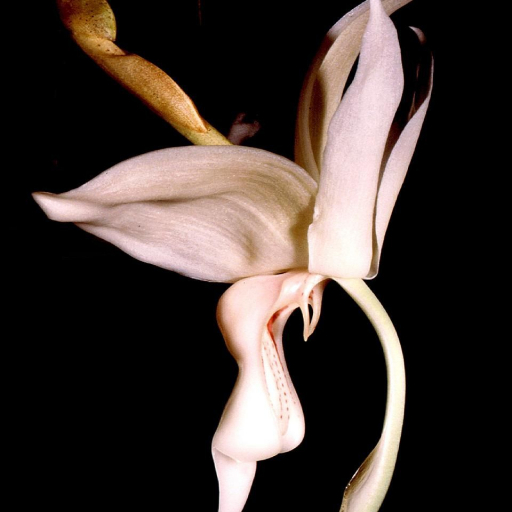
Plant Overview
Known as the "Bird-Head Orchid" or "Grand Stanhopea," this dramatic species is famous for its waxy, ivory-white blooms that appear to defy gravity. Native to the humid forests of South America, it doesn’t just grow; it puts on a theatrical performance, releasing a scent so powerful it can fill an entire room with notes of chocolate and vanilla. It is a favorite among orchid enthusiasts who enjoy a bit of botanical "weirdness."
🔍 How to Identify
- 🌸 Downward Blooms: Unlike most orchids that reach for the sky, the flower spikes of this plant grow straight through the bottom of the substrate, dangling beneath the plant.
- 🦢 The "Bird Head" Lip: The central part of the flower (the lip) is structurally complex, featuring fleshy, horn-like projections that look remarkably like the head and neck of a swan.
- 🍃 Pleated Foliage: It features large, dark green, ribbed leaves that emerge from tough, egg-shaped pseudobulbs, giving the plant a lush, tropical look even when not in bloom.
🏡 In Your Garden
- 🧺 The Basket Rule: Because the flowers emerge from the bottom of the root ball, you must grow this plant in a wire or slatted wooden basket. If planted in a standard solid pot, the flower spikes will get trapped inside the soil and rot before they ever see the light.
- ☁️ Atmospheric Needs: This orchid is a "heavy drinker" that loves high humidity. It prefers "dappled" light—think of the light filtering through a thick tree canopy—and hates being bone-dry. If the leaves start to get brown tips, it’s a sign your air is too dry.
⚠️ Safety & Toxicity
- 🐾 Pet Friendly: Good news for pet parents! Stanhopea grandiflora is considered non-toxic to cats and dogs.
- 👶 Safe for Humans: There are no known toxicities for humans, though the waxy texture of the flowers can be a tempting (but unpleasant-tasting) target for curious toddlers.
✨ Fun Fact
The flowers of the Stanhopea are "fast and furious." While they are some of the most spectacular in the orchid world, each bloom usually lasts only 2 to 4 days. The plant puts all its energy into a short, intoxicating burst of fragrance to attract specific male Euglossine bees, who "collect" the flower's scent to use as a pheromone to attract their own mates!

Detailed Care Instructions
To water this orchid plant, first check the soil moisture level by sticking your finger about an inch into the soil. If the soil feels dry, it is time to water. Use room temperature water and pour it gently onto the soil until it starts to run out of the drainage holes. Avoid getting water on the leaves or flowers as this may cause damage or rot. Watering frequency will depend on several factors such as temperature, humidity, and the size of the pot. However, it is generally recommended to water once or twice a week during the growing season and reduce watering during the dormant season. It is important not to let the soil completely dry out between waterings, but also not to let it sit in water as this can cause root rot.
For Stanhopea Grandiflora plants, it is best to use a well-draining soil mix that is rich in nutrients. The soil should not be too heavy or too compact as it may lead to poor growth and development of the plant. A mixture of organic matter such as sphagnum moss, bark, and perlite is highly recommended. The pH level of the soil should also be slightly acidic to neutral, preferably between 6.0 to 7.0. It is important to avoid overwatering the plant as it can lead to root rot and fungal diseases. Therefore, it is best to allow the soil to dry out between watering to ensure the plant gets enough oxygen. Adequate sunlight exposure, adequate humidity, and moderate temperature levels are also crucial for the plant's growth.








