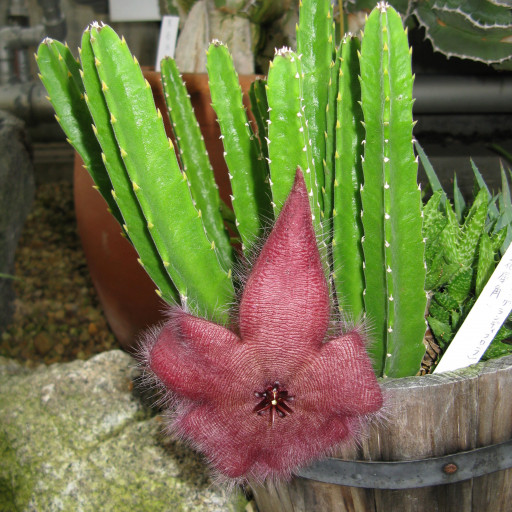
Plant Overview
Often called the "Starfish Flower" or the more provocative "Carrion Plant," Stapelia grandiflora is nature’s master of deception. Native to the arid regions of South Africa, it looks as though a velvet sea creature has crawled out of the ocean and into your garden. While its massive, hairy blooms are breathtakingly beautiful, they are famous for a "stinky" secret designed to lure in very specific prehistoric pollinators.
🔍 How to Identify
- 🌵 The Stems: Thick, succulent, and four-angled. These upright green stems have a soft, velvety texture and lack the sharp spines found on true cacti.
- 🌸 The Bloom: Massive, five-lobed flowers that can reach the size of a dinner plate. They are star-shaped and covered in fine, reddish-purple hairs that catch the light.
- 🎨 Coloration: Deep maroon, chocolate brown, or purple-red, often marked with intricate horizontal ripples that mimic the appearance of decaying organic matter.
🏡 In Your Garden
- 👃 Strategic Placement: While the flowers are a visual masterpiece, they emit an odor similar to rotting meat to attract flies. It is best grown on a sunny patio or in a well-ventilated greenhouse rather than on a cramped kitchen windowsill!
- 🪴 Drainage is Non-Negotiable: Like most desert succulents, this plant is "allergic" to wet feet. It has a relatively shallow root system and prefers gritty, sandy soil; if left in standing water, the stems will turn to mush almost overnight.
- ☀️ The Sun-Stress Signal: If the stems start turning a purplish-red color, the plant is telling you it’s getting plenty of sun. While a little "blush" is fine, deep scorching means it needs a bit more afternoon shade.
⚠️ Safety & Toxicity
- 🐾 Safe for Pets: Unlike many succulents (such as the toxic Kalanchoe or Euphorbia), the Stapelia grandiflora is generally considered non-toxic to cats and dogs.
- 🖐️ Sap Sensitivity: While it isn't poisonous, the sap can be a mild irritant to those with sensitive skin. It is always a good practice to wash your hands after pruning or taking cuttings.
✨ Fun Fact
- 🪰 The Great Bamboozle: To ensure pollination, the plant doesn't just smell like a carcass; the fine hairs on the petals move slightly in the breeze to mimic the movement of maggots. This tricks flies so effectively that they often lay their eggs in the center of the flower, unintentionally moving pollen from one "stinky star" to the next!

Detailed Care Instructions
| Humidity | Dry |
| Lighting | Part Sun |
| Difficulty | Easy |
| Hardiness Zones | 9A - 11 |
To grow Stapelia Grandiflora, also known as Carrion Flower, you can follow these steps:
- Climate: Carrion Flower is a succulent plant native to South Africa, so it thrives in warm and dry climates. Ideally, keep the plant in an area where the temperature is between 65 to 85°F (18 to 29°C).
- Light: It requires bright indirect sunlight. Place the plant near a south or west-facing window where it can receive ample indirect light. Avoid direct sunlight, as it can scorch the leaves.
- Soil: Carrion Flower prefers well-draining soil to prevent root rot. Use a potting mix specifically formulated for cacti and succulents, or create a mix by combining equal parts of perlite, sand, and peat moss.
- Container: Choose a pot with drainage holes to allow excess water to escape. The pot should be slightly larger than the root ball, as Stapelia plants prefer to be slightly root-bound.
- Watering: Water the plant sparingly. Allow the soil to completely dry out between waterings, then water deeply until water drains out of the bottom of the pot. During winter, reduce watering frequency.
- Fertilization: Feed the plant diluted succulent or cacti fertilizer once a month during the growing season (spring and summer). Follow the instructions on the fertilizer label for proper dilution ratios.
- Pruning: Carrion Flower rarely requires pruning. However, if you notice any dead or damaged stems or leaves, remove them with clean, sharp pruning shears.
- Propagation: Propagate the plant by stem cuttings. Take a healthy stem cutting and allow it to dry for a few days until the cut end forms a callous. Plant the cutting in a well-draining succulent mix and keep it slightly moist until roots develop.
- Pests and diseases: Carrion Flower is generally resistant to pests and diseases. However, keep an eye out for mealybugs and spider mites. If infested, use an insecticidal soap or neem oil spray to eliminate the pests.
Remember to research and follow specific care instructions for your specific cultivar of Stapelia Grandiflora, as different varieties may have slightly different growing requirements.

Place in a bright room that is sun drenched almost all day. Or directly in a south-facing window.

To water this plant, you should first make sure that the soil is completely dry before watering. Then, slowly pour water at the base of the plant, avoiding getting water on the leaves or flowers. Be sure to not overwater, as this plant prefers drier conditions and can be susceptible to root rot. Additionally, make sure the plant has proper drainage and is not sitting in standing water.
- Use a balanced fertilizer with equal parts nitrogen, phosphorus, and potassium.
- Dilute the fertilizer to half strength according to the package instructions.
- Apply the fertilizer only during the active growing season, which is typically in the spring and summer months.
- Apply the fertilizer every other week to prevent over-fertilizing.
- Water the plant thoroughly before and after applying the fertilizer.
The ideal soil for this plant should be well-draining and porous, with a pH level between 6.0 and 7.5. It should contain a mix of organic matter, such as peat moss or compost, and coarse sand or perlite to ensure adequate drainage. A good soil mix for this plant would consist of approximately 50% organic matter and 50% coarse, gritty material. It is important to avoid using heavy clay soils or soils that retain too much moisture, as this can lead to root rot and other problems. Additionally, it is important to use a nutrient-rich soil mix that provides adequate levels of minerals and trace elements that are essential for healthy growth and flowering.
One way to propagate this plant is by using stem cuttings. Choose a healthy stem, making sure it is not too young or too old. Cut a section of the stem with a sharp and clean knife, making sure to include at least two nodes. Remove any leaves or flower buds from the stem cutting, as they can inhibit its ability to root.
Next, allow the stem cutting to dry for a few days. This will help prevent rot once it is planted. Once the cut end has dried, fill a pot with well-draining soil and plant the stem cutting. Water the soil lightly and cover the pot with a plastic bag or a clear plastic container to create a humid environment.
Place the potted plant in a bright, warm location with indirect sunlight. After a few weeks, the stem cutting should start to grow roots. Once the plant has established a root system, it can be transferred to a larger pot and grown as usual.
Common pests of the starfish cactus include Scale insect, mealybugs, spider mites, thrips. Make a habit of checking your starfish cactus frequently for pests so that any infestations can be caught and managed early.








