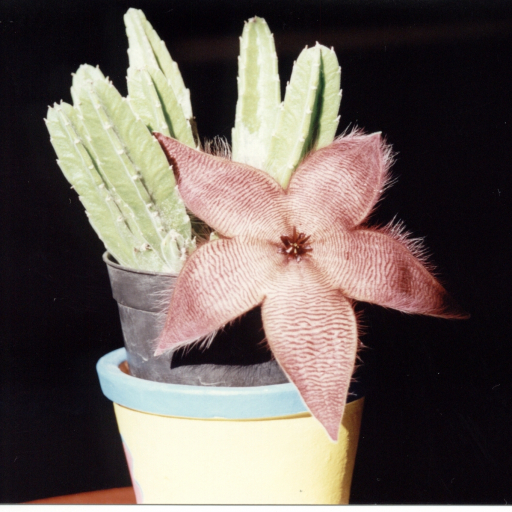
Plant Overview
Known colloquially as the Starfish Flower or the Carrion Plant, Stapelia hirsuta is a show-stopping succulent from South Africa that looks like it belongs on the floor of a tropical ocean rather than in a desert. While it spends most of its time as a humble cluster of green stems, its bloom is a dramatic, fuzzy masterpiece designed to trick the senses.
🔍 How to Identify
- 🌵 The Stems: Features upright, fleshy, four-angled stems that are soft to the touch and a dull green color, occasionally blushing purple in high sun.
- ⭐ The Bloom: A large, flat, five-pointed star-shaped flower. The petals are covered in dense, silky purple hairs that give it a "shaggy" or "hirsute" appearance.
- 🦓 The Pattern: The base color of the petals is usually a creamy yellow, heavily marked with intricate, horizontal maroon or chocolate-brown stripes.
🏡 In Your Garden
- 🏜️ Drainage is Non-Negotiable: Because this plant stores water in its thick stems, it is highly susceptible to root rot. It prefers a very gritty, "fast" soil mix and hates sitting in a saucer of water.
- 👃 A Pungent Surprise: Unlike roses, these flowers emit a distinct odor of decaying meat. This is a brilliant evolutionary tactic to attract carrion flies for pollination. You may want to keep it on a breezy patio rather than a closed bedroom when it’s in bloom!
- 🌡️ Winter Dormancy: It prefers to stay dry and cool during the winter months. Withholding water during the cold season mimics its natural habitat and encourages more prolific blooming in the summer.
⚠️ Safety & Toxicity
- 🟢 Non-Toxic: Stapelia hirsuta is generally considered non-toxic to humans, cats, and dogs, making it a safe choice for households with curious pets.
- 🖐️ Sap Sensitivity: While not poisonous, the milky sap inside the stems can cause mild skin irritation for people with sensitive skin. It is wise to wash your hands after taking cuttings or pruning.
✨ Fun Fact
The plant is so convincing in its "dead animal" disguise that flies will often be fooled into laying their eggs right in the center of the flower. When the larvae hatch, they find no food and eventually perish, but the plant successfully hitches a ride for its pollen in the process!

Detailed Care Instructions
| Humidity | Normal |
| Lighting | Full Sun |
| Difficulty | Medium |
| Hardiness Zones | 9A - 11B |
To grow a Stapelia Hirsuta plant, also known as the Carrion Flower, you will need to follow these steps:
- Start with a healthy cutting or an established plant: Obtain a cutting or purchase a fully-grown Stapelia Hirsuta plant from a reputable nursery or online seller.
- Choose a suitable container: Select a small pot or container with a drainage hole to avoid waterlogging. Use a cactus or succulent potting mix, or create your own by mixing regular potting soil with some sand or perlite to improve drainage.
- Plant the cutting: If you have a cutting, let it dry for a few days until the cut end callouses over. Then gently press the calloused end into the soil, making sure it makes good contact with the soil and supports itself.
- Provide the right lighting: Place your Stapelia Hirsuta in a location that receives bright, indirect sunlight. Avoid direct sunlight, as it can scorch the leaves. A south or east-facing window usually provides suitable light conditions.
- Maintain optimal temperature: Stapelia Hirsuta prefers warm temperatures between 65-85°F (18-30°C). Protect it from cold drafts and keep it away from windows during winter to prevent chilling.
- Water properly: Water the plant thoroughly when the top inch (2.5 cm) of soil feels dry but avoid overwatering or leaving the soil soggy. Carrion plants are native to arid regions and can tolerate drought better than excess moisture. Ensure good drainage to prevent root rot.
- Provide proper humidity: Stapelia Hirsuta plants don't require high humidity levels. Average household humidity is typically suitable, but if your environment is dry, you can occasional mist the plant or place a small tray of water nearby to increase humidity.
- Fertilize sparingly: Use a diluted, balanced houseplant fertilizer during the growing season (spring and summer) only. Follow the instructions on the fertilizer package and apply it every 4-6 weeks.
- Prune or propagate if desired: If your plant becomes leggy or elongated, you can prune it back to encourage a more compact growth. Propagation can be done by taking stem cuttings and replanting them in a similar manner as mentioned in step 3.
- Watch for pests and diseases: Keep an eye out for common succulent pests like mealybugs or spider mites. Treat any infestations promptly with appropriate insecticides or mild soapy water.
By following these steps, you should be able to successfully grow and enjoy your Stapelia Hirsuta plant.

Place in a window with dappled sun or a spot in the middle of a room. Or directly in a window facing west or east.

Stapelia Hirsuta plant requires regular watering to ensure healthy growth. It is important to note that over-watering can lead to root rot and ultimately kill the plant. The plant should be watered only when the soil is completely dry, typically every 7-10 days.
When watering, make sure to thoroughly saturate the soil and allow any excess water to drain away from the plant. It is recommended to use room temperature water, as cold water can shock the plant’s roots.
One way to test if the soil is ready for watering is to stick your finger about an inch into the soil. If it feels dry, it is time to water.
During the winter months, the plant will require less frequent watering, typically every 15-20 days. Additionally, the plant should be kept in a well-draining pot to prevent the soil from becoming waterlogged.
To fertilize this particular plant, you will need to use a balanced liquid fertilizer with a ratio of 10-10-10, or a similar NPK ratio. Dilute the fertilizer according to the instructions on the package, and apply it to the soil every two weeks during the growing season (spring and summer). Avoid fertilizing during the dormant period (fall and winter). Be sure to water the plant well before and after fertilizing to prevent fertilizer burn.
Stapelia Hirsuta plant is a succulent plant that requires well-draining soil with good moisture retention. The ideal soil mix would consist of a combination of potting soil, coarse sand, and perlite or pumice. The soil should be slightly acidic with a pH of around 6.0 to 7.0. It is important to avoid using heavy soils that will hold too much water and cause root rot. Additionally, the plant should be grown in a well-draining pot that is at least 2-3 inches bigger than the root ball of the plant. The pot should have drainage holes at the bottom to allow excess water to drain away. The plant also prefers bright, indirect sunlight and should be watered sparingly only when the soil is completely dry.
Propagation of this plant can be done through stem cuttings. First, select a healthy stem and cut a piece that is about 4-6 inches long. Make sure the cutting has a few nodes, which are the areas where leaves grow. Next, place the cutting in a well-draining soil mix and water it lightly. Keep the soil moist, but not too wet, and place the cutting in a warm, bright location. Within a few weeks, roots should start to develop and the cutting will begin to grow new leaves. Once the cutting has established roots, it can be transplanted into a larger pot with regular potting soil and treated like a mature plant.
Common pests of the hairy starfish-flower include Scale insect, mealybugs, spider mites, thrips. Make a habit of checking your hairy starfish-flower frequently for pests so that any infestations can be caught and managed early.








