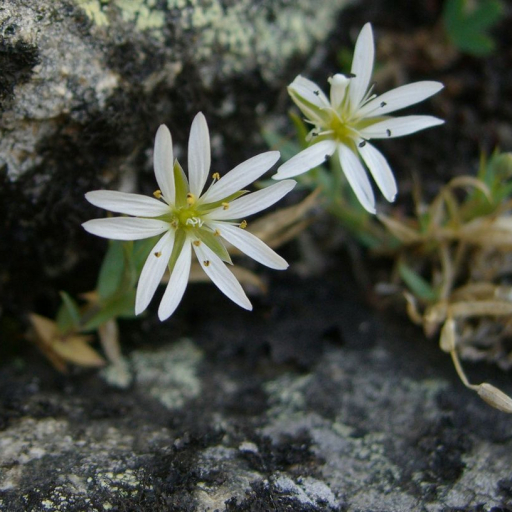
Plant Overview
Commonly known as the Long-stalked Starwort or Long-stalked Stitchwort, this delicate-looking wildflower is a true survivor of the northern hemisphere. Often found dotting alpine meadows and arctic tundras, it earns its name from its exceptionally slender stems that hold tiny, star-shaped blossoms toward the sun. In folklore, stitchworts were once believed to be a "cure" for a "stitch" in the side, though today they are admired more for their resilient beauty in harsh landscapes.
🔍 How to Identify
- ⭐ The Petals: It features five white petals that are so deeply notched they look like ten individual petals, creating a distinct "star" shape.
- 🌿 The Foliage: The leaves are narrow, lance-shaped, and usually grow in opposite pairs along the stem, often displaying a waxy, bluish-green (glaucous) tint.
- 📏 The Stems: True to its name, the flower stalks (pedicels) are noticeably long and hairless, allowing the flowers to dance slightly in the wind.
🏡 In Your Garden
- 🏔️ Alpine Aspirations: This plant is best suited for rock gardens or "scree" plantings where drainage is superb. It thrives in cool, northern climates and struggles in high humidity or intense tropical heat.
- 🌬️ A Tough Character: Unlike many delicate garden flowers, Stellaria longipes is adapted to "disturbed" soil. It uses a creeping root system (rhizomes) to stabilize itself in rocky areas, making it a great choice for naturalizing a rugged landscape.
⚠️ Safety & Toxicity
- 🟢 General Status: Generally considered non-toxic and safe for humans and most common garden visitors.
- 🐾 Pet Watch: While not listed as a high-risk plant, most "stitchworts" contain saponins. If consumed in very large quantities, they might cause mild digestive upset in curious dogs or cats. It is always best to discourage grazing.
✨ Fun Fact
Stellaria longipes is a "shape-shifter" of the plant world! Scientists study it for its "phenotypic plasticity"—it can drastically change its height and leaf size depending on whether it’s growing in a windy mountain peak or a sheltered valley. It effectively "redesigns" itself to survive its specific environment.

Detailed Care Instructions
To grow Stellaria longipes plant, also known as Longstalk Starwort, you can follow these steps:
- Acquire seeds or plants: You can purchase Stellaria longipes seeds or seedlings from nurseries or online retailers specializing in native or rare plants.
- Choose an appropriate location: Stellaria longipes prefers partial shade to full sun, so select a location in your garden that receives some direct sunlight and is well-draining.
- Soil preparation: Prepare the soil by removing any weeds or grasses and loosening it with a garden fork or a tiller. Stellaria longipes prefers moist, sandy loam soil.
- Plant the seeds or seedlings: If you have seeds, sow them directly in the prepared soil at a depth of ¼ inch (0.6 cm). Space the seeds about 12-18 inches (30-45 cm) apart. If you have seedlings, transplant them carefully into the prepared soil.
- Watering: Keep the soil consistently moist but not waterlogged. Water the plants regularly, especially during hot, dry periods.
- Mulching: Use organic mulch, such as straw or wood chips, around the plants to help retain moisture and control weed growth.
- Fertilization: Stellaria longipes does not generally require fertilization. However, you can use a slow-release fertilizer sparingly in the spring if necessary.
- Pruning: If the plant becomes leggy or overgrown, you can trim it back in early spring to maintain its shape and promote new growth.
- Pests and diseases: Stellaria longipes is relatively resistant to pests and diseases. However, occasional inspections for common garden pests like aphids or slugs are recommended. If necessary, treat them with organic insecticides or deterrents.
- Enjoy the flowers: Stellaria longipes will produce delicate white star-shaped flowers in late spring to early summer. Enjoy their beauty and the biodiversity they attract to your garden.
Remember to check your local regulations and consult with experts to ensure Stellaria longipes is suitable for your climate and environment.

Place in a bright room that is sun drenched almost all day. Or directly in a south-facing window.

To water this plant, it is recommended to check the soil moisture level regularly by touching the top layer of soil with your finger. If the soil feels dry, it is time to give the plant water. When watering, use a watering can or gently pour water onto the soil until it flows out of the drainage holes at the bottom of the container. It is important not to overwater the plant as this can lead to root rot. Allow the soil to dry out slightly between watering, but not to the point where the plant wilts or the soil becomes completely dry. The amount and frequency of watering may vary depending on factors such as temperature, humidity, and sunlight.
The Stellaria Longipes plant can benefit from regular fertilization during the growing season. It is recommended to use a balanced, water-soluble fertilizer once every two weeks. Be sure to follow the instructions on the fertilizer package for proper dilution and application. Overfertilization can cause damage to the plant, so be sure not to exceed recommended amounts. It is also important to water the plant thoroughly after fertilizing to ensure the nutrients are absorbed by the roots.
The ideal soil for Stellaria Longipes plant should have good drainage and aeration to prevent waterlogging and allow for air circulation to the roots. It should be a mixture of loam, peat, and sand, with a slightly acidic to neutral pH (6.0-7.0) for optimal growth. The soil should be rich in organic matter and have sufficient nutrients, especially nitrogen, phosphorus, and potassium, to support the plant's growth and development. It is recommended to add some compost or well-rotted manure to the soil before planting to improve its fertility and structure. Additionally, regular fertilization and watering are essential to ensure the plant's health and vigor.
To propagate this plant, you will need to take stem cuttings from the mother plant. Select a healthy stem that is at least 4 inches long and has several leaves. Use a clean, sharp pair of scissors or pruning shears to make a clean cut about ½ inch below a leaf node.
Remove the lower leaves from the stem, leaving only two or three leaves at the top. Dip the cut end of the stem in rooting hormone powder, if desired, and plant it in a pot filled with moist potting soil.
Water the cutting well and cover it with a plastic bag or clear plastic wrap to create a humid environment. Place the pot in a bright, but indirect light and keep the soil moist but not waterlogged.
In about 2-3 weeks, the cutting should begin to develop roots. Once it has established a strong root system, you can transplant it to a larger pot or into your garden bed.








