Plant Overview
Known as the Lowveld Chestnut, Sterculia murex is a charismatic, deciduous tree native to the rocky hillsides of Southern Africa. It is beloved for its dramatic, architectural trunk and its bizarre, "hedgehog-like" seed pods that look like something out of a prehistoric landscape. While it looks tough, it offers a surprisingly sweet reward for those patient enough to handle its prickly exterior.
🔍 How to Identify
- 🖐️ The Leaves: Large, hand-shaped (palmate) leaves with 5 to 9 deep lobes. They have a slightly leathery texture and turn a soft yellow before dropping in the dry season.
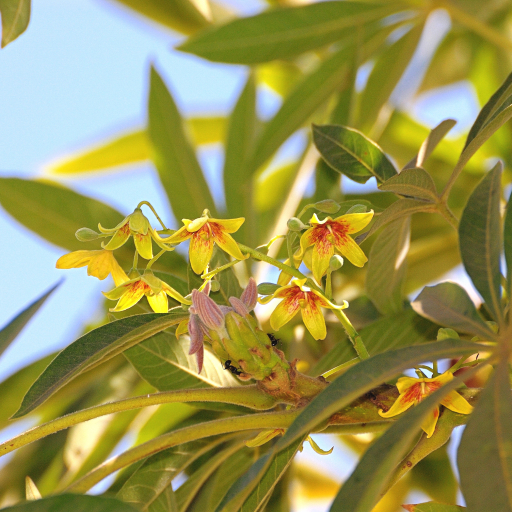
- 🔔 The Flowers: In early spring, the tree produces clusters of waxy, cup-shaped flowers. They are a dusty yellow or greenish color with intricate reddish-brown star patterns in the center.
- 🦔 The Fruit: The most iconic feature. The fruit consists of five large, woody pods joined at the base, covered entirely in hard, sharp, woody prickles that resemble a Murex sea snail or a mace.
🏡 In Your Garden
- ☀️ Sun & Space: This is a sun-worshipper that thrives in heat. Because it develops a thick, water-storing trunk over time, it is exceptionally drought-tolerant once established, making it a "set and forget" tree for arid landscapes.
- 📍 Strategic Planting: Avoid planting this tree near walkways or patios. When the heavy, spiked seed pods fall, they can be a literal "hazard from above" and are quite painful to step on if you’re barefoot.
- 🌱 Root Awareness: Like many Sterculia species, it develops a deep taproot early on. It dislikes being moved once planted, so choose its "forever home" in well-draining soil carefully.
⚠️ Safety & Toxicity
- 🌵 Physical Hazard: The primary danger of the Lowveld Chestnut is its fruit. The sharp spines on the pods can easily puncture skin or paws, so keep curious pets and toddlers away during the fruiting season.
- 🥜 Edibility: The seeds inside the pods are edible and highly nutritious. However, they are surrounded by irritating fine hairs (similar to fiberglass) that must be carefully cleaned off before roasting the nuts.
- 🐾 Pet Safety: The plant itself is not known to be chemically toxic to dogs or cats, but the spiked pods represent a significant choking and physical injury risk.
✨ Fun Fact
The seeds of the Lowveld Chestnut are so rich in oil that they were historically used by local communities to make a coffee substitute. Furthermore, the oil content is so high that if you thread several seeds onto a stick, they can be lit and used as a natural, long-burning candle!

Detailed Care Instructions
To grow Sterculia Murex (also known as the Spiny Bottle Tree or the Piora), you need to follow certain steps:
- Climate and location: Sterculia Murex is native to Australia and thrives in warm, tropical climates. It is sensitive to frost and does best in USDA hardiness zones 9-11. Choose a location that receives full sun to partial shade and provides ample space for the tree to grow, as it can reach up to 30 feet in height.
- Soil: Sterculia Murex prefers well-draining soil enriched with organic matter. Sandy or loamy soil with a pH level between 6.0 and 7.5 is ideal for its growth.
- Planting: Start by germinating the seeds. Place the seeds in a container filled with warm water and let them soak overnight. The next day, plant the seeds in small pots filled with a well-draining potting mix. Sow the seeds at a depth of about half an inch and water lightly. Keep the pots in a warm, sunny area.
- Watering: Once planted, keep the soil consistently moist during the germination process. After the seedlings emerge, gradually reduce watering, allowing the soil to dry out slightly between waterings. Overwatering can lead to root rot, so be mindful of not keeping the soil too wet.
- Fertilizing: Feed young Sterculia Murex plants with a balanced, slow-release fertilizer in the spring and again in the summer. Follow the instructions on the fertilizer packaging for the correct amount and frequency.
- Pruning: Minimal pruning is usually required for Sterculia Murex. Remove any dead, damaged, or crossing branches to maintain a healthy and well-shaped tree. Avoid excessive pruning, as this can impact its natural form.
- Pest and disease control: Sterculia Murex is relatively pest-resistant, but it can occasionally be attacked by aphids or caterpillars. Spray the affected areas with organic insecticides if necessary. Avoid overwatering, as it can lead to fungal diseases like root rot.
- Patience: Sterculia Murex is a slow-growing tree, and it may take several years before it reaches its full height and develops its distinctive bottle-shaped trunk. Be patient and provide consistent care to ensure its healthy growth.
Remember to research any specific requirements or tips for growing Sterculia Murex in your particular region, as environmental conditions can vary.
Sterculia Murex is a species of plant that requires sufficient watering to thrive. When it comes to watering this plant, it is essential to make sure that the soil is moist but not waterlogged. To water this plant, you should first check the soil's moisture level by feeling it with your fingers. If the soil feels dry, you should water the plant immediately.
It is recommended to water Sterculia Murex once every week during the growing season. However, during the winter months, you should reduce the frequency of watering as the plant goes into a semi-dormant state. When watering, you should use room temperature water and avoid watering the leaves as this can cause fungal diseases.
To avoid overwatering, make sure that the plant is growing in well-draining soil. The soil should be able to accommodate the amount of water you give it without becoming waterlogged. You can add a layer of mulch to the soil surface to help retain moisture and limit water evaporation.
In summary, always water Sterculia Murex when the soil is dry, use room temperature water, avoid watering the leaves, and ensure the plant grows in a well-draining soil to avoid overwatering.
To fertilize this plant, use a slow-release, balanced fertilizer during the growing season. Apply the fertilizer according to the package instructions, typically every 6-8 weeks. It's important not to over-fertilize, as this can result in burning the roots and damaging the plant. Use caution when fertilizing during the winter months, as the plant may be dormant and not require as much fertilizer. Water the plant thoroughly after fertilizing.
The ideal soil for Sterculia Murex plant should be well-draining and rich in nutrients. It should have a pH level between 5.5 and 7.0. A mixture of loam, perlite, and sand is suitable for providing good drainage. The soil should also be slightly moist but not wet. It is essential to avoid using heavy clay or compacted soils, as they can impede root growth and cause the plant to suffer. Additionally, the soil should be aerated to allow for proper circulation of air and water. Before planting, it is advisable to amend the soil with organic matter such as compost or manure to improve its nutrient content. This will promote healthy growth and development of the plant.
There are a few methods of propagating Sterculia Murex plants, which can be done with relative ease.
One method is by taking stem cuttings, which involves cutting a section of stem from the parent plant and encouraging it to grow roots. To do this, choose a healthy stem that is about 4-6 inches in length and has several leaves attached. Cut the stem just below a node (the point where a leaf grows from the stem) and remove all but the top two leaves. Dip the cut end into rooting hormone, then plant it into a container filled with a mixture of peat moss and sand, or a well-draining soil blend. Place the container in a bright, but not direct, light and water regularly. After a few weeks, the cutting should have developed roots and can be transplanted into a larger pot or into the ground.
Another method is by layering, which involves bending a flexible stem downwards, covering it partially with soil, and wait for roots to grow from the covered section of the stem. To do this, select a flexible stem that can be bent without breaking, choose a spot along the stem that is close to the soil surface, and gently scrape away the bark and layer of tissue on the stem with a knife or razor blade. Cover the scraped section with soil, securing it in place with a small stone or piece of wood, and keep the soil moist. After a few weeks to a few months, roots should have grown from the scraped section of the stem. Once this has occurred, the new plant can be cut away from the parent plant and transplanted.
Lastly, Sterculia Murex can also be propagated from seeds, which can be collected from the parent plant once they have matured. Sow the seeds in a tray or pot filled with a potting mix and keep the soil moist. The seeds can take several weeks to germinate and should be kept in a warm, well-lit area. Once the seedlings have developed true leaves, they can be transplanted into individual pots or into the ground.








