Plant Overview
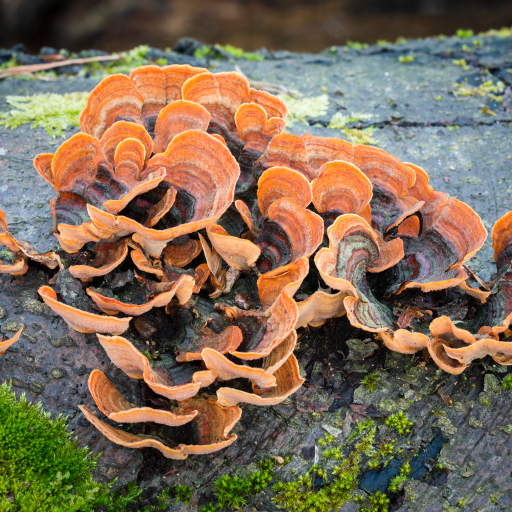
Commonly known as the False Turkey Tail or Hairy Parchment, this fungus is a vibrant architect of the forest floor. Often appearing in ruffled, fan-like tiers, it paints rotting logs with concentric rings of bright orange, yellow, and grey. While it may look like a delicate woodland decoration, it is a hardy decomposer that plays a vital role in recycling nutrients back into the earth.
🔍 How to Identify
- 🪶 The "Hairy" Cap: The upper surface is covered in fine, stiff, velvety hairs (hence the name hirsutum). This gives the mushroom a fuzzy or felt-like texture that is especially noticeable when dry.
- 🎨 Concentric Zones: The cap features distinct bands of color, usually transitioning from a bright orange or yellow edge to a more muted brownish-grey toward the center.
- 🕳️ Smooth Underside: Unlike its famous look-alike, the "True Turkey Tail," the underside of Stereum hirsutum is completely smooth. It has no visible pores, gills, or teeth, and is often a striking saffron yellow.
🌲 Habitat & Ecology
- 🪵 Hardwood Specialist: You will almost exclusively find this fungus growing on fallen hardwood branches and logs, particularly Oak, Beech, and Birch. It causes "white rot," breaking down the lignin in the wood.
- 🍂 Year-Round Presence: While it thrives and brightens up during the wet months of autumn and winter, its leathery body is incredibly resilient. It can dry out and survive through summer, rehydrating and "coming back to life" when the rains return.
⚠️ Safety & Toxicity
- 🚫 Status: INEDIBLE. WARNING: While not known to be acutely toxic, this fungus is considered inedible due to its tough, leathery, and cork-like consistency.
- 🧪 Look-Alike Alert: It is frequently confused with the medicinal Trametes versicolor (True Turkey Tail). The key difference is the underside: True Turkey Tail has tiny visible pores, while the False Turkey Tail is smooth. Never consume wild fungi based on amateur identification.
✨ Fun Fact
- 🍄 Stereum hirsutum is sometimes a host for other organisms! A specific species of jelly fungus, Tremella aurantia (Golden Ear), is a parasite that actually "hunts" the False Turkey Tail, growing directly on top of it and stealing its nutrients.

Detailed Care Instructions
To grow Stereum hirsutum, also known as the hairy curtain crust fungus or false turkey tail, you can follow these steps:
- Location: Find a suitable location for growing the fungus. Stereum hirsutum is a saprophytic fungus that usually grows on fallen or decaying trees. Look for a shaded area with access to decaying logs or stumps.
- Substrate: Stereum hirsutum prefers hardwood logs or stumps, especially oak, beech, and birch. Make sure the substrate is already decaying or dead to provide the necessary nutrition for the fungus.
- Inoculation: Collect spore specimens from an existing Stereum hirsutum fruiting body or obtain spores from a reliable source. Use a scalpel or clean knife to scrape the spores onto the surface of the decaying log or stump. Alternatively, you can place a sterile agar plate close to the fruiting body, wait for spores to disperse onto it, and then use that agar plate to inoculate your substrate.
- Moisture and Shade: Stereum hirsutum thrives in a moist environment, so it needs regular watering or rainfall to keep the substrate damp. Maintain a shady area to prevent the substrate from drying out quickly.
- Patience: Stereum hirsutum can take several months to a year to establish and start fruiting. Be patient and let nature take its course.
- Observations: Monitor the log or stump regularly for any growth or changes. Keep notes on the growth patterns, colors, and any potential issues, such as pests or diseases.
Remember, growing Stereum hirsutum can be challenging, and success is not guaranteed. It requires specific environmental conditions and may take time to establish.

Place in a dark room with little light, like a dark bedroom or a spot far away from a window or directly in a north-facing window.
To water the plant, you should thoroughly moisten the soil around the base of the fungus. Be sure not to overwater as this can lead to root rot. Check the soil's moisture level regularly by sticking your finger about an inch into the soil. If it feels dry, it's time to water. Use room temperature water and avoid getting water on the leaves. If possible, water in the morning to give the plant time to dry before nightfall.
To fertilize Stereum Hirsutum plant, follow these instructions:
- Choose a balanced, slow-release fertilizer that is suitable for woody plants.
- Read the fertilizer packaging for dosage instructions and follow them accordingly.
- Start fertilizing the plant in early spring when it begins to exhibit new growth.
- Dilute the fertilizer with water according to the recommended ratio.
- Apply the fertilizer evenly around the base of the plant, avoiding direct contact with the stems and foliage.
- Use a rake or a hand cultivator to gently scratch the surface of the soil to ensure better absorption.
- Water the plant thoroughly after fertilizing to help the nutrients penetrate the root zone.
- Repeat the fertilization process every 4-6 weeks throughout the growing season.
- Be cautious not to over-fertilize, as it can lead to burning and damage to the plant.
- Monitor the growth and health of the plant after fertilization to assess if adjustments in the fertilizer application are required.
Remember, different plants have specific nutrient requirements, so it's always beneficial to perform research or consult with experts to ensure the best fertilization practices.
To provide the optimal growing environment for the plant scientifically known as Stereum Hirsutum, it is recommended to use a soil that is rich in organic matter and well-draining. The pH level of the soil should be slightly acidic to neutral, preferably between 5.5 and 7.0. The soil should also have good aeration properties, allowing roots to breathe. In terms of texture, a loamy or sandy loam soil with a fine crumbly structure is best suited for this plant. Adding compost or organic fertilizer to the soil can provide the necessary nutrients needed for growth and fruiting. When transplanting the seedling, it is important to ensure that the roots are not damaged and that the plant is placed in well-draining soil that has been thoroughly watered. Regular watering is also important, but care must be taken not to overwater as this can lead to root rot.
To propagate Stereum Hirsutum plant, you can follow these steps:
- Choose a healthy and mature Stereum Hirsutum specimen to take cuttings from. Ensure that the plant is free from any diseases or pests.
- Fill a clean container with well-draining and nutrient-rich soil or a suitable growing medium. Stereum Hirsutum prefers a mixture of equal parts peat moss, perlite, and sand.
- Take a sharp and clean pair of pruning shears or scissors.
- Locate a stem or branch on the Stereum Hirsutum plant that is healthy and strong. This stem should be at least 4-6 inches in length.
- Prepare the cutting by making a clean cut just below a node or a leaf joint. Nodes are the points on the stem where leaves emerge. Ensure the cut is smooth and avoid crushing the stem.
- If desired, dip the bottom end of the cutting in a rooting hormone powder to promote faster root development. This step is optional but can help improve success rates.
- Make a hole in the prepared soil or growing medium. Insert the cutting into the hole, burying it to a depth of around 2-3 inches. Gently firm the soil around the cutting to ensure it remains upright.
- Water the cutting thoroughly but avoid overwatering. Ensure that the soil remains consistently moist but not waterlogged. You can cover the container with a plastic bag or use a greenhouse to create a humid environment that encourages root growth.
- Place the container in a warm and well-lit area, preferably receiving bright indirect sunlight. Stereum Hirsutum requires adequate light to thrive.
- Monitor the moisture levels regularly and water as needed to keep the soil evenly moist.
- After a few weeks, you should start to see signs of new growth indicating successful root formation. At this stage, you can begin to gradually acclimate the plant to outdoor conditions, such as increasing exposure to sunlight and reducing humidity.
- Once the roots are well-established and the plant has adapted to outdoor conditions, it can be transplanted into a larger pot or directly into the garden, depending on your preference and climate.
Remember to provide proper care and maintenance to ensure the healthy growth and longevity of your Stereum Hirsutum plant.







