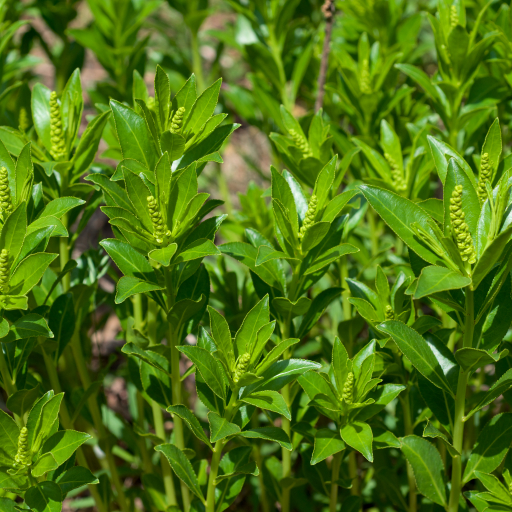
Plant Overview
Known affectionately as Queen’s Delight or Yaw Root, Stillingia sylvatica is a hardy perennial herb native to the sandy pinelands and open woods of the Southeastern United States. Historically, it was a staple in the kits of 19th-century herbalists, earning its "regal" name from the relief it supposedly provided for various ailments. While it may look like a modest wildflower, it carries the bold, resilient spirit of the American wilderness.
🔍 How to Identify
- 🌿 The Foliage: The leaves are leathery, alternate, and can vary from lance-shaped to oval. Look closely at the edges; they often feature very fine, rounded teeth.
- 🌼 Unique Blooms: It produces upright spikes of yellowish-green flowers that lack petals. The male flowers sit at the top of the spike, while the female flowers are tucked at the base.
- 🥛 Milky Sap: If a leaf or stem is broken, the plant exudes a thick, white, latex-like sap, a classic signature of the Spurge (Euphorbiaceae) family.
🏡 In Your Garden
- 🏜️ Soil Specialist: This plant is a "sandsmith." It thrives in nutrient-poor, sandy, or rocky soils where other plants struggle. Its survival secret is a massive, woody taproot that reaches deep into the earth for moisture.
- ☀️ Sun Seeker: Queen’s Delight requires full sun to maintain its structure. In the wild, it is often found in "pine barrens"—ecosystems that are sunny, dry, and frequently visited by natural fires, which the plant survives thanks to its deep roots.
⚠️ Safety & Toxicity
- 🚫 Toxic Irritant: Every part of the plant is considered toxic. The milky sap is particularly caustic and can cause redness, itching, or even blistering if it touches your skin.
- 🐾 Pet & Child Safety: It should never be ingested. It contains acrid compounds that cause severe vomiting and gastrointestinal distress. It is best placed in "look-but-don't-touch" areas of a landscape to keep curious pets and children safe.
✨ Fun Fact
In the mid-1800s, Queen’s Delight was so highly regarded in eclectic medicine that it was a primary ingredient in "Syracuse Sarsaparilla." It was once believed to "alter" the blood, leading to its botanical classification as an "alterative" herb.

Detailed Care Instructions
To grow a Stillingia sylvatica plant, also known as Queen's Delight or Yaw Root, follow these steps:
- Select a suitable location: Stillingia sylvatica prefers partial shade to full sun. Choose a spot in your garden or outdoor area that receives 4-6 hours of direct sunlight and offers well-draining soil.
- Prepare the soil: Stillingia sylvatica prefers slightly acidic to neutral soil with a pH of 5.5-7.0. Amend the soil if necessary by adding organic matter such as compost to improve drainage and fertility.
- Planting: Dig a hole that is slightly larger than the root ball of the Stillingia sylvatica plant. Place the plant in the hole at the same depth it was in the container or nursery pot. Backfill the hole with soil and gently firm it around the plant.
- Watering: Immediately after planting, water the plant thoroughly to help settle the soil and remove any air pockets around the roots. Stillingia sylvatica prefers moist soil, so water regularly to keep the soil consistently moist but not waterlogged.
- Mulching: Apply a layer of organic mulch around the base of the Stillingia sylvatica plant to help retain moisture and suppress weed growth. Leave some space around the stem to prevent rotting.
- Pruning: Prune the plant lightly in early spring to remove any dead or damaged branches. This will promote new growth and maintain its shape. Avoid pruning too heavily, as Stillingia sylvatica does not tolerate extensive pruning.
- Fertilizing: Apply a balanced, slow-release fertilizer in early spring to provide essential nutrients to the plant. Follow the manufacturer's instructions for application rates and timing.
- Pests and diseases: Stillingia sylvatica is relatively resistant to pests and diseases. However, keep an eye out for common garden pests like aphids or mealybugs. If necessary, treat them with organic insecticides or insecticidal soap.
- Propagation: Stillingia sylvatica can be propagated from seeds collected in autumn or by dividing an established plant in late winter or early spring. Sow the seeds in a seed tray or pot with well-drained soil, keeping them moist until they germinate. Divisions should be taken with care to preserve the root system.
By following these steps, you should be able to successfully grow Stillingia sylvatica and enjoy its unique beauty in your garden.

Place in a bright room that is sun drenched almost all day. Or directly in a south-facing window.

To water this particular plant, you should ensure that the soil is moist but not waterlogged. It is important to avoid letting the soil completely dry out between waterings, as this can cause damage to the plant's roots. You can water it regularly, either with a watering can or by using a drip irrigation system. It is recommended to water the plant deeply once a week, rather than giving it frequent light watering. This will allow the plant's roots to grow deeply and also prevent water from pooling at the surface, which can encourage the growth of fungi and other harmful organisms. Additionally, it is important to monitor the plant's watering needs during different seasons and adjust the frequency accordingly, as the plant may require less water during cooler months.
To fertilize this plant, use a slow-release fertilizer in the spring. Apply the fertilizer evenly around the base of the plant, being careful not to get any on the leaves. Water the plant well after fertilizing to help distribute the fertilizer throughout the soil. Do not fertilize in the fall or winter as it may harm the plant.
It is recommended to use a well-draining soil mixture that is rich in organic matter and has a pH range of 6.0 to 7.5. The soil should also be able to retain moisture without becoming waterlogged. A mixture of peat moss, garden soil, sand, and perlite can be a suitable option. It is important to ensure that the soil is not too compacted, as this can lead to poor root growth and nutrient uptake. Additionally, adding a slow-release fertilizer to the soil can provide the plant with essential nutrients throughout the growing season.
Stillingia sylvatica is a perennial herbaceous plant that can be propagated by both seed and vegetative propagation methods.
To propagate via seed, collect mature seeds from the plant in the late summer or early fall when the seed pods have dried and split open. Soak the seeds in water for 24 hours to soften the seed coat, then plant them in a container filled with a well-draining potting mix. Keep the container in a greenhouse or a warm, sunny area and water regularly. Seeds will germinate in 2-4 weeks.
To propagate through vegetative propagation, take stem cuttings from healthy plants during the growing season, making sure to take the cuttings from young, healthy stems. Dip the cut end of the stem in rooting hormone powder to improve rooting, then plant the stem cutting in a pot filled with a well-draining potting mix. Cover the pot with a plastic sheet to create a greenhouse effect and keep the soil moist but not waterlogged. Roots will develop in about 2-3 weeks, at which point the plant can be transplanted to a larger container or the garden.
Once the propagated plant has established roots and is growing well, it can be transplanted to its permanent location in the garden. Stillingia sylvatica prefers well-drained soil and full sun to partial shade.








