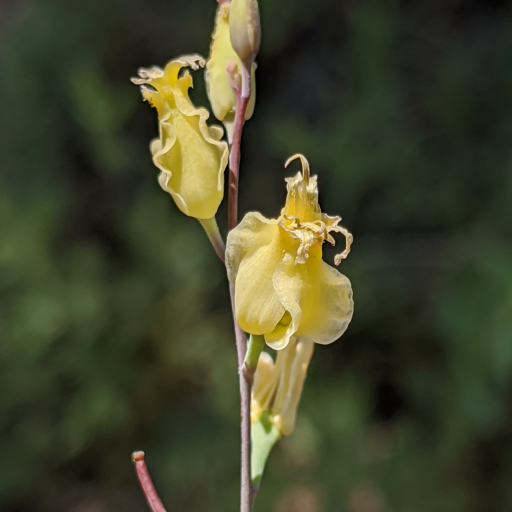
Plant Overview
Known as the San Bernardino Jewel-flower, this elegant wildflower is a rare mountain gem found exclusively in the high-altitude regions of Southern California. Often tucked away among rocky slopes and pine needles, it gets its "jewel" nickname from its uniquely shaped, ornate blossoms that look like delicate, hand-blown glass ornaments hanging from a slender stem.
🔍 How to Identify
- 🌸 Urn-Shaped Blooms: The flowers are the standout feature; they are shaped like tiny, inflated bottles or urns, typically appearing in shades of creamy white to deep, regal purple.
- ❄️ Waxy Foliage: The leaves and stems are "glaucous," meaning they have a dusty, blue-gray waxy coating that feels smooth to the touch and helps the plant survive intense mountain sun.
- 📏 Slender Stature: It grows on thin, upright stalks that can reach up to 2 feet tall, often standing out against the rugged, rocky terrain of its native habitat.
🏡 In Your Garden
- ⛰️ Rock Specialist: This plant is a true lithophyte at heart. In the wild, it thrives in decomposed granite and rocky crevices where drainage is nearly instantaneous.
- 🌲 Wild Spirit: Because it is a rare mountain native with a sensitive taproot, it is rarely seen in traditional home gardens. It resents being moved and requires the specific cool nights and dry summers of the San Bernardino and San Jacinto mountains to truly flourish.
⚠️ Safety & Toxicity
- ✅ Non-Toxic: There are no recorded reports of Streptanthus bernardinus being poisonous to humans, dogs, or cats.
- 🦋 Pollinator Protector: While safe to touch, this plant is best left undisturbed in the wild. It serves as a vital nectar source for native mountain butterflies and bees.
✨ Fun Fact
The "Jewel-flowers" are master mimics of the Mustard family! While most of their cousins have flat, four-petaled flowers, Streptanthus species evolved their enclosed, urn-like shape to specifically accommodate the long tongues of specialized pollinators.

Detailed Care Instructions

Place in a bright room that is sun drenched almost all day. Or directly in a south-facing window.

Water-loving plants flourish in wet or sloppy soil and near ponds. The extensive root system enables these plants to absorb plenty of water. The surface of the soil should be kept moist at all times. Place your pot in a container filled with water to guarantee that plants get enough water. If the ground becomes dry, it is recommended that you water it well. Plants in smaller pots will need to be watered more frequently. Water the soil in which the plant is standing thoroughly using a watering can.








