Plant Overview
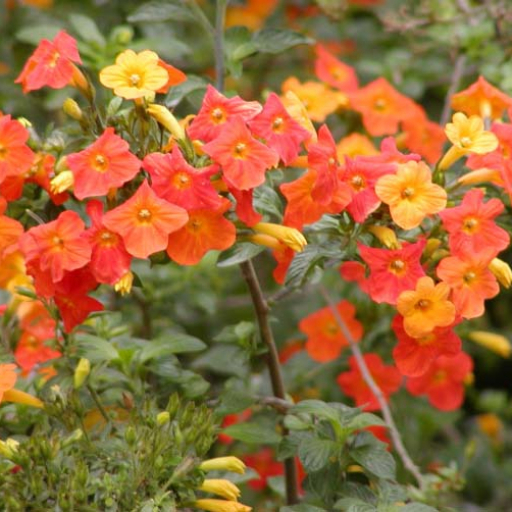
Often called the Marmalade Bush, this South American native looks as if a jar of orange preserves has been spilled over a bright green shrub. Originating from the high-altitude woodlands of the Andes, it is a favorite for sun-drenched patios because its flowers transform in color as they age, creating a "sunset" effect where yellow, orange, and red blooms coexist on the same branch.
🔍 How to Identify
- 🎺 Trumpet Blooms: Small, funnel-shaped flowers that emerge bright yellow and deepen into rich shades of burnt orange and fiery red as they mature.
- 🍃 Ribbed Foliage: Small, oval-shaped green leaves with a distinct "quilted" or ribbed texture that feels slightly rough to the touch.
- 🌿 Scrambling Habit: An evergreen shrub that grows with long, arching stems; it doesn't climb with tendrils but leans and drapes itself over nearby structures or fences.
🏡 In Your Garden
- ☀️ Sun-Seeker: To produce its signature "marmalade" colors, it needs plenty of light. However, in scorching inland climates, it appreciates a bit of afternoon shade to prevent its delicate petals from bleaching.
- 🪴 Humidity Lover: Because it hails from misty mountain regions, it thrives in humidity. It hates "wet feet" but will drop its leaves quickly if the soil stays bone-dry for too long.
- ✂️ Pruning Strategy: It can become quite leggy and messy if left alone. It is best grown against a trellis or wall where its arching branches can be tied and displayed to show off the heavy clusters of flowers.
⚠️ Safety & Toxicity
- 🚫 Toxic Status: As a member of the Solanaceae (Nightshade) family, all parts of the Marmalade Bush are considered toxic if eaten.
- 🐾 Pet & Child Alert: Ingestion can cause nausea, vomiting, and stomach distress. It is best to plant it in a location where curious pets or small children won't be tempted to "sample" the vibrant flowers.
✨ Fun Fact
- 🧪 The name Streptosolen is derived from the Greek words for "twisted tube," referring to the way the base of the flower's corolla is uniquely spiraled.

Detailed Care Instructions
| Humidity | Normal |
| Lighting | Full Sun |
| Difficulty | Medium |
| Hibernation | Cold Period |
| Temperature | 25°C - 28°C |
| Hardiness Zones | 8 - 10 |
To grow Streptosolen Jamesonii plants, also known as Marmalade Bush or Orange Bell, follow these steps:
- Climate: Ensure you live in a suitable climate for growing Streptosolen Jamesonii, which is USDA hardiness zones 10-12. These plants prefer a warm, tropical or subtropical climate.
- Sunlight: Choose a location that receives full sun or partial shade, ideally with protection from afternoon sun in hotter regions.
- Soil: Streptosolen Jamesonii prefers well-draining soil that is rich in organic matter. Amend the soil with compost or well-rotted manure to improve its fertility and texture.
- Planting: Start by selecting a healthy Streptosolen Jamesonii plant from a nursery or propagate one from cuttings. Dig a hole in the soil slightly larger than the pot size and gently remove the plant from its container. Place the plant in the hole, ensuring the top of the root ball is level with or slightly above the soil surface. Backfill the hole with soil and gently firm it around the plant.
- Watering: Provide regular, deep irrigation to keep the soil consistently moist but not waterlogged. Streptosolen Jamesonii plants prefer consistently moist soil, so water them when the top inch of soil feels dry to the touch. During hot and dry weather, you may need to water more frequently.
- Fertilization: Apply a balanced, slow-release fertilizer or a water-soluble fertilizer every 4-6 weeks during the growing season to promote healthy growth and abundant flowering. Follow the instructions on the fertilizer packaging for proper application.
- Pruning: Prune Streptosolen Jamesonii after flowering, cutting back any leggy or overgrown branches to maintain its shape and promote bushier growth. Remove any dead, damaged, or diseased branches as well.
- Pests and diseases: Monitor the plant for common pests such as aphids, spider mites, and whiteflies. Treat any infestations promptly with insecticidal soap or neem oil. Ensure good air circulation around the plant to prevent fungal diseases.
- Mulching: Apply a layer of organic mulch around the base of the plant to suppress weeds, conserve moisture, and maintain an even soil temperature. Keep the mulch a few inches away from the plant's stem to prevent rot.
- Support: As the Streptosolen Jamesonii plant grows, you may need to provide additional support in the form of stakes or trellises to keep the branches upright.
Remember, while Streptosolen Jamesonii is a beautiful flowering plant, it may not be suitable for all regions due to its specific climate requirements.

Place in a bright room that is sun drenched almost all day. Or directly in a south-facing window.

When watering this plant, it is important to first ensure that the soil is dry to the touch. This plant prefers to be watered with room temperature water, slowly and evenly, until water drains from the bottom of the pot. It is important to never let this plant sit in standing water, as this can lead to root rot. During its active growing season, this plant may require more frequent watering, but in the winter months it may require less. It is important to monitor the soil moisture levels and adjust watering accordingly.
To fertilize this plant, use a balanced, water-soluble fertilizer with equal amounts of nitrogen, phosphorus, and potassium. Dilute the fertilizer to half strength and apply every two weeks during the growing season, which is typically spring and summer. Avoid fertilizing during the dormant season, which is typically fall and winter. Always follow the manufacturer's instructions on how much fertilizer to use and how frequently to apply. Over-fertilization can cause damage to the plant.
For optimal growth and health of this plant, it is recommended to use a well-draining soil mix that is rich in organic matter. The soil should have a pH level between 5.5 and 6.5, which is slightly acidic. The soil should be moist but not waterlogged, as excess water can cause root rot and other fungal diseases. To improve soil quality, it is recommended to add compost or other organic material to the soil before planting. Additionally, using a slow-release fertilizer can provide essential nutrients for the plant to grow and thrive.
To propagate this plant, take a cutting from the stem of the plant that is about 4-6 inches long. Make sure the cutting has one or two nodes, which are the points where leaves emerge from the stem. Remove the lower leaves and dip the cut end of the stem in rooting hormone.
Place the cutting in a pot filled with moist potting soil, ensuring that the node(s) are buried in the soil. Cover the pot with a plastic bag to create a humid environment and place it in a bright, indirect light location. Water the cutting regularly to keep the soil moist but not waterlogged.
In about 2-4 weeks, the cutting should start to root and new growth should appear. Once the roots have developed, remove the plastic bag and continue to care for the new plant as you would for an adult plant.








