Plant Overview
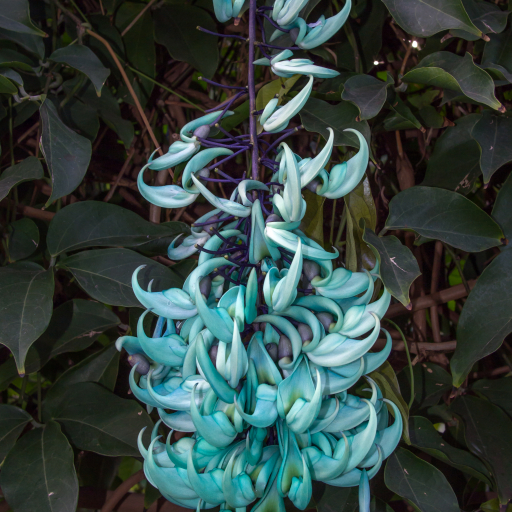
Often called the "Jade Vine" or "Emerald Creeper," this Philippine native looks like it was plucked from a bioluminescent alien forest. Its glowing, sea-foam green flowers are unlike almost any other plant in the world, making it a "holy grail" for botanical gardens and tropical collectors. In the wild, it is a rare treasure of the rainforest, dangling its jewel-like clusters from the high canopy.
🔍 How to Identify
- 🪝 The Flowers: Claw-shaped or beak-like blooms that grow in massive, pendulous clusters called racemes, which can reach up to 3 meters (9 feet) in length.
- 💎 The Color: A striking, luminous turquoise or jade-green that almost looks artificial; the petals have a waxy, translucent quality.
- 🍃 The Foliage: Dark green, glossy leaves that grow in groups of three (trifoliate), typical of the legume family, providing a dense backdrop for the bright flowers.
🏡 In Your Garden
- 🏗️ Support is Key: Because it is a vigorous woody climber (a liana), it requires a heavy-duty pergola or a very strong arbor to support the immense weight of its dangling flower chains.
- 💧 Tropical Demands: This plant is a true tropical; it hates the cold and requires high humidity. It thrives when its "feet" (roots) are kept in the shade while its "head" (vines) reaches for the sun.
- ✂️ Pruning Nuance: It blooms on "old wood," so heavy pruning should be done carefully after the flowering season to avoid cutting away next year's spectacular display.
⚠️ Safety & Toxicity
- 🐾 General Safety: The Jade Vine is not considered highly toxic to touch, but it is best kept away from curious nibblers.
- 🚫 Ingestion: Like many members of the pea family, the seeds and pods should not be eaten by humans or pets, as they can cause digestive upset.
- 🧴 Sap Sensitivity: Sensitive individuals may experience mild skin irritation from the sap when pruning, so wearing gloves is recommended.
✨ Fun Fact
In its native Philippine rainforests, the Jade Vine is pollinated by bats! The flowers are perfectly shaped so that when a bat hangs upside down to drink the nectar, the floral "claw" triggers and brushes pollen onto the bat's head.

Detailed Care Instructions
| Lighting | Part Sun |
| Hardiness Zones | Min 11 |
To grow Strongylodon macrobotrys (also known as Jade Vine), you can follow these steps:
- Climate and location: Jade Vine requires a warm and humid environment. If you live in a colder region, consider growing it in a greenhouse or an indoor space with controlled temperature and humidity. It also prefers a partially shaded area, avoiding direct sunlight.
- Soil: Prepare a well-draining potting mixture with a combination of sandy soil, organic matter, and perlite or vermiculite. This will ensure proper drainage, as Jade Vine dislikes soggy soil.
- Planting: Choose a large pot or container that can accommodate the vigorous growth of the plant. Start by germinating seeds or obtaining a young plant from a nursery. If using seeds, nick them slightly with a file or sandpaper to improve germination rates. Then, place the seeds in warm water for 24-48 hours before planting them about 1 inch deep in the prepared soil mixture.
- Watering: Keep the soil moist but not soaking wet. Ensure the soil doesn't become dry or waterlogged, as either extreme can harm the plant. Water the plant about once or twice a week, adjusting based on the environmental conditions and the plant's needs.
- Pruning: Jade Vine requires regular pruning to promote healthy growth and prevent it from becoming overly tangled. Prune any dead or damaged branches, as well as branches growing in unwanted directions. Pruning should be done after the flowering season to avoid interrupting the blooming process.
- Fertilizing: Feed the plant with a balanced fertilizer every 2-3 months during the growing season, following the instructions specified on the fertilizer packaging. This will provide the necessary nutrients for vibrant growth and blooming.
- Support: Given the vine-like nature of Jade Vine, it requires a sturdy support structure. As it grows, use plant ties or soft twine to guide the branches along the support, preventing damage and ensuring proper growth.
- Propagation: Jade Vine can be propagated through stem cuttings or air layering. Stem cuttings should be taken from healthy, mature stems and inserted into a moist rooting medium. With proper care, these cuttings will develop roots and can be transplanted into individual pots.
Remember to monitor your plant regularly for pests or diseases and take prompt action if any issues arise. With patience and care, your Strongylodon macrobotrys plant should thrive and reward you with its beautiful jade-green blooms.

Place in a window with dappled sun or a spot in the middle of a room. Or directly in a window facing west or east.

The appropriate way to water this plant is to ensure that the soil is consistently moist but not overly saturated. It is best to water it deeply once a week, allowing excess water to drain out of the pot or planting area. It is important to avoid letting the soil dry out completely between waterings or to overwater, as both can stress the plant. When watering, it is recommended to water at the base of the plant rather than overhead to prevent moisture from sitting on the foliage, which can encourage fungal growth. Additionally, it is important to ensure proper drainage and avoid allowing the plant to sit in standing water.
To properly fertilize the Strongylodon Macrobotrys plant, follow the instructions below:
- Choose a balanced, water-soluble fertilizer suitable for flowering plants. Look for one with a N-P-K ratio of 10-10-10 or similar.
- Dilute the fertilizer in water according to the instructions on the packaging. The recommended ratio is usually 1 tablespoon per gallon of water, but it may vary depending on the specific brand.
- Water the plant thoroughly before applying the fertilizer to ensure that the soil is moist.
- Pour the diluted fertilizer evenly around the base of the plant, taking care not to let it touch the leaves or flowers.
- Repeat the application of fertilizer every two weeks during the active growing season, usually from spring to early fall. Reduce or stop fertilizing during the dormant period, which typically occurs during winter.
- Avoid over-fertilizing, as this can lead to nutrient burn and damage the plant. Always follow the recommended dosage on the fertilizer packaging.
- Monitor the plant's growth and health regularly. If you notice any signs of nutrient deficiencies or excesses, adjust the fertilization routine accordingly.
Remember, proper watering and adequate sunlight are equally important for the overall health of the Strongylodon Macrobotrys plant.
Strongylodon Macrobotrys requires a well-drained soil that is rich in organic matter. It thrives in soil that is slightly acidic to neutral with a pH range of 5.5 to 7.5. The soil should be moist but not waterlogged, and it should not be allowed to dry out completely between watering. It is important to avoid using heavy clay soil or soil with poor drainage as this can lead to root rot. A good soil mix for Strongylodon Macrobotrys could include a blend of peat moss, perlite, compost, and loam.
To propagate this plant, you can take stem cuttings from a healthy parent plant during the growing season. Cuttings should be around 6-8 inches long and taken from a section of stem that has at least two nodes. Remove the leaves from the bottom half of the cutting, leaving only a few leaves at the top. Dip the cut end of the cutting in rooting hormone and plant it in a container filled with well-draining soil. Keep the soil moist and the cutting in a warm, bright location but out of direct sunlight. After a few weeks, roots should begin to develop, and new growth will appear. Wait until the cutting has developed a robust root system before transplanting it into a larger container or into the ground.
Common pests of the jade vine include Spider mites. Make a habit of checking your jade vine frequently for pests so that any infestations can be caught and managed early.








